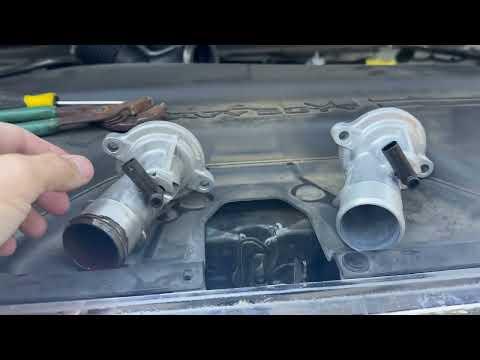
1500 Classic - Thermostat Replacement 🔧
I’ll walk you through replacing the thermostat + housing assembly
Safety & Prep ⚠️
- ⚠️ Work only on a cold engine. Hot coolant can cause serious burns.
- ⚠️ Keep coolant away from kids/pets; it’s poisonous and sweet-tasting.
- ⚠️ Disconnect the negative battery cable if you might bump the fan or wiring.
Tip: Take pictures as you go so reassembly is easier.
Parts You’ll Need 📦
- 🧩 Thermostat housing assembly (thermostat + plastic housing, with seal/O-ring)
- 🧩 New coolant: HOAT / OAT type that meets Chrysler MS-12106 (usually pink/purple Mopar OAT). Get about 2–3 gallons premixed 50/50 or concentrate + distilled water.
- 🧩 New hose clamp(s) if any are rusty or damaged (worm-gear or spring clamps).
Tools You’ll Need 🛠️
- 🔧 Socket set (metric):
- Common sizes: 8mm, 10mm, 13mm sockets
- 🔧 Ratchet and short extension (3/8" drive is ideal)
- 🔧 Torque wrench (3/8" drive, capable of 5–30 N·m / 50–250 in-lb)
- 🔧 Pliers:
- Hose clamp pliers (special pliers for spring clamps) or regular slip-joint pliers
- 🔧 Flat-blade screwdriver (for hose clamps or gently prying hoses)
- 🪣 Drain pan (at least 10 liters / 3 gallons)
- 🧽 Rags / paper towels
- 🧴 Plastic scraper (if any old gasket material needs cleaning; usually not needed with O-ring style)
- 🧪 Funnel (for refilling coolant)
Where the Thermostat Is 📍
- 🚗 On the 3.6L in your 1500 Classic, the thermostat housing is:
- Mounted low on the front of the engine, near the lower radiator hose.
- The lower radiator hose connects directly to the thermostat housing.
Step 1 – Get Access & Make It Safe 🧊
- 🛑 Make sure the engine is completely cold.
- 🔌 Disconnect the negative battery terminal (10mm) and tuck it aside.
- 🪜 If needed, remove any plastic engine covers that block access (they usually pull up or have a few 10mm bolts).
Step 2 – Drain Coolant 💧
- 🪣 Place the drain pan under the radiator area.
- 🔧 On many Ram 1500 Classics, there is a radiator drain plug (petcock) at the bottom of the radiator:
- Turn it counterclockwise by hand or with pliers gently.
- Let coolant drain until it slows down.
- 🧴 If there is no easy drain plug or it’s stuck:
- Loosen the lower radiator hose clamp at the radiator.
- Carefully twist and pull the hose off to drain into the pan.
- 🔁 When done draining, close the drain plug or temporarily slip the hose back on so it doesn’t drip everywhere.
Step 3 – Remove Lower Radiator Hose From Thermostat Housing 🧵
- 🔍 Follow the lower radiator hose from the radiator to the engine – it ends at the thermostat housing.
- 🔧 Use hose clamp pliers or regular pliers to:
- Squeeze the spring clamp and slide it back along the hose.
- 🪛 Gently twist the hose to break it free, then pull it off the thermostat housing.
- If it’s stuck, use a flat screwdriver to gently work around the edge, but don’t gouge the plastic.
Step 4 – Remove Thermostat Housing 🔩
- 🔍 Locate the bolts holding the thermostat housing to the engine (usually 2 or 3 bolts).
- 🔧 Use the correct socket (often 10mm) and ratchet to remove the bolts.
- 🫗 A little coolant may spill when you pull the housing away – keep the drain pan under it.
- 📸 Note the orientation of the thermostat/housing before removal.
- 🧽 Remove the housing and thermostat assembly from the engine.
Step 5 – Clean the Mating Surface 🧼
- 🧽 Use a clean rag to wipe the engine’s thermostat mounting surface.
- 🧴 If there is any old gasket material (usually there isn’t, it’s an O-ring):
- Use a plastic scraper to gently remove it.
- Do not use a metal scraper that can scratch the aluminum.
- ❌ Do not use sealant unless the new part instructions specifically say so (most Mopar O-ring housings do not need sealant).
Step 6 – Install New Thermostat Housing 🆕
- 🔍 Make sure the new thermostat’s O-ring is seated correctly in its groove on the housing.
- 📐 Position the new housing on the engine in the same orientation as the old one.
- 🔩 Install the bolts by hand first to avoid cross-threading.
- 🔧 Snug them evenly with the ratchet.
- 📏 Then torque the bolts:
- Thermostat housing bolts: about 10 N·m (89 in-lb) (lightly snug, not “gorilla tight”).
Step 7 – Reattach Lower Radiator Hose 🧷
- 🧴 Slide the hose fully onto the new thermostat housing neck.
- 🔧 Move the clamp back into place over the hose and fitting:
- For spring clamps: squeeze with pliers and slide into position.
- For screw clamps: tighten with a screwdriver until snug (don’t overtighten).
Step 8 – Refill Coolant 🧪
- 🧊 Make sure the radiator drain plug is closed and all hoses are attached.
- 🧴 Remove the coolant reservoir cap (and radiator cap if equipped; some systems only have a reservoir).
- 🧪 Using a funnel, fill with the correct 50/50 coolant mix until the reservoir is at the MAX line.
Step 9 – Bleed Air From the System 🌬️
- 🔌 Reconnect the negative battery terminal.
- 🚗 Start the engine and let it idle with the heater set to HOT and fan on low.
- 👀 Watch the coolant level in the reservoir:
- As the engine warms up, the thermostat will open and the level may drop.
- Add coolant as needed to keep it at or near the MAX line.
- 🌡️ Let the engine reach normal operating temperature:
- Upper and lower radiator hoses should both feel warm.
- Heater inside the cab should blow hot air.
- 🫧 You may see small bubbles in the reservoir – that’s air bleeding out.
- ⏱️ Let it run 10–15 minutes, then shut off the engine and let it cool completely.
- 🔁 After it’s fully cool, recheck the coolant level and top off to the MAX line if needed.
Step 10 – Final Checks ✅
- 👀 Check around the thermostat housing and hose connections for any leaks.
- 🧽 Wipe off any spilled coolant so you can spot fresh leaks easily.
- 🚗 Take a short test drive, watching the temperature gauge:
- It should rise to normal and stay steady, not overheat and not stay ice-cold.
- 🔁 After the drive and cool-down, recheck coolant level one more time.
Common Beginner Tips & Mistakes 💡
- 🧊 Never open the coolant cap on a hot engine. Always wait until it’s cool.
- 🪛 If a hose is stuck, twist it first; don’t just pull straight or you can crack the plastic fitting.
- 🔩 When tightening small bolts into aluminum, use a torque wrench if possible – it’s easy to strip them.
- 🧪 Always use the correct type of coolant; mixing types can cause sludge and overheating.
If you tell me whether your truck has manual A/C or dual-zone automatic climate control, I can add the exact factory-style bleed procedure for your setup. And if you want, I can also list the exact Mopar part number options for the thermostat housing and coolant.
HowToo makes it easy: below this answer you’ll see recommended parts and tools for this job. You can add them to your cart right from the tools and parts section, with fast shipping so you can get this done in a day or two. 🚚