









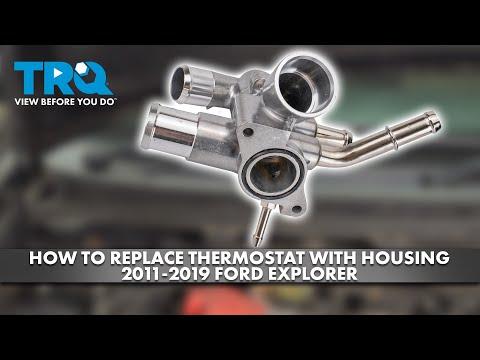






How to Replace the Thermostat on a 2022 Ford Explorer 3.3L V6
Step-by-step DIY thermostat housing replacement with tools, parts list, torque specs, coolant bleeding, and safety tips
How to Replace the Thermostat on a 2022 Ford Explorer 3.3L V6
Step-by-step DIY thermostat housing replacement with tools, parts list, torque specs, coolant bleeding, and safety tips


🔧 Explorer - Thermostat Replacement
You’ll be replacing the thermostat assembly on your Explorer, which controls engine temperature by opening and closing to let coolant flow. A sticking thermostat can cause overheating, poor heat, or temperature gauge issues. This job is a bit involved but very doable at home if you move slowly and stay organized.
Difficulty Level: Intermediate | Estimated Time: 2–3 hours
⚠️ Safety & Precautions
- ⚠️ Always work on a cold engine. Hot coolant can cause serious burns.
- ⚠️ Coolant is toxic to people and animals. Avoid skin contact and clean spills immediately.
- ⚠️ Support the front of the vehicle with jack stands, never rely on a jack alone.
- ⚠️ Keep tools, rags, and hands clear of the engine belt and cooling fan.
- ⚠️ Disconnect the negative battery cable if your tools might contact the starter or main power cables.
- ⚠️ Dispose of old coolant at a proper recycling facility. Do not pour it down drains or on the ground.
🔧 Required Tools
You'll need the following tools for this repair:
- 🛠️ Floor jack (rated 3-ton minimum)
- 🛠️ Jack stands (rated 3-ton minimum, Qty: 2)
- 🛠️ Wheel chocks
- 🛠️ 1/4" drive ratchet
- 🛠️ 3/8" drive ratchet
- 🛠️ 1/4" drive metric socket set (6–13mm)
- 🛠️ 3/8" drive metric socket set (8–19mm)
- 🛠️ 6" socket extension (1/4" drive)
- 🛠️ 6" socket extension (3/8" drive)
- 🛠️ Torque wrench (inch‑pound, 40–200 in‑lb range)
- 🛠️ Torque wrench (foot‑pound, 10–100 ft‑lb range)
- 🛠️ Flathead screwdriver (medium)
- 🛠️ Phillips screwdriver (medium)
- 🛠️ Pliers (slip‑joint)
- 🛠️ Hose clamp pliers (specialty)
- 🛠️ Trim clip removal tool (specialty)
- 🛠️ Plastic scraper
- 🛠️ Shop towels or rags
- 🛠️ Drain pan (at least 10 liters)
- 🛠️ Coolant funnel or spill‑free funnel (specialty)
- 🛠️ Small wire brush (soft bristle)
- 🛠️ Work light or flashlight
- 🛠️ Safety glasses
- 🛠️ Nitrile gloves
🔩 Required Parts
HowToo sells all the parts you need for this repair:
- 🔩 Thermostat and housing assembly (3.3L engine) - Qty: 1
- 🔩 Thermostat housing gasket/O‑ring - Qty: 1 (often included with assembly)
- 🔩 Engine coolant (Ford Yellow, WSS‑M97B57‑A1 equivalent) - Qty: 6–8 liters premixed
- 🔩 New hose clamps (correct size for upper radiator/thermostat hoses) - Qty: 2–4 (optional but recommended)
- 🔩 Dielectric grease (for coolant temp sensor connector) - Qty: small tube (optional)
- 🔩 Anti‑seize compound - Qty: small tube (optional for bolt threads)
- 🔩 Shop towels - Qty: 1 pack
📋 Before You Begin
- 🧾 Park the Explorer on level ground, engage the parking brake, shift to Park, and let the engine cool completely (at least 1–2 hours).
- 🧾 Open the hood and locate the coolant reservoir. Verify coolant is cool by carefully squeezing the upper radiator hose; it should feel soft, not pressurized.
- 🧾 Place wheel chocks behind the rear wheels before lifting the front.
- 🧾 If you prefer extra safety, disconnect the negative battery cable using a 10mm socket and set the cable aside.
- 🧾 Have your drain pan ready under the front of the vehicle before loosening any coolant hoses.
🔨 Step-by-Step Instructions
Follow these steps in order:
Step 1: Lift and secure the front of the vehicle
- Use the floor jack (3‑ton) to lift the front center jacking point of your Explorer (behind the front bumper, on the subframe).
- Place jack stands under the factory pinch welds or frame points on both sides and lower the vehicle onto them with the floor jack.
- Leave the floor jack touching (with light pressure) as a backup, but do not rely on it alone.
- Always shake vehicle slightly to confirm stability.
Step 2: Remove any lower splash shield (if equipped)
- Use a Phillips screwdriver or the appropriate 8mm socket on a 1/4" drive ratchet to remove the screws/bolts holding the front lower splash shield.
- Use the trim clip removal tool to gently pop out any plastic push clips.
- Lower the shield and set it aside, keeping fasteners in a small container so you don’t lose them.
Step 3: Drain coolant from the system
- Position the drain pan under the lower radiator area or where the lower radiator hose meets the radiator.
- If your radiator has a drain valve (petcock), use a flathead screwdriver to gently open it and let coolant drain. If not, use pliers or hose clamp pliers to loosen the lower radiator hose clamp and carefully twist and pull the hose off to drain.
- Allow several minutes for coolant to drain, then close the drain valve or slide the hose back on loosely for now.
- Capture as much coolant as possible in the pan.
Step 4: Remove air intake ducting for access
- On top, locate the air intake tube between the air filter box and the throttle body.
- Use a flathead screwdriver to loosen the hose clamps at each end of the intake tube.
- Unclip any small vacuum hoses or electrical connectors attached to the intake tube by hand or with the trim clip removal tool.
- Lift the intake tube out and set it aside. This opens up access to the front of the engine where the thermostat housing is mounted.
Step 5: Locate the thermostat housing
- The thermostat housing on the 3.3L V6 is mounted at the front of the engine block, near where the upper radiator hose meets the engine.
- Follow the upper radiator hose from the radiator toward the engine; it connects directly to the thermostat housing.
- Identify the electrical connector for the engine coolant temperature (ECT) sensor on or near the housing.
Step 6: Disconnect hoses and sensor from thermostat housing
- Place the drain pan under the thermostat housing to catch any remaining coolant.
- Use hose clamp pliers or pliers to compress the hose clamps and slide them back along the hoses.
- Gently twist and pull the hoses off the thermostat housing nipples by hand. If stuck, use the flathead screwdriver to carefully break the seal, but avoid cutting the hose.
- Press the tab and pull off the ECT sensor connector by hand; if tight, gently wiggle while pulling. Optionally, apply a tiny bit of dielectric grease later when reconnecting.
Step 7: Remove thermostat housing bolts
- Use an 8mm or 10mm socket on a 1/4" drive ratchet (verify exact size on the bolts) to remove the bolts securing the thermostat housing to the engine.
- Use a 6" extension if any bolts are recessed or hard to reach.
- Keep track of bolt lengths and positions; some may be different lengths. Lay them out on a rag in the pattern you remove them.
- Carefully pull the thermostat housing away from the engine. A little coolant may spill, so keep the drain pan in place.
Step 8: Remove old thermostat and clean sealing surface
- On many 3.3L setups, the thermostat is integrated into the housing. If it’s separate, lift the thermostat out from the engine side.
- Remove the old gasket or O‑ring from either the thermostat housing or engine mating surface.
- Use the plastic scraper to gently clean the engine’s sealing surface. Avoid gouging aluminum.
- Use a small wire brush very lightly if corrosion is present, then wipe clean with shop towels.
- Surface must be clean, smooth, and dry.
Step 9: Install new thermostat and housing
- If your new part is a complete thermostat/housing assembly, confirm the new gasket/O‑ring is correctly seated in its groove.
- If using a separate thermostat, place it into the engine with the correct orientation as it came out (spring side toward engine, jiggle pin or bleed hole up if equipped).
- Position the new thermostat housing against the engine, aligning bolt holes and ensuring the gasket/O‑ring stays in place.
- Hand‑thread each bolt in by hand to avoid cross‑threading.
- Use the 8mm or 10mm socket on a 1/4" drive ratchet to snug the bolts evenly in a criss‑cross pattern (do not fully tighten yet).
- Use the inch‑pound torque wrench with the correct socket and tighten housing bolts to 10 Nm (89 in‑lb) in 2 passes, again in a criss‑cross pattern.
Step 10: Reconnect hoses and sensor
- Push the coolant hoses fully onto the new thermostat housing connections until they bottom out.
- Slide the hose clamps back into their original positions using hose clamp pliers or pliers. Make sure each clamp is centered over the hose bead.
- Reconnect the ECT sensor connector by hand until it clicks. Optionally, apply a dab of dielectric grease to the terminals before reconnecting.
Step 11: Reinstall air intake ducting
- Place the air intake tube back between the airbox and throttle body.
- Use a flathead screwdriver to tighten the hose clamps at both ends.
- Reconnect any vacuum hoses or clips to the intake tube by hand or with the trim clip removal tool.
Step 12: Reinstall splash shield
- Lift the lower splash shield back into position under the front.
- Install screws/bolts using the Phillips screwdriver or 8mm socket on a 1/4" drive ratchet.
- Reinstall plastic clips with the trim clip removal tool, pushing them firmly until seated.
Step 13: Lower the vehicle
- Use the floor jack to lift the front slightly off the jack stands.
- Remove the jack stands and slowly lower the vehicle to the ground.
- Remove the wheel chocks.
Step 14: Refill and bleed the cooling system
- Make sure the radiator drain valve (if used) is closed and all hoses are tight.
- Remove the coolant reservoir cap by hand.
- Place the coolant funnel into the reservoir opening.
- Slowly pour premixed coolant (or concentrate plus distilled water at the correct ratio) into the reservoir until it reaches the “MAX” line.
- Start the engine and set the heater to HOT and fan on low.
- Let the engine idle, occasionally revving gently to about 1500–2000 rpm for a few seconds, while watching the coolant level in the funnel and adding as needed.
- As the thermostat opens, the coolant level may drop and small bubbles will appear. Keep adding coolant to maintain the level.
- When the upper radiator hose feels hot and firm and cabin heat is strong, you’ve likely purged most air.
- Shut the engine off and let it cool completely, then top off the reservoir to the “MAX” line if needed and install the cap by hand.
Step 15: Reconnect battery (if disconnected) and clean up
- Reconnect the negative battery terminal using a 10mm socket on a 1/4" drive ratchet and snug it down. Do not overtighten.
- Wipe any spilled coolant with shop towels and transfer used coolant from the drain pan into sealed containers for recycling.
✅ After Repair
- ✅ Start the engine and let it reach normal operating temperature while parked. Watch for any coolant drips around the thermostat housing, hoses, and radiator connections.
- ✅ Observe the temperature gauge; it should rise steadily to the normal range and stay there, not fluctuating wildly.
- ✅ Check for strong heat from the cabin heater after a few minutes.
- ✅ After a full warm‑up and cool‑down cycle, recheck the coolant level in the reservoir and top off to the “MAX” line if needed.
- ✅ Over the next few drives, occasionally inspect under the Explorer and under the hood for leaks and recheck coolant level when the engine is cold.
💰 DIY vs Shop Cost
Shop Cost: $350–$550 (parts + labor)
DIY Cost: $60–$120 (parts only, depending on coolant and brand)
You Save: $230–$490 by doing it yourself!
Shop labor rates vary but typically run $100–$150/hour. This repair takes a shop approximately 1.5–2.0 hours.
🎯 Ready to get started?
HowToo makes it easy: same-day/2-day shipping on every part, plus all the tools and specialty tools you need! Check out the parts and tools sections above to add everything to your cart.