









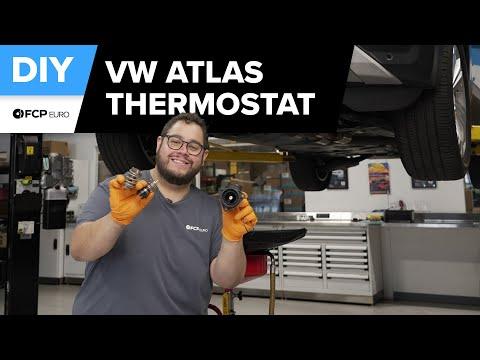







How to Replace the Thermostat on a 2018 Volkswagen Atlas (Cooling System Repair)
Step-by-step DIY instructions with required tools, parts list, safety tips, and coolant refill/bleeding steps for 2018, 2019, 2021, 2022
How to Replace the Thermostat on a 2018 Volkswagen Atlas (Cooling System Repair)
Step-by-step DIY instructions with required tools, parts list, safety tips, and coolant refill/bleeding steps for 2018, 2019, 2021, 2022


🔧 Atlas - Thermostat Replacement
On your Atlas, the thermostat is part of the engine’s cooling system and controls when coolant flows to the radiator. A stuck thermostat can cause slow warm-up, poor heat, or overheating, and it often triggers a check-engine light like P0128.
Difficulty Level: Advanced | Estimated Time: 3-6 hours
⚠️ Safety & Precautions
- ⚠️ Never open the coolant reservoir cap on a hot engine; hot coolant can spray and burn you.
- ⚠️ Support the Atlas with jack stands if you raise it; never rely on a floor jack alone.
- ⚠️ Coolant is toxic; keep it away from kids/pets and dispose of it properly.
- ⚠️ If you remove the intake manifold/throttle body connectors, avoid pulling on wires; release connector locks first.
- ⚠️ Battery disconnect is recommended if you’ll unplug the throttle body and work near the starter/alternator area.
🔧 Required Tools
You'll need the following tools for this repair:
- Safety glasses
- Nitrile gloves
- Floor jack (rated 3-ton minimum)
- Jack stands (rated 3-ton minimum)
- Wheel chocks
- Drain pan (at least 10-quart)
- Funnel
- Trim removal tool
- Pick tool
- Hose clamp pliers
- Ratchet (3/8")
- Torque wrench (5–60 Nm range)
- Socket set (8mm, 10mm, 13mm)
- Torx bit set (T25, T30)
- Extension set (3" and 6")
- Flat-blade screwdriver
- Vacuum coolant fill tool (specialty)
- Scan tool with VW-compatible live data (specialty)
🔩 Required Parts
HowToo sells all the parts you need for this repair:
- Thermostat assembly (with housing/module, as equipped) - Qty: 1
- Intake manifold gasket set - Qty: 1
- Throttle body seal/O-ring - Qty: 1
- Coolant pipe O-rings (as equipped) - Qty: 1 set
- VW-spec coolant concentrate (G13/G12 evo equivalent) - Qty: 1-2 gallons concentrate
- Distilled water - Qty: 1-2 gallons
- Shop towels - Qty: 1
📋 Before You Begin
- Park on level ground, set the parking brake, and let the engine cool completely.
- Open the hood and remove the engine cover using a trim removal tool (it pulls upward).
- Place a drain pan under the front of the Atlas before you disconnect any coolant hoses.
- If you’ll be unplugging the throttle body, disconnect the battery negative terminal using a 10mm socket.
- Hose clamp pliers squeeze spring clamps safely. If you don’t have them, a flat-blade screwdriver can help, but it’s easier to slip.
- A vacuum coolant fill tool pulls air out, reducing overheating risk. It’s strongly recommended after thermostat work.
🔨 Step-by-Step Instructions
Follow these steps in order:
Step 1: Depressurize and drain coolant
- Verify the engine is cold, then slowly loosen the coolant reservoir cap by hand to release any residual pressure.
- Raise the front of the Atlas using a floor jack (rated 3-ton minimum) and support with jack stands (rated 3-ton minimum).
- Position a drain pan (at least 10-quart) under the lower radiator hose area.
- Use hose clamp pliers to release the lower radiator hose clamp and carefully pull the hose off to drain coolant.
Step 2: Remove the air intake ducting
- Loosen intake clamps using a flat-blade screwdriver (or 8mm socket, if equipped with worm clamps).
- Unclip/remove the air ducting and move it out of the way.
Step 3: Remove the throttle body (to access the intake manifold)
- Unplug the throttle body electrical connector carefully (release the lock first).
- Remove the throttle body fasteners using a Torx T30 bit and ratchet (3/8").
- Remove the throttle body and replace the seal/O-ring.
- Reinstall later and Torque to 10 Nm (7 ft-lbs).
Step 4: Remove the intake manifold (common on the 3.6L layout)
- Disconnect any intake manifold vacuum/PCV hoses using hose clamp pliers as needed.
- Unplug any sensors/connectors attached to the intake manifold (press tab, then pull straight off).
- Remove intake manifold bolts using a 10mm socket, extension set (3" and 6"), and ratchet (3/8").
- Lift the intake manifold off carefully and cover the intake ports with clean shop towels.
- During reassembly, install new intake manifold gaskets and Torque intake manifold bolts to 10 Nm (7 ft-lbs).
Step 5: Identify which thermostat setup you have
- If you now see a plastic coolant housing/module in the “valley” area under the intake manifold with multiple hoses, follow Step 6A.
- If your thermostat housing is front-accessible without being under the intake manifold, follow Step 6B.
Step 6A: Replace thermostat in the coolant housing/module (under intake manifold)
- Place shop towels under the housing to catch spills.
- Use hose clamp pliers to release spring clamps and disconnect coolant hoses from the housing.
- Unplug any coolant temperature sensor connectors on/near the housing.
- Remove housing bolts using a 10mm socket and ratchet (3/8").
- Remove the housing/module and thermostat assembly.
- Clean the mating surface gently with a shop towel; do not gouge the sealing surface.
- Install the new thermostat assembly with new seals/O-rings.
- Reinstall bolts and Torque to 10 Nm (7 ft-lbs).
Step 6B: Replace thermostat in a front-mounted housing (if equipped)
- Locate the thermostat housing at the front of the engine where the upper radiator hose connects.
- Use hose clamp pliers to remove the hose(s) from the housing.
- Remove housing bolts using a 10mm socket and ratchet (3/8").
- Remove the thermostat/housing, replace seals, and clean the mating surface.
- Reinstall and Torque to 10 Nm (7 ft-lbs).
Step 7: Reassemble intake/throttle body and reconnect everything
- Reinstall the intake manifold using a 10mm socket and torque wrench (5–60 Nm range), then Torque to 10 Nm (7 ft-lbs).
- Reinstall the throttle body using a Torx T30 bit and torque wrench (5–60 Nm range), then Torque to 10 Nm (7 ft-lbs).
- Reconnect all electrical connectors and hoses (double-check each one by feel).
- Reinstall air intake ducting using a flat-blade screwdriver or 8mm socket.
Step 8: Refill and bleed the cooling system
- Reconnect the lower radiator hose and secure the clamp using hose clamp pliers.
- Mix VW-spec coolant with distilled water (typically 50/50 unless your coolant is pre-mixed) and refill using a funnel.
- If available, use a vacuum coolant fill tool (specialty) to fill the system (this helps prevent air pockets).
- Start the engine and set HVAC to maximum heat and low fan, then let it idle while you watch the coolant level.
- Top off as needed as the thermostat opens and the level drops.
- Do not rev a cold engine hard.
✅ After Repair
- Check for leaks around all hose connections and the thermostat housing/module with the engine running.
- Test drive 10–15 minutes, then recheck coolant level after the Atlas cools down.
- Use a scan tool with VW-compatible live data (specialty) to verify coolant temp rises smoothly and stabilizes (and clear any stored codes).
- If you disconnected the battery, confirm idle quality is normal after a short drive; the throttle may relearn.
💰 DIY vs Shop Cost
Shop Cost: $600-$1,200 (parts + labor)
DIY Cost: $120-$350 (parts only)
You Save: $480-$850 by doing it yourself!
Shop labor rates vary but typically run $100-$150/hour. This repair takes a shop approximately 3-6 hours.
🎯 Ready to get started?
HowToo makes it easy: same-day/2-day shipping on every part, plus all the tools and specialty tools you need! Check out the parts and tools sections below to add everything to your cart.
❓ Quick check (2 questions so I can match the exact procedure)
- Do you have a check-engine code (like P0128), or is it overheating/leaking?
- Did you buy a complete thermostat housing/module, or just a thermostat insert?