









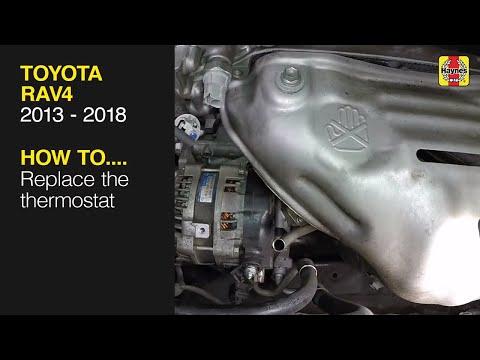






How to Replace the Thermostat on a 2017 Toyota RAV4 2.5L
Step-by-step DIY thermostat replacement with tools, parts list, torque specs, safety tips, and coolant bleeding instructions for 2001, 2002, 2003
How to Replace the Thermostat on a 2017 Toyota RAV4 2.5L
Step-by-step DIY thermostat replacement with tools, parts list, torque specs, safety tips, and coolant bleeding instructions for 2001, 2002, 2003


🔧 RAV4 - Thermostat Replacement
You’ll be draining some coolant, removing the thermostat housing where the lower radiator hose meets the engine, and installing a new thermostat and seal. This restores proper engine temperature control and can fix overheating or slow warm-up issues.
Difficulty Level: Intermediate | Estimated Time: 2-3 hours
⚠️ Safety & Precautions
- ⚠️ Never open the cooling system when the engine is hot; hot coolant can spray and cause severe burns.
- ⚠️ Support the front of your RAV4 with jack stands if you lift it; never rely only on a jack.
- ⚠️ Coolant is poisonous to people and animals; keep it off skin and away from children and pets.
- ⚠️ Disconnect the negative battery terminal if your hands will be near the radiator fan; it can start automatically.
- ⚠️ Work in a well-ventilated area and avoid breathing coolant mist.
🔧 Required Tools
You'll need the following tools for this repair:
- 🛠️ Floor jack (rated 3-ton minimum)
- 🛠️ Jack stands (rated 3-ton minimum) - Qty: 2
- 🛠️ Wheel chocks
- 🛠️ 10mm socket
- 🛠️ 12mm socket
- 🛠️ 3/8" drive ratchet
- 🛠️ 3/8" drive extension (3"-6")
- 🛠️ 1/4" drive ratchet
- 🛠️ 1/4" drive extension (3")
- 🛠️ Inch-pound torque wrench (40-200 in-lbs range)
- 🛠️ Foot-pound torque wrench (5-75 ft-lbs range)
- 🛠️ Long-nose pliers
- 🛠️ Hose clamp pliers (specialty)
- 🛠️ Flat-blade screwdriver (small)
- 🛠️ Plastic trim clip removal tool
- 🛠️ Drain pan (at least 10-liter capacity)
- 🛠️ Coolant funnel
- 🛠️ Shop towels or rags
- 🛠️ Work gloves
- 🛠️ Safety glasses
🔩 Required Parts
HowToo sells all the parts you need for this repair:
- 🔩 Engine thermostat with seal/gasket (2.5L 2AR-FE) - Qty: 1
- 🔩 Toyota Super Long Life Coolant (pink, premixed 50/50) - Qty: 2 gallons
- 🔩 Lower radiator hose clamp (spring style or worm-drive) - Qty: 1 (optional, if original is weak)
- 🔩 Thermostat housing O-ring (if not included with thermostat) - Qty: 1
- 🔩 Shop towels - Qty: as needed
- 🔩 Coolant-safe catch container for used coolant - Qty: 1
📋 Before You Begin
- Park your RAV4 on level ground, set the parking brake, and chock the rear wheels.
- Let the engine cool completely; it should be cool to the touch before you open the cooling system.
- Open the hood and locate the coolant reservoir on the passenger side near the fender.
- If you prefer extra safety near the radiator fan, disconnect the negative battery cable using a 10mm socket.
- Have your drain pan ready under the front of the vehicle before loosening any coolant fittings.
🔨 Step-by-Step Instructions
Follow these steps in order:
Step 1: Raise and secure the front of the vehicle
- Use the floor jack (rated 3-ton minimum) to lift the front of your RAV4 at the front center jacking point (behind the front bumper, on the subframe).
- Place jack stands (rated 3-ton minimum) under the pinch welds or designated support points on both sides and slowly lower the vehicle onto them.
- Leave the jack in place as a backup and ensure the vehicle is stable before going underneath.
Step 2: Remove the lower engine splash shield
- Slide the drain pan under the front area for any drips.
- Use the 10mm socket and 3/8" drive ratchet to remove the bolts holding the lower splash shield.
- Use the plastic trim clip removal tool to pop out any plastic clips holding the shield.
- Lower the splash shield and set it aside.
Step 3: Drain some coolant from the system
- Place the drain pan (at least 10-liter capacity) under the radiator drain (bottom of the radiator, usually on the passenger side).
- Use your hand or small flat-blade screwdriver to carefully open the radiator drain cock (petcock) counterclockwise. Do not force it.
- Allow coolant to drain until the flow slows significantly. You do not need to drain every drop, just enough so the level is below the thermostat area.
- Close the drain cock by hand until snug. Do not overtighten plastic drains.
Step 4: Locate the thermostat housing
- From above, follow the lower radiator hose (the thicker hose at the bottom of the radiator) back toward the engine.
- The hose connects to an aluminum housing on the front of the engine block; this is the thermostat housing.
- Make sure the engine is still cool and no pressure is in the hose (it should feel soft when squeezed).
Step 5: Remove the lower radiator hose from the thermostat housing
- Place the drain pan directly under the thermostat housing area to catch any remaining coolant.
- Use the hose clamp pliers (specialty) or long-nose pliers to squeeze the spring clamp on the lower radiator hose at the thermostat housing.
- Slide the clamp away from the housing along the hose.
- Gently twist the hose by hand to break it loose, then pull it off the housing. Use a flat-blade screwdriver (small) gently if needed, but avoid tearing the hose.
Step 6: Remove the thermostat housing
- Locate the two bolts holding the thermostat housing to the engine.
- Use the 10mm socket, 1/4" drive ratchet, and 1/4" drive extension (3") to remove the housing bolts.
- Support the housing as you remove the last bolt to avoid dropping it.
- Carefully pull the housing straight off; a little coolant may spill into the pan.
- Note the orientation of the old thermostat before removing it. Take a quick photo for reference.
Step 7: Remove the old thermostat and seal
- Pull the old thermostat out of the engine by hand.
- Remove the old seal or O-ring from the housing or thermostat groove.
- Use a shop towel to gently clean the sealing surfaces on the engine and housing. Do not scratch the aluminum.
Step 8: Install the new thermostat and seal
- Compare the new thermostat with the old one to confirm they match in size and shape.
- Install the new seal or O-ring onto the thermostat or into the housing groove, as designed for your part.
- Position the new thermostat into the engine with the correct orientation (the spring side goes toward the engine; the flat side toward the housing).
- If there is a small jiggle pin or air bleed hole on the thermostat, orient it toward the top (12 o’clock position). This helps air escape.
Step 9: Reinstall the thermostat housing
- Carefully position the housing back over the thermostat without knocking it out of place.
- Hand-thread the housing bolts to avoid cross-threading.
- Use the 10mm socket and 1/4" drive ratchet to snug both bolts evenly.
- Then use the inch-pound torque wrench with the 10mm socket to tighten both bolts to 10 Nm (89 in-lbs).
- Tighten bolts in two passes, alternating between them for even pressure.
Step 10: Reattach the lower radiator hose
- Slide the lower radiator hose fully onto the thermostat housing nipple until it seats against the stop.
- Use the hose clamp pliers (specialty) or long-nose pliers to move the clamp back into position over the raised bead on the housing.
- If the original clamp looks weak or damaged, replace it with the new clamp and tighten using a flat-blade screwdriver if it is a screw-type clamp.
Step 11: Reinstall the lower splash shield
- Lift the splash shield back into place under the engine.
- Install the clips using the plastic trim clip removal tool (press them back in by hand).
- Install and tighten the bolts with the 10mm socket and 3/8" drive ratchet. Torque to 5 Nm (44 in-lbs) if desired (snug, not overtight).
Step 12: Lower the vehicle
- Use the floor jack to lift your RAV4 slightly off the jack stands.
- Remove the jack stands and carefully lower the vehicle to the ground.
- Remove the wheel chocks when finished.
Step 13: Refill the cooling system
- Remove the radiator cap by pushing down and turning it counterclockwise (engine must be cool).
- Place the coolant funnel into the radiator neck.
- Pour Toyota Super Long Life Coolant (pink, premixed 50/50) slowly into the radiator until it reaches the top.
- Fill the coolant reservoir to the “FULL” or “MAX” line.
Step 14: Bleed air from the cooling system
- Set the cabin heater to maximum heat and fan to low. This opens the heater core.
- Start the engine and let it idle with the radiator cap off and the funnel in place.
- Watch for bubbles in the funnel; as the thermostat opens, the level may drop.
- Add more coolant as needed to keep the radiator full.
- Gently squeeze the upper and lower radiator hoses by hand to help push out trapped air.
- Once bubbles mostly stop and the upper radiator hose feels hot (thermostat opened), install the radiator cap by pressing down and turning clockwise until fully seated.
Step 15: Final checks for leaks and level
- With the engine still running, check around the thermostat housing and lower radiator hose for any leaks.
- After a few minutes, turn off the engine and let it cool completely (at least 1-2 hours).
- When cool, recheck the coolant level in the reservoir and top off with the same coolant if needed.
- Dispose of old coolant at a recycling center or authorized shop; never pour it on the ground.
✅ After Repair
- Take a short test drive, watching the temperature gauge; it should reach normal operating temperature and stay steady.
- Turn the heater on during the drive to confirm you get hot air (this shows coolant is circulating).
- Park, let the engine cool, and recheck for any coolant leaks around the thermostat housing and hose connections.
- Recheck coolant level in the reservoir over the next couple of days and top off as needed with the same coolant.
💰 DIY vs Shop Cost
Shop Cost: $250-$400 (parts + labor)
DIY Cost: $60-$120 (parts only)
You Save: $190-$280 by doing it yourself!
Shop labor rates vary but typically run $100-$150/hour. This repair takes a shop approximately 1.5-2.0 hours.
🎯 Ready to get started?
HowToo makes it easy: same-day/2-day shipping on every part, plus all the tools and specialty tools you need! Check out the parts and tools sections above to add everything to your cart.