









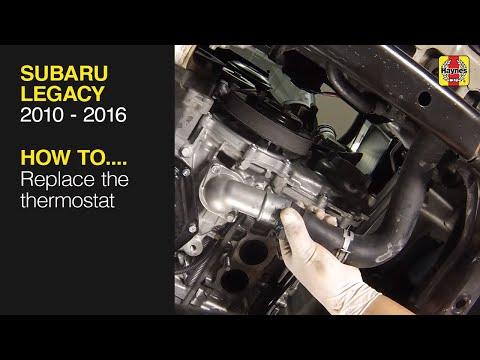







How to Replace the Thermostat on a 2015 Subaru Legacy 2.5L (FB25)
Step-by-step DIY instructions with tools, parts list, coolant bleed tips, and thermostat bolt torque specs for 2015
How to Replace the Thermostat on a 2015 Subaru Legacy 2.5L (FB25)
Step-by-step DIY instructions with tools, parts list, coolant bleed tips, and thermostat bolt torque specs for 2015


🔧 Legacy - Thermostat Replacement
The thermostat helps your A4—sorry, your Legacy—reach and hold the correct engine temperature. When it sticks open you may get low heat and poor fuel economy; when it sticks closed the engine can overheat. This job involves draining coolant, swapping the thermostat at the engine-side housing, then refilling and bleeding air out.
Difficulty Level: Intermediate | Estimated Time: 2-3 hours
Assumption: Stock 2.5L FB25 layout with thermostat at water pump housing.
⚠️ Safety & Precautions
- ⚠️ Only work on a cold engine; hot coolant can cause severe burns.
- ⚠️ Support the car on jack stands; never rely on a floor jack alone.
- ⚠️ Keep coolant away from kids/pets; it’s toxic and attractive-tasting.
- ⚠️ Clean spills immediately and dispose of coolant properly.
- ⚠️ Battery disconnect is not required, but keep hands clear of fans and belts.
🔧 Required Tools
You'll need the following tools for this repair:
- Floor jack (rated 3-ton minimum)
- Jack stands (rated 3-ton minimum)
- Wheel chocks
- Safety glasses
- Nitrile gloves
- Drain pan (at least 10-quart)
- Socket set with 10mm socket
- 3/8" ratchet
- 3" extension for 3/8" ratchet
- Torque wrench (5-30 Nm range)
- Hose clamp pliers
- Pick tool
- Trim clip removal tool
- Phillips #2 screwdriver
- Spill-free coolant funnel kit (specialty)
- Shop towels
🔩 Required Parts
HowToo sells all the parts you need for this repair:
- Engine thermostat - Qty: 1
- Thermostat seal / O-ring - Qty: 1
- Engine coolant (Subaru Super Coolant premix equivalent) - Qty: 2 gallons
- Lower radiator hose clamp - Qty: 1
📋 Before You Begin
- Park on level ground, set the parking brake, and chock the rear wheels.
- Let the engine cool fully (at least 2-3 hours).
- Set the HVAC to full HOT during bleeding later; this opens the heater flow path.
- Have a drain pan ready under the radiator area before opening anything.
🔨 Step-by-Step Instructions
Follow these steps in order:
Step 1: Raise and secure the front of the car
- Use wheel chocks behind the rear tires.
- Use a floor jack (rated 3-ton minimum) to lift the front at the proper front jacking point.
- Place jack stands (rated 3-ton minimum) under the front support points and lower the car onto them.
Step 2: Remove the lower engine under cover (splash shield)
- Use a trim clip removal tool to pop out plastic clips.
- Use a Phillips #2 screwdriver for any screws.
- Use a 10mm socket with a 3/8" ratchet to remove any 10mm bolts.
- Tip: Keep clips in a small container.
Step 3: Drain the coolant
- Place a drain pan (at least 10-quart) under the radiator drain area.
- Open the radiator cap slowly once the engine is cold (use nitrile gloves and safety glasses).
- Open the radiator drain (petcock) carefully; use a Phillips #2 screwdriver only if needed (many are hand-turn).
- Let coolant drain completely, then close the drain.
Step 4: Locate the thermostat housing
- From underneath, follow the lower radiator hose toward the front of the engine.
- The hose connects to the thermostat/water pump housing (this is where the thermostat sits).
Step 5: Remove the lower radiator hose from the housing
- Use hose clamp pliers to compress the clamp and slide it back on the hose.
- Twist the hose gently to break it free; use a pick tool carefully at the edge if it’s stuck (don’t gouge the plastic/metal neck).
- Pull the hose off and aim it into the drain pan (at least 10-quart) to catch remaining coolant.
Step 6: Remove the thermostat cover
- Use a 10mm socket with a 3/8" ratchet and 3" extension to remove the thermostat cover bolts.
- Remove the cover and note the thermostat orientation before pulling it out.
- Tip: Take a quick photo for reference.
Step 7: Replace the thermostat and seal
- Remove the old thermostat and old thermostat seal / O-ring.
- Clean the mating surfaces using shop towels (no scraping that could gouge).
- Install the new thermostat in the same orientation as the old one.
- Install the new thermostat seal / O-ring (make sure it sits flat and is not pinched).
Step 8: Reinstall the thermostat cover and torque bolts
- Position the cover and hand-start all bolts.
- Use a torque wrench (5-30 Nm range) with a 10mm socket to tighten evenly.
- Torque to 10 Nm (7 ft-lbs).
Step 9: Reconnect the lower radiator hose
- Push the hose fully onto the housing neck.
- Use hose clamp pliers to position the clamp back in its original spot.
- If the clamp is weak or distorted, replace it with the new lower radiator hose clamp.
Step 10: Refill coolant and bleed air
- Install a spill-free coolant funnel kit (specialty) on the radiator fill neck.
- Slowly add engine coolant (Subaru Super Coolant premix equivalent) until the radiator stays full.
- Start the engine and let it idle; keep the funnel at least half-full.
- Set HVAC to heat on high (fan speed can be low) and watch for air bubbles.
- When the thermostat opens, the coolant level may drop—add more as needed.
- Squeeze the upper radiator hose carefully (with nitrile gloves) to help burp air.
- Once bubbles stop and the heater blows hot, shut the engine off and let it cool.
- Remove the funnel and install the radiator cap.
Step 11: Reinstall the under cover and lower the car
- Reinstall the splash shield using the trim clip removal tool, Phillips #2 screwdriver, and 10mm socket as applicable.
- Raise slightly with the floor jack (rated 3-ton minimum), remove jack stands (rated 3-ton minimum), and lower the car.
✅ After Repair
- With the engine fully warmed up, verify the temperature gauge stays normal.
- Check for leaks at the thermostat cover and the lower hose connection.
- After the car cools completely, recheck the coolant level in the overflow bottle and top off if needed.
- If you hear sloshing behind the dash or get no heat, there is likely trapped air—repeat bleeding with the spill-free coolant funnel kit (specialty).
💰 DIY vs Shop Cost
Shop Cost: $350-$600 (parts + labor)
DIY Cost: $60-$150 (parts only)
You Save: $200-$500 by doing it yourself!
Shop labor rates vary but typically run $100-$150/hour. This repair takes a shop approximately 2-3 hours.
🎯 Ready to get started?
HowToo makes it easy: same-day/2-day shipping on every part, plus all the tools and specialty tools you need! Check out the parts and tools sections below to add everything to your cart.