









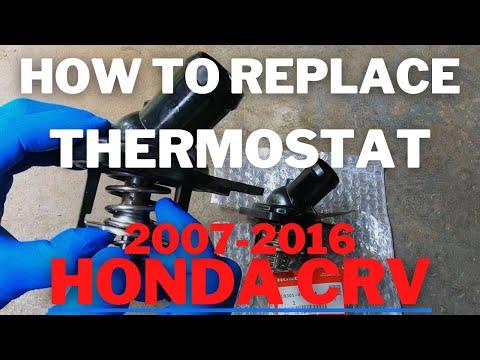




How to Replace the Thermostat on a 2007-2014 Honda CR‑V 2.4L (Engine: Inline 4 2.4L)
Step-by-step DIY thermostat replacement with tools, parts list, torque specs, coolant refill, bleeding, safety tips, and cost savings
How to Replace the Thermostat on a 2007-2014 Honda CR‑V 2.4L (Engine: Inline 4 2.4L)
Step-by-step DIY thermostat replacement with tools, parts list, torque specs, coolant refill, bleeding, safety tips, and cost savings for 2007, 2008, 2009, 2010, 2011, 2012, 2013, 2014


🔧 CR-V - Thermostat Replacement
The thermostat in your CR-V controls coolant flow and engine temperature. To replace it, you’ll drain some coolant, remove the thermostat housing on the engine, swap the thermostat and seal, then refill and bleed the cooling system.
Difficulty Level: Intermediate | Estimated Time: 2–3 hours
⚠️ Safety & Precautions
- 🔥 Only work on the cooling system when the engine is completely cool to avoid serious burns.
- 🧪 Coolant is poisonous; keep it away from children and pets and clean spills immediately.
- 🧤 Wear safety glasses and gloves; coolant can irritate skin and eyes.
- 🚗 Safely support the front of the CR-V on jack stands if you raise it—never rely on a jack alone.
- 🔌 Battery disconnect is not required for this job, but avoid shorting any electrical connectors.
- ♻️ Collect old coolant in a drain pan and dispose of it according to local rules (no dumping).
🔧 Required Tools
You'll need the following tools for this repair:
- 🛠️ 3/8" drive ratchet
- 🛠️ 1/4" drive ratchet
- 🛠️ 10mm socket
- 🛠️ 12mm socket
- 🛠️ 8mm socket
- 🛠️ 3" socket extension
- 🛠️ 6" socket extension
- 🛠️ 1/4" drive inch‑pound torque wrench
- 🛠️ 3/8" drive foot‑pound torque wrench
- 🛠️ Flat blade screwdriver (medium)
- 🛠️ Phillips screwdriver (medium)
- 🛠️ Needle-nose pliers
- 🛠️ Hose clamp pliers (specialty)
- 🛠️ Drain pan (at least 10 liters)
- 🛠️ Funnel with small spout
- 🛠️ Plastic trim clip remover (specialty)
- 🛠️ Shop rags or paper towels
- 🛠️ Floor jack (rated 2‑3 ton minimum)
- 🛠️ Jack stands (rated 2‑3 ton minimum)
- 🛠️ Work light or flashlight
- 🛠️ Safety glasses
- 🛠️ Mechanic’s gloves
🔩 Required Parts
HowToo sells all the parts you need for this repair:
- 🔩 Engine thermostat (correct for 2.4L) - Qty: 1
- 🔩 Thermostat rubber seal/O-ring - Qty: 1
- 🔩 Honda-type blue long-life coolant (premix 50/50) - Qty: 1–2 gallons (3.8–7.6 liters)
- 🔩 Thermostat housing gasket (if separate on your part) - Qty: 1
- 🔩 Replacement hose clamps (spring or worm-gear) 32–38mm - Qty: 2 (optional, if old clamps are weak)
- 🔩 Anti-seize compound (small tube) - Qty: 1 (optional, for bolt threads)
- 🔩 Shop towels or absorbent pads - Qty: 1 pack
📋 Before You Begin
- Park the CR-V on a level surface, set the parking brake, and place the transmission in P.
- Let the engine cool for at least 1–2 hours until the upper radiator hose is cool to the touch.
- Open the hood and locate the radiator cap, coolant reservoir, and upper and lower radiator hoses.
- Turn the heater temperature knob inside the cabin to full hot; this helps coolant flow through the heater core later.
- You do not need any infotainment or scan-tool steps for this job on your CR-V.
🔨 Step-by-Step Instructions
Follow these steps in order:
Step 1: Raise and prepare the CR-V
- Use the floor jack to lift the front of your CR-V at the front jacking point (center under the subframe).
- Place jack stands under the left and right pinch welds or frame points and gently lower the vehicle onto them.
- Remove the engine splash shield if fitted by using the 10mm socket and plastic trim clip remover for clips.
- Shake the car slightly to confirm it’s stable on stands.
Step 2: Relieve any residual pressure and drain some coolant
- Place the drain pan under the radiator drain area at the front of the car.
- Slowly loosen the radiator cap by hand; if you hear hissing, stop and let pressure bleed off before removing fully.
- Use the Phillips screwdriver or fingers (depending on style) to open the radiator drain plug (petcock) at the bottom of the radiator.
- Drain about 3–4 liters of coolant into the pan; this reduces spillage when you open the thermostat housing.
- Close the drain plug by hand then snug it gently with the Phillips screwdriver—do not overtighten.
Step 3: Remove air intake duct for better access
- The thermostat on this engine is at the end of the lower radiator hose, near the front of the engine block under the intake area.
- Use the flat blade screwdriver to loosen the hose clamp on the intake tube at the air filter box.
- Disconnect any small vacuum or breather hoses by hand, noting where they go.
- Lift the intake tube out of the way and set it aside.
- Take a quick photo to remember hose routing.
Step 4: Locate the thermostat housing and hose
- Follow the lower radiator hose (the thick hose at the bottom of the radiator) back to where it connects to the engine.
- The metal or plastic part where this hose meets the engine block is the thermostat housing.
- Use your work light or flashlight to clearly see the housing and bolts.
Step 5: Remove the lower radiator hose from the thermostat housing
- Place the drain pan under the thermostat housing to catch any remaining coolant.
- Use hose clamp pliers (or needle-nose pliers for spring clamps) to compress the hose clamp and slide it back along the hose.
- Gently twist the hose at the housing by hand to break it loose; if it’s stuck, carefully work it with the flat blade screwdriver without cutting the hose.
- Pull the hose off and let any coolant drain into the pan.
Step 6: Remove the thermostat housing
- Locate the two or three small bolts holding the thermostat housing to the engine.
- Use the 10mm socket, 3" extension, and 1/4" ratchet to loosen and remove these bolts.
- Support the housing with your other hand as you remove the last bolt so it doesn’t drop.
- Note the orientation of the housing and thermostat for reassembly.
- Keep bolts in a small tray so you don’t lose them.
Step 7: Remove the old thermostat
- Gently pull the housing away from the engine; the thermostat will usually stay in the engine side.
- Remove the old thermostat by hand; if it’s stuck, carefully pry it out with the flat blade screwdriver.
- Remove the old rubber seal or O-ring from the thermostat or housing.
- Use a clean shop rag to wipe the sealing surfaces on both the engine and housing until they are clean and smooth.
Step 8: Install the new thermostat and seal
- Compare the old and new thermostat to confirm size and shape match.
- Install the new thermostat rubber seal/O-ring on the thermostat or into the groove in the housing, depending on design.
- On your CR-V’s thermostat, install it with the jiggle valve (small pin or hole, if present) at the top, roughly at the 12 o’clock position.
- Seat the thermostat fully and evenly in the recess; it should not rock or move.
Step 9: Reinstall the thermostat housing
- Position the housing back over the thermostat, aligning the bolt holes.
- Start all bolts by hand to avoid cross-threading.
- (Optional) Apply a tiny amount of anti-seize compound to the bolt threads, avoiding the tips.
- Use the 10mm socket and 1/4" ratchet to snug the bolts evenly in a criss-cross pattern.
- Then use the inch‑pound torque wrench with the 10mm socket to tighten the bolts to 12 N·m (8.7 ft‑lb).
- Do not overtighten; the housing can crack.
Step 10: Reinstall the lower radiator hose
- Slide the hose back onto the thermostat housing until it fully covers the nipple.
- Position the hose clamp over the raised bead on the housing outlet.
- Use hose clamp pliers or needle-nose pliers to compress the clamp and release it in place.
- If using new worm-gear clamps, use the flat blade screwdriver to tighten them snugly—do not strip them.
Step 11: Reinstall air intake duct
- Place the intake tube back between the air box and throttle body.
- Reconnect any small vacuum or breather hoses by hand.
- Use the flat blade screwdriver to tighten the large hose clamp at the air box and any other clamps.
Step 12: Refit splash shield and lower the vehicle
- Reinstall the lower splash shield using the 10mm socket and plastic trim clip remover (to push clips back in if needed).
- Use the floor jack to lift the vehicle slightly, remove the jack stands, and lower the CR-V back to the ground.
Step 13: Refill the cooling system
- Place the funnel in the radiator filler neck.
- Slowly pour the premixed Honda-type coolant into the radiator until it is full.
- Fill the coolant reservoir to the “MAX” line using the funnel.
- Leave the radiator cap off for now.
Step 14: Bleed air from the cooling system
- Start the engine and let it idle with the radiator cap off.
- Watch the coolant level in the radiator; as the thermostat opens, the level may drop.
- Add more coolant using the funnel as needed to keep it near the neck.
- Turn the heater inside the car to full hot and fan on medium; warm air from the vents shows coolant is flowing through the heater core.
- When you see steady flow and few bubbles and the upper radiator hose is hot, turn the engine off.
- Top off the radiator if needed and install the cap securely by hand.
Step 15: Final checks for leaks
- With the engine off, inspect around the thermostat housing and hose connection using your work light.
- Look for any drips, wet areas, or coolant smell.
- Check under the car for any new puddles in your drain pan area.
- If you find leaks, gently snug clamps or bolts.
✅ After Repair
- Take the CR-V for a short 10–15 minute drive, watching the temperature gauge; it should rise to the middle and stay steady.
- After the engine cools completely, recheck the coolant level in the radiator and reservoir; top off to the “MAX” line if needed.
- Inspect again around the thermostat housing and lower hose for any sign of seepage.
- No scan-tool or reset is required for the cooling system on your CR-V.
💰 DIY vs Shop Cost
Shop Cost: $250–$400 (parts + labor)
DIY Cost: $50–$120 (parts and coolant)
You Save: $130–$350 by doing it yourself!
Shop labor rates typically run $100–$150/hour. This repair takes a shop approximately 1.5–2.0 hours.
🎯 Ready to get started?
HowToo makes it easy: same-day/2-day shipping on every part, plus all the tools and specialty tools you need! Check out the parts and tools sections above to add everything to your cart.
Guide for Engine Coolant Thermostat replace for these Honda vehicles
| Year Make Model | Sub Model | Engine | Body Style |
|---|---|---|---|
| 2014 Honda CR-V | - | Inline 4 2.4L | - |
| 2013 Honda CR-V | - | Inline 4 2.4L | - |
| 2012 Honda CR-V | - | Inline 4 2.4L | - |
| 2011 Honda CR-V | - | Inline 4 2.4L | - |
| 2010 Honda CR-V | - | Inline 4 2.4L | - |
| 2009 Honda CR-V | - | Inline 4 2.4L | - |
| 2008 Honda CR-V | - | Inline 4 2.4L | - |
| 2007 Honda CR-V | - | Inline 4 2.4L | - |