









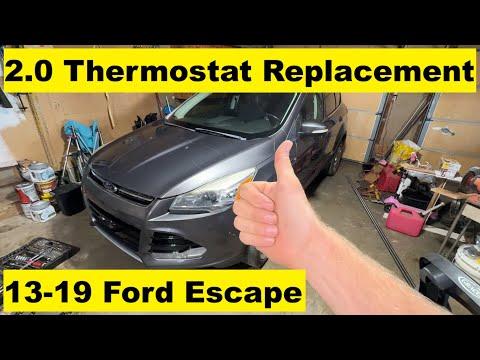







How to Replace the Thermostat Housing on a 2014 Ford Escape (Coolant Outlet)
Step-by-step instructions with required tools, parts list, coolant refill/bleed tips, and leak checks
How to Replace the Thermostat Housing on a 2014 Ford Escape (Coolant Outlet)
Step-by-step instructions with required tools, parts list, coolant refill/bleed tips, and leak checks


🔧 Escape - Thermostat Replacement
On your Escape, the thermostat is part of the engine’s coolant outlet/thermostat housing area. Replacing it usually means draining some coolant, removing the housing, swapping the thermostat (or the whole housing assembly), and refilling/bleeding the cooling system.
Difficulty Level: Intermediate | Estimated Time: 2.0-4.0 hours
⚠️ Safety & Precautions
- ⚠️ Never open the coolant reservoir when hot; wait until fully cool.
- ⚠️ Support the vehicle securely if you need to access the lower splash shield.
- ⚠️ Keep coolant off belts/alternator connectors; coolant is slippery and corrosive.
- ⚠️ Dispose of old coolant properly; it’s toxic to people and animals.
- Disconnecting the battery is recommended if you’ll unplug connectors near the alternator/throttle body.
🔧 Required Tools
You'll need the following tools for this repair:
- Safety glasses
- Nitrile gloves
- Floor jack (rated 3-ton minimum)
- Jack stands (rated 3-ton minimum)
- Wheel chocks
- Drain pan (at least 10-quart)
- Funnel (coolant-safe)
- Trim clip removal tool
- Flat-blade screwdriver
- Pick tool set
- 1/4" drive ratchet
- 3/8" drive ratchet
- Extension set (1"–6")
- 8mm socket
- 10mm socket
- 13mm socket
- Torx T20 bit
- Torque wrench (inch-pound, 20–200 in-lb range)
- Torque wrench (ft-lb, 10–150 ft-lb range)
- Hose clamp pliers (specialty)
- Cooling system vacuum fill tool (specialty)
🔩 Required Parts
HowToo sells all the parts you need for this repair:
- Thermostat - Qty: 1
- Thermostat housing / coolant outlet assembly - Qty: 1
- Thermostat housing gasket / O-ring - Qty: 1
- Engine coolant (Motorcraft orange OAT coolant) - Qty: 1-2 gallons
- Distilled water - Qty: 1-2 gallons
- Hose clamp - Qty: 1
📋 Before You Begin
- Park on level ground, set the parking brake, and let the engine go fully cold.
- Place wheel chocks behind the rear wheels.
- If you’ll raise the front: use a floor jack and support with jack stands at the proper lift points.
- Have a drain pan ready and keep coolant off drive belts and electrical connectors.
🔨 Step-by-Step Instructions
Follow these steps in order:
Step 1: Confirm which thermostat setup your Escape has
- Please answer these 2 quick questions so I can give you the exact bolt locations and correct Ford torque specs (there are common variations):
- 1) Are you replacing the thermostat only or the entire thermostat housing/coolant outlet assembly?
- 2) Can you upload a clear photo of the thermostat housing area (top-front of the engine, where the large radiator hose connects), or tell me if the housing has 2 bolts or 3 bolts holding it?
Step 2: Drain enough coolant to get below thermostat level
- Use floor jack (rated 3-ton minimum) and jack stands (rated 3-ton minimum) if you need access underneath.
- Remove the lower splash shield as needed using a trim clip removal tool and 8mm socket.
- Position a drain pan (at least 10-quart) under the radiator drain area.
- Open the coolant reservoir cap slowly only when cold.
- Drain coolant until the level is below the thermostat housing connection point.
Step 3: Remove intake ducting for access
- Loosen intake clamps using a flat-blade screwdriver or 8mm socket.
- Remove any engine cover/duct fasteners using a 10mm socket as needed.
- Move the intake ducting out of the way for a clear view of the upper radiator hose connection.
Step 4: Disconnect the upper radiator hose from the thermostat housing
- Use hose clamp pliers (specialty) to compress the hose clamp and slide it back on the hose.
- Twist the hose gently to break it free; use a pick tool set carefully if it’s stuck. Do not gouge the hose.
- Pull the hose off and aim it into the drain pan (at least 10-quart).
Step 5: Remove the thermostat housing / coolant outlet
- Remove any interfering brackets using a 10mm socket and extension set (1"–6").
- Remove housing bolts using a 10mm socket (some fasteners may require a Torx T20 bit depending on build).
- STOP HERE: The exact housing fastener torque and reassembly sequence depends on the housing style. Reply with the answers from Step 1 (or upload a photo), and I’ll give you the exact Ford torque specs and the remaining steps (cleaning surfaces, gasket/O-ring placement, refill/bleed procedure).
✅ After Repair
- Refill with the correct coolant mix and bleed air from the system; trapped air can cause overheating.
- Warm the engine to operating temp with the heater on high and confirm steady cabin heat.
- Check for leaks at the housing and hose connections after a full heat-soak and cool-down.
- Recheck coolant level the next morning (cold) and top off if needed.
💰 DIY vs Shop Cost
Shop Cost: $450-$900 (parts + labor)
DIY Cost: $60-$220 (parts only)
You Save: $230-$840 by doing it yourself!
Shop labor rates vary but typically run $100-$150/hour. This repair takes a shop approximately 2.0-4.0 hours.
🎯 Ready to get started?
HowToo makes it easy: same-day/2-day shipping on every part, plus all the tools and specialty tools you need! Check out the parts and tools sections below to add everything to your cart.