









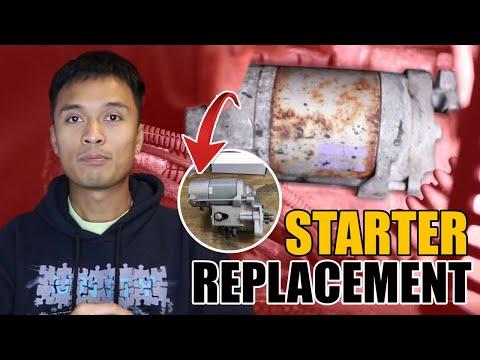







How to Replace the Starter Motor on a 2022 Toyota Tacoma 3.5L V6
Step-by-step DIY starter replacement with tools, parts list, torque specs, safety tips, and cost savings for 2016, 2017, 2018, 2019, 2020, 2021, 2022, 2023
How to Replace the Starter Motor on a 2022 Toyota Tacoma 3.5L V6
Step-by-step DIY starter replacement with tools, parts list, torque specs, safety tips, and cost savings for 2016, 2017, 2018, 2019, 2020, 2021, 2022, 2023


🔧 Tacoma - Starter Motor Replacement
You’ll be removing the old starter motor from the side of the transmission bellhousing and installing a new one. This involves disconnecting the battery, getting under the truck, and unbolting the starter and its electrical cables.
Difficulty Level: Intermediate | Estimated Time: 2-3 hours
⚠️ Safety & Precautions
- ⚠️ Disconnect the negative battery cable before touching the starter wiring to avoid sparks or short circuits.
- ⚠️ Always support the Tacoma with jack stands; never rely only on a floor jack.
- ⚠️ Let the exhaust cool completely before working underneath; the starter is near hot exhaust parts.
- ⚠️ Wear safety glasses; dirt and rust can fall into your eyes when working under the truck.
- ⚠️ Chock the rear wheels to prevent any vehicle movement while it’s lifted.
🔧 Required Tools
You'll need the following tools for this repair:
- 🛠️ Floor jack (rated 3-ton minimum)
- 🛠️ Jack stands (rated 3-ton minimum, Qty: 2-4)
- 🛠️ Wheel chocks
- 🛠️ Metric socket set (8mm–19mm)
- 🛠️ 3/8" drive ratchet
- 🛠️ 1/2" drive ratchet
- 🛠️ 3/8" drive extensions (3" and 6")
- 🛠️ 1/2" drive extensions (6")
- 🛠️ 12mm socket
- 🛠️ 13mm socket
- 🛠️ 14mm socket
- 🛠️ 10mm socket
- 🛠️ Torque wrench (3/8" drive, 5–80 ft-lbs range)
- 🛠️ Torque wrench (1/2" drive, 20–150 ft-lbs range)
- 🛠️ Flathead screwdriver (medium)
- 🛠️ Needle-nose pliers
- 🛠️ Trim clip removal tool
- 🛠️ Work light or headlamp
- 🛠️ Mechanic’s creeper
- 🛠️ Gloves
- 🛠️ Safety glasses
🔩 Required Parts
HowToo sells all the parts you need for this repair:
- 🔩 Starter motor (3.5L V6, 4WD) - Qty: 1
- 🔩 Starter mounting bolt set (if not reusing) - Qty: 1
- 🔩 Battery terminal cleaner or brush - Qty: 1
- 🔩 Dielectric grease - Qty: 1
- 🔩 Anti-seize compound - Qty: 1
- 🔩 Replacement skid plate bolts or clips (if any are damaged) - Qty: as needed
- 🔩 Shop towels or rags - Qty: 1 pack
📋 Before You Begin
- Park the Tacoma on a flat, level surface and set the parking brake fully.
- Place wheel chocks behind the rear wheels so the truck cannot roll.
- Open the hood and locate the battery on the driver side.
- Disconnect the negative (-) battery terminal with a 10mm socket and secure the cable so it cannot touch the post again.
- Gather all tools and parts where you can easily reach them once the truck is in the air.
🔨 Step-by-Step Instructions
Follow these steps in order:
Step 1: Safely raise and support the Tacoma
- Position the floor jack (3-ton) under the front frame crossmember (center front area under the truck).
- Pump the jack to lift the front high enough to work under comfortably.
- Place jack stands (3-ton) under the frame rails on both sides, then slowly lower the truck onto the stands using the floor jack.
- Give the truck a gentle shake to confirm it is solidly supported.
- Never work under a truck supported only by a jack.
Step 2: Remove front skid plate (if equipped)
- The skid plate is the metal shield under the engine area that protects off-road components.
- Use a 12mm socket with the 3/8" ratchet to remove the skid plate bolts at the front and rear edges.
- If there are plastic clips, use the trim clip removal tool to pop them out without breaking them.
- Support the skid plate with one hand while removing the last bolt, then lower it and set it aside.
- Lay bolts out in order to remember positions.
Step 3: Locate the starter motor
- Slide under the truck using the mechanic’s creeper and shine the work light upward near the transmission bellhousing on the passenger side of the engine.
- The starter is a small cylindrical motor with a wiring harness and a thick cable going to it.
- Note the routing of the wires and the orientation of the starter for reinstallation.
Step 4: Disconnect starter electrical connections
- Confirm the negative battery cable is still disconnected before touching any wires.
- Locate the small plug (solenoid connector) on the starter and gently release the tab using a flathead screwdriver if needed, then unplug it by hand.
- Find the thick cable attached with a nut on the starter terminal.
- Use a 12mm socket and 3/8" ratchet to remove the nut holding the thick cable to the starter terminal.
- Pull the cable off the stud and set it aside out of your way.
- Torque for reassembly later: Torque cable nut to 13 Nm (10 ft-lbs).
Step 5: Remove starter mounting bolts
- The starter is held to the transmission bellhousing with two bolts (one upper, one lower).
- Use a 14mm socket with a 3/8" extension and ratchet to loosen and remove the lower starter bolt.
- For the upper bolt, use the 14mm socket plus a 6" extension and the 3/8" ratchet to reach it from below or slightly from the side.
- Support the starter body with one hand as you remove the last bolt so it does not drop.
- Torque for reassembly later: Torque starter mounting bolts to 37 Nm (27 ft-lbs).
Step 6: Remove the old starter
- Once the bolts are out, gently wiggle the starter away from the transmission.
- If it is stuck, tap it lightly with your hand or a gloved fist, not a hammer, to break it loose.
- Rotate and maneuver the starter down and out from the engine bay, watching for any wiring harnesses or hoses that may be in the way.
- Notice exactly how the starter comes out to match when reinstalling.
Step 7: Prepare the new starter
- Set the old and new starters side by side and compare them: mounting holes, electrical terminals, and shape should match.
- Lightly clean the mounting surface on the transmission with a shop towel so the new starter sits flat.
- Apply a tiny amount of anti-seize compound on the threads of the mounting bolts if desired, but keep it off the bolt heads and starter body.
- Put a small dab of dielectric grease on the electrical connector seal for better water resistance.
Step 8: Install the new starter
- Carefully maneuver the new starter into position at the bellhousing opening in the same orientation as the old one.
- Start the upper mounting bolt by hand through the starter into the transmission to hold it in place. Thread it a few turns only.
- Install the lower mounting bolt by hand to avoid cross-threading.
- Use the 14mm socket, extension, and 3/8" ratchet to snug both bolts evenly.
- Then use the 3/8" torque wrench with the 14mm socket to tighten each bolt to 37 Nm (27 ft-lbs).
- Hand-start bolts first to prevent damaged threads.
Step 9: Reconnect starter wiring
- Reinstall the thick cable onto the starter terminal stud.
- Thread the nut on by hand, then tighten with a 12mm socket and 3/8" torque wrench to 13 Nm (10 ft-lbs).
- Do not over-tighten; you can crack the plastic insulator on the starter.
- Plug the smaller solenoid connector back into the starter until it clicks firmly.
- Apply a light film of dielectric grease over exposed metal if desired to protect from corrosion.
Step 10: Reinstall skid plate
- Lift the skid plate back into position under the engine area.
- Install the bolts by hand first to avoid cross-threading.
- Use the 12mm socket and 3/8" ratchet to tighten the skid plate bolts snugly.
- If using a torque wrench, tighten skid plate bolts to about 29 Nm (21 ft-lbs) if specified for similar Toyota skid plates.
- Reinstall any plastic clips using the trim clip removal tool in reverse to press them back in.
Step 11: Lower the Tacoma
- Use the floor jack to raise the front slightly off the jack stands.
- Remove the jack stands from both sides.
- Slowly lower the truck back down to the ground with the floor jack.
- Remove the wheel chocks from behind the rear tires.
Step 12: Reconnect the battery and test
- Under the hood, clean the battery terminals with the battery terminal cleaner if there is any corrosion.
- Reconnect the negative (-) battery cable using a 10mm socket.
- Tighten the clamp bolt to about 5 Nm (44 in-lbs)—snug but not over-tight.
- Get in the Tacoma, shift to Park, and keep your foot on the brake.
- Turn the ignition to start the engine; the starter should crank quickly and smoothly.
- Listen for any grinding or unusual noises from the starter area.
✅ After Repair
- Start the engine several times to confirm consistent, strong cranking with no hesitation.
- Check under the Tacoma for any loose tools or parts you may have left behind.
- Verify that no warning lights appear on the dash related to charging or electrical systems.
- After a short drive, recheck the battery terminals and starter cable nut for tightness.
💰 DIY vs Shop Cost
Shop Cost: $650-$900 (parts + labor)
DIY Cost: $220-$380 (parts only)
You Save: $270-$520 by doing it yourself!
Shop labor rates typically run $100-$150/hour. This repair takes a shop approximately 1.5-2.0 hours.
🎯 Ready to get started?
HowToo makes it easy: same-day/2-day shipping on every part, plus all the tools and specialty tools you need! Check out the parts and tools sections above to add everything to your cart.