








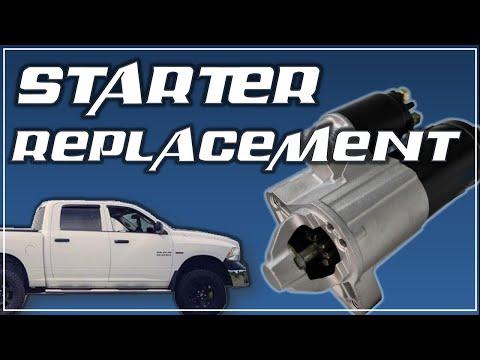





How to Replace the Starter Motor on a 2022 Ram 1500 Classic 3.6L
Step-by-step DIY starter removal and installation with tools, torque specs, safety tips, and testing instructions for 2019, 2020, 2021, 2022
How to Replace the Starter Motor on a 2022 Ram 1500 Classic 3.6L
Step-by-step DIY starter removal and installation with tools, torque specs, safety tips, and testing instructions for 2019, 2020, 2021, 2022


1500 Classic - Starter Motor Replacement 🔧
Got it—you want to replace the starter on your 2022 1500 Classic SLT 3.6L 4WD. I’ll walk you through it step by step.
Quick check first: On your truck, the starter is mounted low on the passenger side of the engine, near the transmission bellhousing. Please confirm:
- ✅ You are working on the 3.6L V6 (not the 5.7 HEMI).
- ✅ You have a safe, flat place to jack up the truck and use jack stands.
If both are true, follow the guide below.
Safety First ⚠️
- ⚠️ Disconnect the battery: You will be working on the main power cable from the battery. Always remove the negative (-) battery cable before touching the starter.
- ⚠️ Support the truck: Use a floor jack and jack stands (stands are solid supports that hold the vehicle safely). Never rely on the jack alone.
- ⚠️ Let the exhaust cool if the truck was just running; the exhaust pipe runs near the starter.
Tools & Parts You’ll Need 🧰
- 🛠️ New starter motor (3.6L V6, 4WD, correct for your 1500 Classic)
- 🛠️ Ratchet and socket set:
- 10 mm socket – battery terminal and small starter wire nut (if equipped)
- 13 mm or 15 mm socket – main starter power cable nut (varies by supplier)
- 15 mm and/or 16 mm sockets – starter mounting bolts
- Short and deep sockets if possible
- 🛠️ Extensions (metal rods that extend your ratchet reach) – 3" and 6"
- 🛠️ Torque wrench (tool that lets you tighten bolts to a specific force)
- 🛠️ Flat-blade screwdriver or trim tool – to release any plastic clips or wire retainers
- 🛠️ Floor jack and jack stands
- 🛠️ Wheel chocks (blocks behind wheels so the truck can’t roll)
- 🛠️ Safety glasses and mechanic gloves
- 🛠️ Dielectric grease (non-conductive grease to protect electrical connections; optional but recommended)
Key Torque Specs 📏
- 🧩 Starter mounting bolts: ~ 40 N·m (30 ft-lb)
- 🧩 Main battery cable nut at starter: ~ 15 N·m (11 ft-lb) (snug, not over-tight)
- 🧩 Small “S” terminal nut (if present): ~ 5 N·m (44 in-lb) (just snug)
Do not overtighten the electrical studs; they can crack the starter housing.
Step 1 – Prepare the Truck 🧱
- 🧰 Park on a flat surface, shift to PARK, and set the parking brake.
- 🧰 Place wheel chocks behind the rear wheels.
- 🧰 Open the hood.
- 🧰 Disconnect the negative (-) battery cable:
- Use a 10 mm socket to loosen the clamp on the negative terminal.
- Lift the cable off and tuck it aside so it cannot spring back to the terminal.
Step 2 – Raise and Support the Front of the Truck 🏗️
- 🧰 Position the floor jack under the front frame crossmember (strong metal bar under the front of the truck).
- 🧰 Lift the front high enough to work comfortably under the passenger side.
- 🧰 Place jack stands under the frame rails on both sides and lower the truck onto the stands.
- 🧰 Give the truck a gentle push to confirm it’s stable.
Step 3 – Locate the Starter 🔍
- 🧰 Slide under the truck from the front or passenger side.
- 🧰 On the 3.6L, the starter is:
- Mounted low on the passenger side of the engine.
- Bolted to the transmission bellhousing (where engine meets transmission).
- Has a thick battery cable and a smaller control wire plugged or bolted to it.
Step 4 – Disconnect Starter Wiring 🔌
- 🧰 Before touching anything, double-check the negative battery cable is disconnected.
- 🧰 Remove any plastic cover over the starter terminals if present (it may just unclip or pull off).
- 🧰 Main battery cable:
- Use a 13 mm or 15 mm socket to remove the nut holding the thick cable to the large stud on the starter.
- Pull the cable off and set it aside.
- 🧰 Small control wire (“S” terminal):
- Some have a small nut (often 10 mm); others use a plug connector.
- If nut: remove it carefully and slide the small ring terminal off.
- If plug: press the tab with your thumb or a small screwdriver and pull the connector straight off.
- 🧰 Note the routing of the wires so you can put them back the same way.
Step 5 – Remove the Starter Motor 🔩
- 🧰 The starter is held by two mounting bolts that go into the transmission bellhousing.
- 🧰 Use a 15 mm or 16 mm socket with an extension:
- Loosen and remove the lower bolt first (easier to reach).
- Support the starter with one hand as you loosen the upper bolt.
- 🧰 Once both bolts are out, the starter may still be snug in the housing:
- Wiggle it gently side to side and pull it away from the engine.
- If it’s stuck, tap lightly with your hand or a rubber mallet—do not hit it hard with metal tools.
- 🧰 Lower the starter out of the truck.
Step 6 – Compare Old and New Starter 🧾
- 🧰 Place the old and new starters side by side.
- 🧰 Check:
- Mounting holes line up.
- Electrical studs/connectors are in the same positions.
- Gear (pinion) size and nose length match.
- 🧰 If anything looks different, do not install—you may have the wrong part.
Step 7 – Install the New Starter ⚙️
- 🧰 Lift the new starter into position, aligning the nose into the opening in the bellhousing.
- 🧰 Start the upper mounting bolt by hand first (just a few turns so it holds the starter).
- 🧰 Start the lower mounting bolt by hand.
- 🧰 Once both bolts are threaded by hand (to avoid cross-threading), tighten them with the ratchet.
- 🧰 Use the torque wrench to tighten both bolts to about 40 N·m (30 ft-lb).
Step 8 – Reconnect Wiring to the Starter 🔄
- 🧰 If you have dielectric grease, apply a thin film to the electrical contact surfaces (not required, but helps prevent corrosion).
- 🧰 Install the main battery cable onto the large stud:
- Push the ring terminal fully onto the stud.
- Install the nut and tighten to about 15 N·m (11 ft-lb) – snug but not overly tight.
- 🧰 Install the small control wire:
- If ring terminal: install over the small stud and snug the nut to about 5 N·m (44 in-lb).
- If plug: push it on until it clicks.
- 🧰 Reinstall any plastic terminal cover you removed earlier.
- 🧰 Make sure wires are routed away from the exhaust and moving parts.
Step 9 – Lower the Truck and Reconnect Battery ⬇️
- 🧰 Remove tools from under the truck.
- 🧰 Raise the truck slightly with the floor jack, remove the jack stands, and lower the truck to the ground.
- 🧰 Reconnect the negative (-) battery cable:
- Place it on the battery post and tighten the 10 mm nut until snug (do not overtighten).
Step 10 – Test the Repair 🚀
- 🧰 Sit in the truck and turn the key / push the start button.
- 🧰 Listen for:
- Strong, smooth cranking sound.
- No grinding or unusual noises.
- 🧰 If it cranks and starts normally, you’re done.
- 🧰 If you hear only a click or nothing at all:
- Recheck battery connections (both ends).
- Recheck the starter wiring for loose or missed connections.
Tips & Beginner Tricks 💡
- 💡 Take a photo of the wiring before removal so you can match it during reassembly.
- 💡 Keep bolts and nuts in a small tray or cup so nothing gets lost.
- 💡 If bolts are hard to start by hand, wiggle the starter slightly to relieve tension.
If you’d like, tell me what tools you already have, and I can simplify the list and suggest the easiest way for you to tackle this with what’s on hand.
HowToo makes it easy: below this answer you’ll see starter options and any tools you’re missing, with same-day/2-day shipping. You can add them to your cart right from the parts section.