















How to Replace the Starter Motor on a 2020-2023 Ford Escape 1.5L AWD (Engine: Inline 3 1.5L)
Step-by-step DIY starter replacement with tools, parts list, safety tips, and torque specs to fix no-crank or slow-crank issues
How to Replace the Starter Motor on a 2020-2023 Ford Escape 1.5L AWD (Engine: Inline 3 1.5L)
Step-by-step DIY starter replacement with tools, parts list, safety tips, and torque specs to fix no-crank or slow-crank issues for 2020, 2021, 2022, 2023


🔧 Escape - Starter Motor Replacement
You’ll be removing the old starter from the front of the engine (where it meets the transmission) and bolting in a new one, then reconnecting the wiring. This fixes no-crank or slow-crank issues when the battery and cables are good but the starter has failed.
Difficulty Level: Intermediate | Estimated Time: 2–3 hours
⚠️ Safety & Precautions
- 🛑 Always disconnect the negative battery terminal before working on the starter to avoid short circuits and accidental cranking.
- 🛑 Support the front of the vehicle securely on jack stands; never rely only on a floor jack.
- 🛑 The starter has a large “hot” cable directly from the battery; touching it to metal without disconnecting the battery can create sparks and fire.
- 🛑 Let the engine and exhaust cool completely before working underneath to avoid burns.
- 🛑 Keep the key and any key fobs away from the vehicle so no one tries to start it while you’re working.
🔧 Required Tools
You'll need the following tools for this repair:
- Floor jack (rated 3-ton minimum)
- Jack stands (rated 3-ton minimum, set of 2)
- Wheel chocks
- Ratchet 3/8" drive
- Ratchet 1/2" drive
- Socket 8mm
- Socket 10mm
- Socket 13mm
- Socket 15mm
- Deep socket 13mm
- Extension 3/8" drive (3"–6")
- Extension 1/2" drive (6")
- Torque wrench 3/8" drive (5–80 ft-lbs range)
- Torque wrench 1/2" drive (20–150 ft-lbs range)
- Flathead screwdriver (medium)
- Trim removal tool plastic
- Needle-nose pliers
- Work light or headlamp
- Mechanic’s creeper or mat
- Gloves mechanic
- Safety glasses
- Battery terminal brush
🔩 Required Parts
HowToo sells all the parts you need for this repair:
- Starter motor assembly (for 1.5L engine, AWD) - Qty: 1
- Starter motor mounting bolts (set) - Qty: 1 (if specified as one-time-use)
- Battery terminal protector spray - Qty: 1
- Dielectric grease - Qty: 1
- Anti-corrosion spray for electrical connectors - Qty: 1
- Plastic push-pin clips for lower engine splash shield - Qty: 4–6 (in case any break)
📋 Before You Begin
- Park the Escape on level ground, put the transmission in Park, and set the parking brake firmly.
- Turn off all accessories and remove the key or key fob from the vehicle.
- Open the hood and locate the battery on the left side of the engine bay.
- Plan to work mostly from underneath; make sure you have enough space and lighting.
- No scan tool or programming is normally required after starter replacement on this model.
🔨 Step-by-Step Instructions
Follow these steps in order:
Step 1: Disconnect the battery
- Put on your safety glasses and gloves.
- Use a 10mm socket and 3/8" ratchet to loosen the nut on the negative (-, usually black) battery terminal clamp.
- Twist and lift the negative cable off the battery post and tuck it to the side so it cannot spring back.
- Always remove negative terminal first for safety.
Step 2: Raise and support the front of the vehicle
- Place wheel chocks behind both rear wheels.
- Position the floor jack under the front center jacking point (front subframe or crossmember, as marked in the owner’s manual).
- Jack up the front of the Escape until you have enough room to work underneath.
- Place jack stands under the left and right front pinch welds or frame points and slowly lower the vehicle onto the stands.
- Give the vehicle a firm shake to confirm it’s stable before going underneath.
Step 3: Remove the lower engine splash shield
- The splash shield is the plastic cover under the engine.
- Use a flathead screwdriver or trim removal tool to pry out the plastic push-pin clips along the front and sides.
- Use an 8mm socket and 3/8" ratchet to remove any small bolts holding the shield.
- Lower the splash shield and set it aside.
- Keep clips and bolts in a small container.
Step 4: Locate the starter motor
- From under the front of the vehicle, look up at the area where the engine meets the transmission (bellhousing).
- The starter is a cylindrical motor bolted to the transmission side of the engine, with a thick cable and a small plug attached.
- Use your work light to clearly see the starter and its wiring.
Step 5: Disconnect the starter electrical connectors
- The large cable is the main battery cable (B+), attached with a nut; the smaller connector is the control wire.
- First, remove the small control connector:
- Press the lock tab on the connector (use needle-nose pliers if needed) and pull it straight off the starter solenoid.
- Next, remove the large battery cable:
- Use a 13mm deep socket with a 3/8" ratchet to loosen and remove the nut on the large terminal.
- Pull the cable eyelet off the stud and move it aside.
- Battery is disconnected, but still avoid shorting tools to metal.
Step 6: Remove the starter mounting bolts
- The starter is typically held by two or three mounting bolts into the transmission or engine block.
- Use a 15mm socket with a 1/2" ratchet and appropriate extension to reach each starter mounting bolt.
- Break each bolt loose, then remove them one by one. Support the starter with your free hand as you remove the last bolt so it doesn’t drop.
- Once all bolts are out, carefully lower and remove the starter from the vehicle.
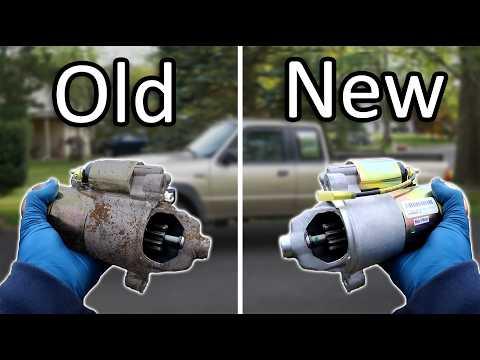
Step 7: Compare old and new starters
- Set the old starter and new starter side by side on the ground.
- Check:
- Mounting holes are in the same positions.
- Electrical terminals are in the same locations and sizes.
- Gear size and position match.
- If anything is different, do not install it.
Step 8: Install the new starter
- Lift the new starter into position at the bellhousing opening.
- Align the starter nose with the opening and the bolt holes with the threaded holes in the transmission/engine.
- Install the mounting bolts by hand first to avoid cross-threading.
- Once all bolts are finger-tight, use a 15mm socket and 1/2" ratchet to snug them evenly.
- Then use a 1/2" torque wrench with the 15mm socket to tighten the starter mounting bolts to 48 Nm (35 ft-lbs).
- Tighten each bolt gradually to keep the starter flat.
Step 9: Reconnect the starter wiring
- Lightly clean the eyelet of the large battery cable with the battery terminal brush if corroded.
- Place the large cable eyelet onto the large stud on the new starter.
- Install the nut and tighten it with a 13mm deep socket and 3/8" torque wrench to 15 Nm (11 ft-lbs). Do not overtighten; you can damage the stud.
- Apply a small amount of dielectric grease to the small control connector pins.
- Push the small control connector back onto the starter until it clicks.
Step 10: Reinstall the lower engine splash shield
- Lift the splash shield back into place under the engine.
- Install any bolts first using an 8mm socket and 3/8" ratchet; snug them but do not overtighten.
- Reinstall the plastic push-pin clips using your fingers or trim removal tool to press them fully seated.
Step 11: Lower the vehicle
- Position the floor jack under the same front jacking point and raise the vehicle slightly to take weight off the jack stands.
- Remove the jack stands from both sides.
- Slowly lower the vehicle to the ground with the jack.
- Remove the wheel chocks from behind the rear wheels.
Step 12: Reconnect the battery
- At the battery, inspect the terminals; clean them with the battery terminal brush if needed.
- Place the negative (-) cable back on the negative battery post.
- Use a 10mm socket and 3/8" ratchet to tighten the clamp just enough so it does not move by hand.
- Spray a light coat of battery terminal protector spray on the terminals to reduce future corrosion.
✅ After Repair
- Start the Escape and listen for normal cranking: it should be quick and smooth with no grinding, whining, or clicking.
- If the starter just clicks or does nothing, recheck the battery connection and both starter connections.
- Check under the vehicle for any loose parts or hanging wiring before driving.
- Take a short test drive, then shut off and restart the engine several times to confirm consistent operation.
- Most radio and settings should remain; if any clock or presets reset, adjust them through the infotainment menus as needed.
💰 DIY vs Shop Cost
Shop Cost: $550–$800 (parts + labor)
DIY Cost: $220–$380 (parts only)
You Save: $330–$420 by doing it yourself!
Shop labor rates vary but typically run $100–$150/hour. This repair takes a shop approximately 2–3 hours.
🎯 Ready to get started?
HowToo makes it easy: same-day/2-day shipping on every part, plus all the tools and specialty tools you need! Check out the parts and tools sections above to add everything to your cart.
Guide for Starter Motor replace for these Ford vehicles
| Year Make Model | Sub Model | Engine | Body Style |
|---|---|---|---|
| 2023 Ford Escape | - | Inline 3 1.5L | - |
| 2022 Ford Escape | - | Inline 3 1.5L | - |
| 2021 Ford Escape | - | Inline 3 1.5L | - |
| 2020 Ford Escape | - | Inline 3 1.5L | - |