









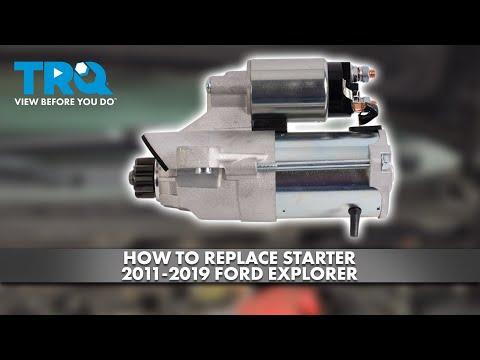






How to Replace the Starter Motor on a 2019 Ford Explorer 3.5L EcoBoost
Step-by-step DIY starter replacement with tools, parts list, torque specs, safety tips, and cost savings breakdown
How to Replace the Starter Motor on a 2019 Ford Explorer 3.5L EcoBoost
Step-by-step DIY starter replacement with tools, parts list, torque specs, safety tips, and cost savings breakdown


🔧 Explorer - Starter Motor Replacement
To replace the starter on your Explorer, you’ll disconnect the battery, remove some intake and splash shield parts, then unbolt and swap the starter from the transmission bellhousing. This job is tight but very doable at home with patience, good lighting, and safe vehicle support.
Difficulty Level: Intermediate | Estimated Time: 2–4 hours
⚠️ Safety & Precautions
- ⚠️ Always disconnect the negative battery cable before working on the starter to avoid sparks or short circuits.
- ⚠️ Support the Explorer with jack stands under the frame/subframe; never work under a vehicle supported only by a jack.
- ⚠️ Let the exhaust cool completely before you start; the starter is near the exhaust and can be very hot.
- ⚠️ Keep the key fob away from the vehicle so it cannot accidentally be turned on while you work.
- ⚠️ Wear safety glasses; dirt and rust can fall when you’re working underneath.
🔧 Required Tools
You'll need the following tools for this repair:
- 🛠️ Floor jack (rated 3-ton minimum)
- 🛠️ Jack stands (rated 3-ton minimum, Qty: 2)
- 🛠️ Wheel chocks
- 🛠️ 1/4" drive ratchet
- 🛠️ 3/8" drive ratchet
- 🛠️ 3/8" drive torque wrench (5–80 ft-lbs range)
- 🛠️ 1/2" drive torque wrench (50–200 ft-lbs range)
- 🛠️ 8mm socket
- 🛠️ 10mm socket
- 🛠️ 13mm socket
- 🛠️ 15mm socket
- 🛠️ 18mm socket
- 🛠️ E8 external Torx socket
- 🛠️ 3" extension (3/8" drive)
- 🛠️ 6" extension (3/8" drive)
- 🛠️ Universal joint adapter (3/8" drive)
- 🛠️ Flat-blade screwdriver (medium)
- 🛠️ Trim clip removal tool
- 🛠️ Needle-nose pliers
- 🛠️ Battery terminal brush or small wire brush
- 🛠️ Flashlight or work light
- 🛠️ Mechanic’s gloves
- 🛠️ Safety glasses
🔩 Required Parts
HowToo sells all the parts you need for this repair:
- 🔩 Starter motor (3.5L EcoBoost, AWD) - Qty: 1
- 🔩 Starter motor mounting bolts (if not reusing) - Qty: 2–3
- 🔩 Battery terminal anti-corrosion pads - Qty: 1 set
- 🔩 Dielectric grease - Qty: 1 small tube
- 🔩 Plastic splash shield push clips - Qty: 4–6
- 🔩 Fender liner clips (RH front, if damaged) - Qty: 4–6
- 🔩 Brake cleaner spray - Qty: 1 can
- 🔩 Shop towels or rags - Qty: 1 pack
📋 Before You Begin
- Park the Explorer on level ground, shift to P, and set the parking brake.
- Place wheel chocks behind the rear wheels to prevent movement.
- Open the hood and make sure you have good lighting in the engine bay and under the vehicle.
- Have your radio presets or settings handy; disconnecting the battery may reset some preferences.
- Make sure you have your key and any anti-theft codes if required for accessories.
🔨 Step-by-Step Instructions
Follow these steps in order:
Step 1: Disconnect the battery
- Open the hood and locate the battery on the passenger side of the engine bay.
- Use an 8mm socket and 1/4" drive ratchet to loosen the negative (black) battery terminal clamp.
- Twist and lift the negative cable off the post and tuck it aside so it cannot spring back.
- Repeat with the positive (red) terminal if you want extra safety, using the same 8mm socket.
- Always remove negative cable first, reconnect last.
Step 2: Raise and support the front of the Explorer
- Place the floor jack under the front subframe or center jacking point (behind the front crossmember).
- Lift the front of the Explorer high enough to work comfortably underneath.
- Set jack stands under the left and right frame rails/subframe and slowly lower the vehicle onto them.
- Leave the floor jack just touching the frame as a backup, but do not rely on it alone.
Step 3: Remove the right front wheel and inner fender splash access
- Use an 18mm socket and 1/2" drive ratchet to slightly loosen the right front wheel lug nuts while the tire is just touching the ground.
- Raise the vehicle as in Step 2 if not already done, then fully remove the lug nuts with the 18mm socket and remove the wheel.
- Use a trim clip removal tool to remove plastic clips holding the right front inner fender splash shield near the rear of the wheel well.
- Use a 10mm socket to remove any small bolts securing the splash shield.
- Pull back or remove the rear portion of the right front fender liner/splash shield to create access toward the back of the engine and transmission area.
Step 4: Remove lower engine splash shield (if equipped)
- Under the front of the Explorer, locate the plastic lower engine splash shield.
- Use a 10mm socket and 3/8" drive ratchet to remove the bolts along the front and sides.
- Use the trim clip removal tool to pop out any push clips holding the shield.
- Lower the shield and set it aside.
Step 5: Remove air intake ducting on top (for access/visibility)
- From above, locate the air intake tube from the air box to the throttle body.
- Use an 8mm socket or flat-blade screwdriver to loosen the hose clamps at each end.
- Unclip any electrical connectors or hoses attached to the intake tube using your fingers or needle-nose pliers if stiff.
- Lift out the intake tube and set aside. This gives more room and light down the back of the engine.
Step 6: Locate the starter motor
- The starter on your Explorer is mounted to the transmission bellhousing on the engine’s rear side, generally near the passenger side.
- From under the vehicle, look up between the engine and transmission near the right side; from the wheel well, look inwards behind the engine.
- You’ll see a cylindrical motor with a smaller solenoid on top and thick battery cables attached.
- Take a picture of wiring before removal.
Step 7: Remove starter heat shield (if equipped)
- If your starter has a metal shield around it, use a 10mm socket and 3/8" drive ratchet to remove the small bolts securing the heat shield.
- Carefully slide the heat shield away and set aside.
Step 8: Disconnect electrical connections from starter
- Locate the large power cable attached to the starter solenoid post with a nut.
- Use a 13mm socket and 3/8" drive ratchet (with extension or universal joint adapter if needed) to remove the nut.
- Pull the cable eyelet off the stud and tuck the cable out of the way.
- Locate the small electrical connector (starter signal wire) and release its tab by hand or with a flat-blade screwdriver, then pull the plug straight off.
- Do not pull on wires; grab connectors only.
Step 9: Remove starter mounting bolts
- Most 3.5L EcoBoost setups use two main mounting bolts from the transmission side.
- Use a 15mm socket with 3/8" drive ratchet, plus extensions and a universal joint adapter as needed, to reach and loosen the starter mounting bolts.
- Support the body of the starter with one hand while you remove the last bolt so it doesn’t drop.
- Once both bolts are out, carefully wiggle and pull the starter away from the bellhousing.
- If there is a small support bracket held with an E8 external Torx socket, remove that bolt first, then the main bolts.
Step 10: Remove the old starter from the vehicle
- Note the orientation of the starter (angle and solenoid position) for installing the new one.
- Carefully guide the old starter out through the bottom or wheel well opening, whichever is easier based on access.
- Rotate starter slightly to clear obstacles.
Step 11: Prepare the new starter
- Compare the new starter to the old one: same mounting holes, same electrical stud size, and same connector location.
- Lightly clean the cable eyelet ends with a wire brush or battery terminal brush so they are shiny metal.
- Apply a very thin film of dielectric grease to the electrical stud area and connector seal (not on contact surfaces themselves).
Step 12: Install the new starter
- Position the new starter into the bellhousing opening in the same orientation as the old one.
- Hand-thread the starter mounting bolts using your fingers to avoid cross-threading.
- Once finger-tight, use a 15mm socket and 3/8" drive ratchet to snug them evenly.
- Then torque the starter mounting bolts to 47 Nm (35 ft-lbs) using a 3/8" drive torque wrench.
- If there is a support bracket with an E8 external Torx socket bolt, install and torque it to 23 Nm (17 ft-lbs).
Step 13: Reconnect electrical connections to the starter
- Push the small starter signal connector back into place until it clicks.
- Install the main power cable eyelet onto the starter solenoid stud.
- Thread the nut by hand, then tighten using a 13mm socket and 3/8" drive torque wrench to 14 Nm (10 ft-lbs).
- Ensure the cable is routed so it is not rubbing on sharp edges or touching the exhaust.
Step 14: Reinstall starter heat shield (if equipped)
- Place the heat shield back over the starter.
- Install the small bolts with a 10mm socket and snug them; torque to about 8 Nm (71 in-lbs).
Step 15: Reinstall splash shields and wheel
- Reinstall the lower engine splash shield using the 10mm socket for bolts and push new clips in with your hands where needed.
- Reposition the right front inner fender splash shield and secure it with its 10mm bolts and plastic clips using the trim clip removal tool to press them in fully.
- Reinstall the right front wheel and hand-thread the lug nuts.
- Lower the Explorer off the jack stands using the floor jack.
- With the vehicle on the ground, torque the wheel lug nuts in a star pattern to 183 Nm (135 ft-lbs) using an 18mm socket and 1/2" drive torque wrench.
Step 16: Reinstall air intake ducting
- Place the air intake tube back between the air box and throttle body.
- Reconnect any hoses or electrical connectors that were removed.
- Tighten the hose clamps using an 8mm socket or flat-blade screwdriver until snug.
Step 17: Reconnect the battery
- Clean the battery posts lightly with a battery terminal brush if corroded.
- Install anti-corrosion pads on the battery posts if you have them.
- Reconnect the positive (red) terminal first and tighten with an 8mm socket to about 7 Nm (62 in-lbs) (snug, not crushed).
- Reconnect the negative (black) terminal and tighten to the same torque with the 8mm socket.
✅ After Repair
- Remove all tools and rags from the engine bay and under the vehicle.
- Sit in the driver’s seat with the transmission in P and foot on the brake.
- Turn the key or push the start button. The engine should crank strongly and start quickly.
- Listen for any unusual grinding or whining noises from the starter area.
- Check that there are no warning lights staying on related to charging or starting.
- Re-enter radio presets or clock settings if they were reset.
- After a short drive, recheck under the vehicle visually to ensure no loose parts or hanging shields.
💰 DIY vs Shop Cost
Shop Cost: $550–$850 (parts + labor)
DIY Cost: $180–$350 (starter + small supplies)
You Save: $370–$500 by doing it yourself!
Shop labor rates vary but typically run $100–$150/hour. This repair takes a shop approximately 2–3 hours.
🎯 Ready to get started?
HowToo makes it easy: same-day/2-day shipping on every part, plus all the tools and specialty tools you need! Check out the parts and tools sections above to add everything to your cart.