















How to Replace the Starter Motor on a 2018 Nissan Frontier (Step-by-Step Guide)
Tools, parts list, wiring tips, and torque specs for a safe DIY starter replacement for 2005, 2006, 2007, 2008, 2009, 2010, 2011, 2012, 2013, 2014, 2015, 2016, 2017, 2018, 2019
How to Replace the Starter Motor on a 2018 Nissan Frontier (Step-by-Step Guide)
Tools, parts list, wiring tips, and torque specs for a safe DIY starter replacement for 2005, 2006, 2007, 2008, 2009, 2010, 2011, 2012, 2013, 2014, 2015, 2016, 2017, 2018, 2019


🔧 Frontier - Starter Motor Replacement
The starter motor cranks your Frontier’s engine when you turn the key. If it’s failing, you may hear a single click, slow cranking, or nothing at all even with a good battery. Replacing it is mostly an under-truck job with basic hand tools.
Difficulty Level: Intermediate | Estimated Time: 1.0-2.0 hours
⚠️ Safety & Precautions
- 🛑 Disconnect the battery negative cable before touching starter wiring (prevents short circuits).
- 🛑 Support the truck on jack stands; never rely on a floor jack alone.
- 🛑 Let the exhaust cool; the starter sits near hot components.
- 🛑 Keep tools off the starter B+ terminal; it’s direct battery power.
🔧 Required Tools
You'll need the following tools for this repair:
- Safety glasses
- Mechanic gloves
- Floor jack (rated 3-ton minimum)
- Jack stands (rated 3-ton minimum)
- Wheel chocks
- 3/8" drive ratchet
- 3/8" drive torque wrench (10–100 ft-lbs range)
- 6" extension (3/8" drive)
- 12" extension (3/8" drive)
- Universal joint adapter (3/8" drive)
- 10mm socket (3/8" drive)
- 12mm socket (3/8" drive)
- 14mm socket (3/8" drive)
- 10mm wrench
- 12mm wrench
- Flat-blade screwdriver
- Flashlight
🔩 Required Parts
HowToo sells all the parts you need for this repair:
- Starter motor - Qty: 1
- Starter electrical terminal nut kit - Qty: 1
- Dielectric grease - Qty: 1
📋 Before You Begin
- 🧰 Park on level ground, shift to Park, and chock the rear wheels.
- 🧰 Open the hood and make sure you have your radio presets noted if you care about them.
- 🧰 Plan your access: the starter is mounted at the rear of the engine on the passenger side of the transmission bellhousing.
🔨 Step-by-Step Instructions
Follow these steps in order:
Step 1: Disconnect the battery
- Use a 10mm wrench to loosen the negative (-) battery terminal and remove it.
- Move the cable aside so it can’t spring back onto the post.
- Torque to 5.4 Nm (48 in-lbs) when reinstalling the battery terminal clamp.
Step 2: Raise and support your Frontier
- Use a floor jack (rated 3-ton minimum) to lift the front of the truck at the approved front jacking point.
- Set it down securely on jack stands (rated 3-ton minimum) and give the truck a firm shake test.
Step 3: Remove the front skid plate (if equipped)
- Use a 12mm socket and 3/8" drive ratchet to remove the skid plate bolts.
- Lower the skid plate and set it aside.
- Torque to 34 Nm (25 ft-lbs) when reinstalling skid plate bolts.
- Keep one hand supporting the plate.
Step 4: Locate the starter motor
- From underneath, use a flashlight and look at the passenger side rear of the engine where it meets the transmission.
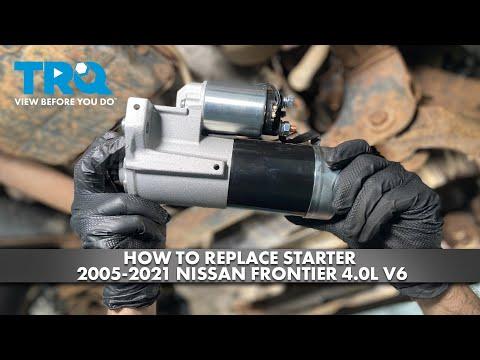
- You’ll see the starter body (cylindrical) and the smaller solenoid with two electrical connections.
Step 5: Disconnect the starter wiring
- Unclip or peel back any protective boot on the large battery cable at the starter.
- Use a 12mm socket (or 12mm wrench if space is tight) to remove the nut from the large B+ terminal cable.
- Torque to 9.8 Nm (87 in-lbs) when reinstalling the B+ terminal nut.
- Remove the small solenoid signal wire connector:
- If it’s a push-on connector, pull it straight off (use a flat-blade screwdriver gently if stuck).
- If it’s a small nut, use a 10mm socket to remove it.
- Torque to 4.9 Nm (43 in-lbs) if your connection uses a small terminal nut.
Step 6: Remove the starter mounting bolts
- Support the starter with one hand.
- Use a 14mm socket, 3/8" drive ratchet, and a 6" extension (3/8" drive) to remove the two starter mounting bolts.
- If access is tight, add a universal joint adapter (3/8" drive) and 12" extension (3/8" drive).
- Pull the starter straight out from the bellhousing.
Step 7: Install the new starter
- Compare the new starter to the old one (same mounting ears and electrical studs).
- Position the starter into the bellhousing opening and start both mounting bolts by hand to avoid cross-threading.
- Use a 14mm socket to tighten the bolts evenly.
- Torque to 44 Nm (32 ft-lbs) for the starter mounting bolts.
Step 8: Reconnect the starter wiring
- Apply a thin smear of dielectric grease to the connector seals (not the stud threads).
- Reconnect the small solenoid signal wire (push-on or nut style).
- Reconnect the large battery cable to the B+ stud and install the nut.
- Use a 12mm socket to tighten the B+ nut: Torque to 9.8 Nm (87 in-lbs).
- Reinstall the protective boot over the B+ terminal.
Step 9: Reinstall skid plate (if removed) and lower the truck
- Lift the skid plate into place and start bolts by hand.
- Use a 12mm socket to tighten bolts: Torque to 34 Nm (25 ft-lbs).
- Use the floor jack (rated 3-ton minimum) to lift slightly, remove jack stands (rated 3-ton minimum), then lower the truck.
Step 10: Reconnect the battery and test
- Reconnect the negative (-) battery cable using a 10mm wrench.
- Torque to 5.4 Nm (48 in-lbs).
- Start your Frontier and confirm strong, normal cranking.
✅ After Repair
- 🧪 Start the engine 3–5 times to confirm consistent cranking.
- 🧪 Check that the starter wiring boot is fully covering the B+ terminal.
- 🧪 Verify no warning lights appear and no burning smell (wire routing issue) is present.
- 🧪 If you hear grinding, stop and re-check starter seating and bolts.
💰 DIY vs Shop Cost
Shop Cost: $450-$900 (parts + labor)
DIY Cost: $140-$350 (parts only)
You Save: $310-$550 by doing it yourself!
Shop labor rates vary but typically run $100-$150/hour. This repair takes a shop approximately 1.0-1.5 hours.
🎯 Ready to get started?
HowToo makes it easy: same-day/2-day shipping on every part, plus all the tools and specialty tools you need! Check out the parts and tools sections below to add everything to your cart.