









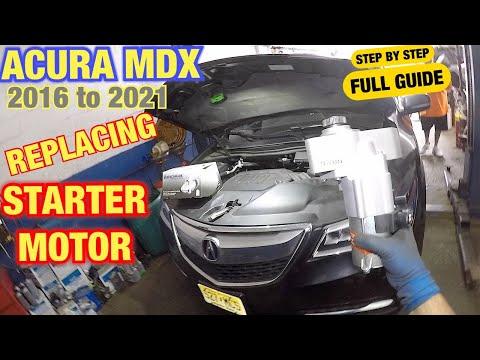





How to Replace the Starter Motor on a 2018 Acura MDX (Intake Manifold Removal Guide)
Step-by-step instructions with required tools/parts, safety tips, and key torque specs for reinstall
How to Replace the Starter Motor on a 2018 Acura MDX (Intake Manifold Removal Guide)
Step-by-step instructions with required tools/parts, safety tips, and key torque specs for reinstall


🔧 MDX - Starter Motor Replacement
On your MDX, the starter sits in the “V” of the engine under the intake manifold, so you’ll remove the intake manifold to access it. The job is very doable at home, but it has a lot of connectors and hoses—go slow and label things so reassembly is stress-free.
Difficulty Level: Advanced | Estimated Time: 3-6 hours
⚠️ Safety & Precautions
- ⚠️ Disconnect the negative battery cable first to prevent a short at the starter power cable.
- ⚠️ Work on a cool engine; the rear cylinder head area gets very hot.
- ⚠️ Keep dirt out of the intake ports—stuff clean rags in the ports as soon as the manifold is off.
- ⚠️ Do not pry on plastic connectors; use the release tabs to avoid breaking them.
🔧 Required Tools
You'll need the following tools for this repair:
- Safety glasses
- Nitrile gloves
- 10mm socket
- 12mm socket
- 14mm socket
- 8mm socket
- 3/8" ratchet
- 3/8" torque wrench (10–80 Nm range)
- 6" extension (3/8")
- 12" extension (3/8")
- Universal joint adapter (3/8")
- Phillips screwdriver
- Flathead screwdriver
- Needle-nose pliers
- Hose clamp pliers
- Trim clip removal tool
- Magnetic pickup tool
- Shop light
- Masking tape and marker
- Clean shop rags
🔩 Required Parts
HowToo sells all the parts you need for this repair:
- Starter motor - Qty: 1
- Intake manifold gasket set - Qty: 1
- Throttle body gasket - Qty: 1
- Dielectric grease - Qty: 1
📋 Before You Begin
- 🅿️ Park on level ground, shift to Park, and set the parking brake.
- 🏷️ Use masking tape and a marker to label vacuum hoses and electrical connectors as you remove them.
- 🔋 Disconnect the battery: use a 10mm socket to remove the negative (–) terminal first, and tuck it aside so it can’t spring back.
- 🧼 Clean around the intake area with a dry rag so loose dirt doesn’t fall into the engine.
🔨 Step-by-Step Instructions
Follow these steps in order:
Step 1: Remove the engine cover and air intake duct
- Pull up to remove the plastic engine cover (it’s held by grommets).
- Use an 8mm socket or flathead screwdriver to loosen the intake tube clamps.
- Disconnect any small breather hoses using needle-nose pliers, then remove the intake duct.
Step 2: Disconnect the throttle body connectors and nearby vacuum hoses
- Unplug the throttle body electrical connector by pressing the lock tab with your fingers (don’t pull on wires).
- Label and disconnect any vacuum/PCV hoses using hose clamp pliers or needle-nose pliers.
- Take a quick photo before unplugging.
Step 3: Remove the intake manifold (upper) to access the starter
- Remove any brackets or wire looms attached to the manifold using a 10mm socket.
- Remove the intake manifold fasteners using a 12mm socket with a 6" extension (3/8").
- Lift the intake manifold straight up and out. If it feels stuck, gently rock it—do not pry on sealing surfaces.
- Immediately place clean shop rags into the intake ports to block debris from falling in.
Step 4: Disconnect the starter electrical connections
- Locate the starter in the engine valley.
- Unplug the small starter solenoid connector by pressing the tab (use a flathead screwdriver only if needed).
- Remove the rubber boot from the main starter cable.
- Remove the main cable nut using a 12mm socket, then move the cable aside.
Step 5: Remove the starter mounting bolts and remove the starter
- Remove the starter mounting bolts using a 14mm socket, 12" extension (3/8"), and a universal joint adapter (3/8") as needed.
- Lift the starter out carefully—watch for wiring and hoses.
- Use a magnetic pickup for dropped bolts.
Step 6: Install the new starter
- Set the new starter into place by hand, making sure it sits flat against the mounting surface.
- Start both mounting bolts by hand to avoid cross-threading.
- Tighten the mounting bolts using a 14mm socket and torque wrench: Torque to 44 Nm (32 ft-lbs).
- Reconnect the main power cable and tighten with a 12mm socket: Torque to 12 Nm (9 ft-lbs).
- Apply a thin dab of dielectric grease to the small connector seal, then reconnect the solenoid plug until it clicks.
Step 7: Replace intake gaskets and reinstall the intake manifold
- Remove the old intake manifold gaskets and install the new ones (make sure they’re fully seated in their grooves).
- Remove the rags from the intake ports.
- Set the intake manifold back in place.
- Install fasteners finger-tight first, then tighten with a 12mm socket in an even pattern: Torque to 22 Nm (16 ft-lbs).
Step 8: Reinstall ducts, hoses, and connectors
- Reconnect all vacuum/PCV hoses using hose clamp pliers or needle-nose pliers.
- Reconnect the throttle body electrical connector and any other connectors you labeled.
- Reinstall the air intake duct and tighten clamps using an 8mm socket or flathead screwdriver.
- Reinstall the engine cover by pressing it down onto the grommets.
Step 9: Reconnect the battery
- Reconnect the negative battery terminal using a 10mm socket and tighten snugly.
✅ After Repair
- 🔍 Do a final visual check: no tools in the engine bay, no unplugged connectors, and all hoses clamped.
- 🔑 Start the engine and listen: cranking should be strong and smooth.
- 🧪 If the idle is rough after battery disconnect, perform an idle relearn: warm the engine fully, turn all electrical loads off, then let it idle undisturbed for about 5 minutes.
- 🚦 Test drive and re-check for warning lights and any intake air leaks (hissing sound).
💰 DIY vs Shop Cost
Shop Cost: $900-$1,600 (parts + labor)
DIY Cost: $220-$450 (parts only)
You Save: $680-$1,150 by doing it yourself!
Shop labor rates vary but typically run $100-$150/hour. This repair takes a shop approximately 3-5 hours.
🎯 Ready to get started?
HowToo makes it easy: same-day/2-day shipping on every part, plus all the tools and specialty tools you need! Check out the parts and tools sections below to add everything to your cart.