









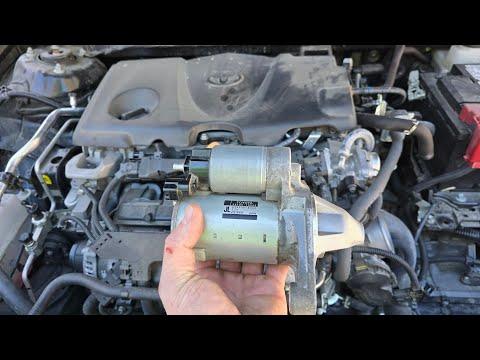





How to Replace the Starter Motor on a 2018-2024 Toyota Camry 2.5L (Engine: Inline 4 2.5L)
Step-by-step DIY starter replacement with tools, parts list, torque specs, safety tips, and cost savings
How to Replace the Starter Motor on a 2018-2024 Toyota Camry 2.5L (Engine: Inline 4 2.5L)
Step-by-step DIY starter replacement with tools, parts list, torque specs, safety tips, and cost savings for 2018, 2019, 2020, 2021, 2022, 2023, 2024


🔧 Camry - Starter Motor Replacement
You’ll remove the old starter motor (it cranks the engine) and install a new one on your Camry. This involves disconnecting the battery, removing a few covers and the air box, then unbolting the starter from the transmission.
Difficulty Level: Intermediate | Estimated Time: 2–3 hours
⚠️ Safety & Precautions
- ⚠️ Disconnect the negative battery terminal before touching the starter. This prevents sparks and accidental cranking.
- ⚠️ You’ll be working both under the hood and under the car. Always use a proper floor jack and solid jack stands; never rely on the jack alone.
- ⚠️ Let the engine cool completely before starting; the exhaust and engine can stay very hot.
- ⚠️ Keep metal tools away from the battery positive terminal once the negative cable is removed.
- ⚠️ Wear safety glasses and gloves to protect from falling dirt, sharp edges, and accidental slips.
🔧 Required Tools
You'll need the following tools for this repair:
- 🔹10mm socket
- 🔹12mm socket
- 🔹14mm socket
- 🔹3/8" drive ratchet
- 🔹3/8" drive torque wrench (5–80 ft-lbs range)
- 🔹3/8" drive socket extension (6")
- 🔹Flathead screwdriver (medium)
- 🔹Trim clip removal tool
- 🔹Needle-nose pliers
- 🔹Floor jack (rated 3-ton minimum)
- 🔹Jack stands (rated 3-ton minimum)
- 🔹Wheel chocks
- 🔹Work light or LED lamp
- 🔹Mechanic’s gloves
- 🔹Safety glasses
- 🔹Battery terminal brush
- 🔹Small wire brush
🔩 Required Parts
HowToo sells all the parts you need for this repair:
- 🔹Starter motor assembly (2.5L engine, automatic) - Qty: 1
- 🔹Starter mounting bolts - Qty: 2 (optional but recommended if corroded)
- 🔹Battery terminal anti-corrosion spray - Qty: 1
- 🔹Dielectric grease - Qty: 1 small tube
- 🔹Plastic push clips for engine under cover - Qty: 4–6 (in case originals break)
📋 Before You Begin
- Park the Camry on level ground, shift to PARK, and set the parking brake.
- Chock the rear wheels so the car cannot roll.
- Open the hood and make sure you have enough light to see clearly.
- Locate the battery on the left side of the engine bay as you face the car.
🔨 Step-by-Step Instructions
Follow these steps in order:
Step 1: Disconnect the battery
- Use the 10mm socket and ratchet to loosen the nut on the negative (black “-”) battery terminal.
- Pull the negative cable off the battery post and tuck it aside so it cannot spring back.
- Torque on reassembly: tighten terminal nut to 5 N·m (4 ft-lbs)—just snug, do not crush it.
- Always remove negative cable first, reconnect it last.
Step 2: Raise the front of the car
- Place wheel chocks behind both rear tires.
- Use the floor jack under the front center jacking point (under the subframe crossmember) and lift until the front wheels are off the ground.
- Slide jack stands under the reinforced pinch welds or subframe points on both sides and slowly lower the car onto the stands.
- Give the car a firm shake to confirm it is stable.
Step 3: Remove the engine under cover (splash shield)
- Crawl under the front of the Camry with your work light.
- Use the trim clip removal tool to pop out the plastic push clips holding the under cover.
- Use the 10mm socket and ratchet to remove any small bolts around the edges.
- Lower the under cover and set it aside.
- Keep all clips and bolts in a tray to avoid losing them.
Step 4: Remove the air intake duct and air filter box (for access)
- Under the hood, locate the plastic air duct from the front grille to the air box on the driver side.
- Use the 10mm socket to remove any bolts securing the duct, then lift it out.
- Unclip the air filter box top latches by hand, and disconnect the mass airflow sensor connector by pressing the tab and pulling straight out.
- Use a flathead screwdriver to loosen the hose clamp at the throttle body.
- Lift the top of the air box and intake hose off, then lift out the lower air box section if it blocks access (it is usually held by rubber grommets—pull straight up).
- The starter sits near the front of the transmission, now more visible.
Step 5: Locate the starter motor
- From above, look down between the engine and the transmission bellhousing on the front side of the engine bay.
- The starter is a cylindrical metal unit bolted to the transmission housing, with a thick battery cable and a smaller plug/connector attached.
- Confirm you can see the electrical connections and at least one of the mounting bolts.
Step 6: Disconnect the starter electrical connections
- From above (or below if access is better), use the 12mm socket and ratchet to remove the nut holding the thick battery cable to the starter terminal.
- Pull the cable eyelet off the stud and set it aside.
- Use the flathead screwdriver or your fingers to release the tab on the smaller electrical connector (solenoid connector), then pull it straight off.
- Do not twist hard on plastic connector; it can crack.
Step 7: Remove the starter mounting bolts
- Locate the two main starter mounting bolts where the starter meets the transmission housing.
- Use the 14mm socket, extension, and ratchet to loosen and remove the upper and lower mounting bolts.
- Support the starter with one hand while removing the last bolt so it doesn’t drop.
- Once both bolts are removed, carefully pull the starter straight out from the transmission.
- Factory torque on reassembly: starter mounting bolts to 39 N·m (29 ft-lbs).
Step 8: Compare old and new starters
- Place the old and new starters side by side on a clean surface.
- Check that the mounting holes, electrical stud location, and connector shape all match.
- Lightly clean the mating surface on the transmission housing with a small wire brush so the new starter sits flat.
Step 9: Install the new starter motor
- Position the new starter in place, aligning the gear end into the opening on the transmission.
- Hand-thread the upper and lower mounting bolts to avoid cross-threading.
- Use the 14mm socket and ratchet to snug both bolts evenly.
- Then use the torque wrench with the 14mm socket to tighten both starter mounting bolts to 39 N·m (29 ft-lbs).
Step 10: Reconnect the starter wiring
- Push the small electrical connector (solenoid connector) onto its terminal until it clicks.
- Slide the thick battery cable eyelet back onto the starter stud.
- Install the nut and tighten it with the 12mm socket and ratchet until snug.
- Torque: starter terminal nut to about 9 N·m (7 ft-lbs)—just snug enough so it does not move.
- Apply a small dab of dielectric grease over the exposed terminal if available.
Step 11: Reinstall the air box and intake duct
- Set the lower air box back into position, pressing it down into its rubber grommets.
- Install the air filter if removed, then place the upper air box and intake hose back on.
- Use the flathead screwdriver to tighten the hose clamp at the throttle body.
- Reconnect the mass airflow sensor connector until it clicks.
- Reinstall the front air duct and secure it with any 10mm bolts you removed.
Step 12: Reinstall the engine under cover
- From under the car, lift the engine under cover back into place.
- Install the 10mm bolts by hand, then snug them with the 10mm socket and ratchet (do not overtighten; they are small).
- Press the plastic clips back into their holes; replace any broken ones with new clips.
Step 13: Lower the car and reconnect the battery
- Use the floor jack to lift the front slightly, remove the jack stands, then lower the car to the ground.
- At the battery, use the battery terminal brush to clean the negative terminal and clamp if needed.
- Place the negative cable back on the negative battery post.
- Use the 10mm socket and torque wrench to tighten the clamp nut to 5 N·m (4 ft-lbs)—snug, not crushing.
- Spray battery terminal anti-corrosion spray on the terminals if you have it.
✅ After Repair
- Turn the key or push the start button to start your Camry. It should crank smoothly and start quickly without grinding or clicking.
- Listen for any unusual noises near the starter area, such as grinding or loud whirring; if heard, shut off the engine and recheck mounting and wiring.
- Make sure the “Check Engine” and other warning lights behave as normal; they should go off after the engine starts.
- Take a short drive and restart the engine several times to confirm consistent operation.
💰 DIY vs Shop Cost
Shop Cost: $600–$900 (parts + labor)
DIY Cost: $200–$350 (parts only)
You Save: $400–$550 by doing it yourself!
Shop labor rates typically run $100–$150/hour. This repair takes a shop about 1.5–2.0 hours.
🎯 Ready to get started?
HowToo makes it easy: same-day/2-day shipping on every part, plus all the tools and specialty tools you need! Check out the parts and tools sections above to add everything to your cart.
Guide for Starter Motor replace for these Toyota vehicles
| Year Make Model | Sub Model | Engine | Body Style |
|---|---|---|---|
| 2024 Toyota Camry | - | Inline 4 2.5L | - |
| 2023 Toyota Camry | - | Inline 4 2.5L | - |
| 2022 Toyota Camry | - | Inline 4 2.5L | - |
| 2021 Toyota Camry | - | Inline 4 2.5L | - |
| 2020 Toyota Camry | - | Inline 4 2.5L | - |
| 2019 Toyota Camry | - | Inline 4 2.5L | - |
| 2018 Toyota Camry | - | Inline 4 2.5L | - |