









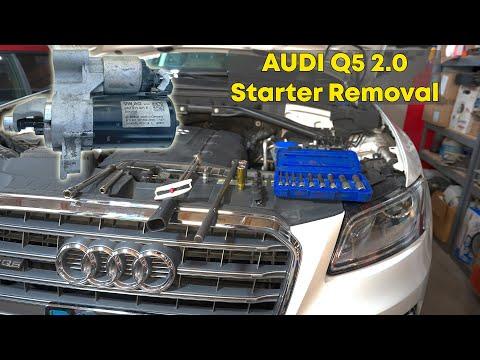







How to Replace the Starter Motor on a 2018-2022 Audi Q5 (Step-by-Step DIY Guide) (Engine: Inline 4 2.0L)
Tools, parts list, safety tips, and torque specs for removing and installing the starter motor
How to Replace the Starter Motor on a 2018-2022 Audi Q5 (Step-by-Step DIY Guide) (Engine: Inline 4 2.0L)
Tools, parts list, safety tips, and torque specs for removing and installing the starter motor for 2018, 2019, 2020, 2021, 2022


🔧 Q5 - Starter Motor Replacement
The starter motor cranks your engine when you press the start button. If it’s failing, you’ll often get a slow crank, a single click, or no crank even with a good battery.
Difficulty Level: Advanced | Estimated Time: 2.5-4.5 hours
⚠️ Safety & Precautions
- ⚠️ Disconnect the 12V battery before touching the starter wiring (high-current cable).
- ⚠️ Let the engine cool; the turbo/exhaust area can burn you.
- ⚠️ Support your Q5 with jack stands on solid, level ground—never rely on a jack.
- ⚠️ Keep the key fob away from the vehicle so it can’t “wake up” modules while you work.
🔧 Required Tools
You'll need the following tools for this repair:
- Floor jack (rated 3-ton minimum)
- Jack stands (rated 3-ton minimum)
- Wheel chocks
- Safety glasses
- Mechanic gloves
- 10mm socket
- 13mm socket
- 16mm socket
- Torx T25 bit
- Torx T30 bit
- External Torx E12 socket
- External Torx E14 socket
- 3/8" ratchet
- 3/8" torque wrench (10–100 Nm range)
- 6" extension (3/8" drive)
- 12" extension (3/8" drive)
- Universal joint (3/8" drive)
- Flat trim tool
- Pick tool
- Work light
🔩 Required Parts
HowToo sells all the parts you need for this repair:
- Starter motor - Qty: 1
- Starter mounting bolts (single-use) - Qty: 2
- Intake/charge pipe clamp(s) - Qty: 1-2
📋 Before You Begin
- Park on level ground, turn ignition off, and remove the key fob from the vehicle.
- Open the tailgate and leave a window cracked (battery disconnect can lock you out).
- Record radio presets/seat memory if you care about them.
- Disconnect the 12V battery negative terminal using a 10mm socket.
🔨 Step-by-Step Instructions
Follow these steps in order:
Step 1: Disconnect the battery
- In the rear cargo area, access the battery and loosen the negative terminal using a 10mm socket.
- Move the cable aside so it can’t spring back and touch the post.
- Tip: Wrap the terminal with a glove.
Step 2: Raise the vehicle and remove the lower cover
- Chock the rear wheels using wheel chocks.
- Lift the front using a floor jack (rated 3-ton minimum) and support with jack stands (rated 3-ton minimum).
- Remove the engine undertray bolts using a Torx T25 bit and Torx T30 bit, then pull the undertray down and out using a flat trim tool.
Step 3: Create access to the starter area
- From underneath, locate the starter on the transmission bellhousing area.
- If a small heat shield blocks access, remove its fasteners using a Torx T30 bit and 10mm socket.
- Use a work light so you can clearly see the wiring and bolts.
Step 4: Disconnect starter electrical connections
- Remove the protective cap on the large battery cable (B+) using a pick tool.
- Remove the B+ cable nut using a 13mm socket, then lift the cable off and position it safely aside.
- Unplug the small starter solenoid connector by releasing the lock tab using a pick tool (this is the small “signal” plug).
- Tip: Don’t pull on the wire—pull the connector.
Step 5: Remove the starter mounting bolts
- Support the starter with one hand.
- Remove the two starter mounting bolts using an External Torx E14 socket on a 3/8" ratchet with a 12" extension (3/8" drive) and universal joint (3/8" drive) as needed.
- Carefully slide the starter out of the bellhousing and down.
Step 6: Install the new starter
- Compare the new starter to the old one (connector positions and mounting ears should match).
- Position the starter into the bellhousing and start both new bolts by hand to prevent cross-threading.
- Tighten the starter mounting bolts using an External Torx E14 socket and then a 3/8" torque wrench (10–100 Nm range): Torque to 60 Nm (44 ft-lbs).
Step 7: Reconnect the starter wiring
- Install the large B+ cable onto the starter stud and tighten using a 13mm socket: Torque to 15 Nm (11 ft-lbs).
- Reinstall the protective cap over the B+ terminal.
- Plug in the solenoid connector until it clicks (use a work light to confirm it’s fully seated).
Step 8: Reinstall shields/undertray and lower the vehicle
- Reinstall any removed heat shields using a Torx T30 bit and 10mm socket.
- Reinstall the undertray using a Torx T25 bit and Torx T30 bit.
- Lower the vehicle safely using the floor jack (rated 3-ton minimum) and remove the jack stands (rated 3-ton minimum).
Step 9: Reconnect the battery and function check
- Reconnect the negative battery terminal using a 10mm socket: Torque to 6 Nm (53 in-lbs).
- Start the engine and confirm it cranks strongly with no clicking.
✅ After Repair
- Verify there are no warning messages after the first start.
- Confirm the undertray is secure and nothing is touching the driveshaft or exhaust.
- Reset the clock and one-touch window operation if needed (hold the window switch up for a few seconds after it fully closes).
- If you still get a no-crank, check battery condition and starter signal connector seating.
💰 DIY vs Shop Cost
Shop Cost: ₹25,000-₹55,000 (parts + labor)
DIY Cost: ₹12,000-₹30,000 (parts only)
You Save: ₹13,000-₹25,000 by doing it yourself!
Shop labor rates vary but typically run ₹1,000-₹2,500/hour. This repair takes a shop approximately 2.5-4.0 hours.
🎯 Ready to get started?
HowToo makes it easy: same-day/2-day shipping on every part, plus all the tools and specialty tools you need! Check out the parts and tools sections below to add everything to your cart.
Guide for Starter Motor replace for these Audi vehicles
| Year Make Model | Sub Model | Engine | Body Style |
|---|---|---|---|
| 2022 Audi Q5 | - | Inline 4 2.0L | - |
| 2021 Audi Q5 | - | Inline 4 2.0L | - |
| 2020 Audi Q5 | - | Inline 4 2.0L | - |
| 2019 Audi Q5 | - | Inline 4 2.0L | - |
| 2018 Audi Q5 | - | Inline 4 2.0L | - |