









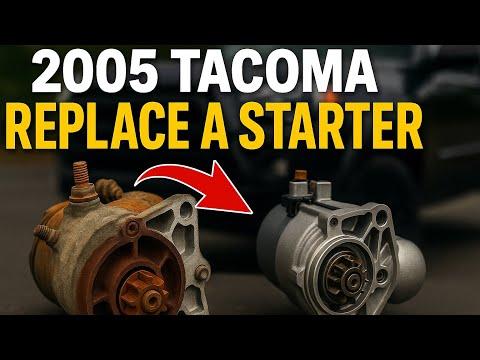





How to Replace the Starter Motor on a 2017 Toyota Tacoma 3.5L V6
Step-by-step DIY starter replacement with tools, parts list, torque specs, safety tips, and cost savings for 2016, 2017, 2018, 2019, 2020, 2021, 2022, 2023
How to Replace the Starter Motor on a 2017 Toyota Tacoma 3.5L V6
Step-by-step DIY starter replacement with tools, parts list, torque specs, safety tips, and cost savings for 2016, 2017, 2018, 2019, 2020, 2021, 2022, 2023


🔧 Tacoma - Starter Motor Replacement
You’ll be removing the old starter from the side of the engine, near the transmission, and installing a new one. This involves disconnecting the battery, removing the skid plate, unbolting the starter, and swapping it with the replacement part.
Difficulty Level: Intermediate | Estimated Time: 2–3 hours
⚠️ Safety & Precautions
- 🔹Always disconnect the negative battery cable before working on the starter; you are working directly on the main power cable from the battery.
- 🔹Support the truck securely with jack stands; never rely on a floor jack alone.
- 🔹Allow the exhaust and engine to cool completely before working underneath.
- 🔹Wear safety glasses; dirt and rust may fall while removing the skid plate and starter.
- 🔹Keep the ignition key out of the vehicle while the starter is disconnected.
🔧 Required Tools
You'll need the following tools for this repair:
- 🔹10mm socket
- 🔹12mm socket
- 🔹14mm socket
- 🔹3/8" drive ratchet
- 🔹3/8" drive socket extension (3–6")
- 🔹1/2" drive ratchet
- 🔹1/2" drive torque wrench (10–100 ft-lbs range)
- 🔹Flathead screwdriver (medium)
- 🔹Needle-nose pliers
- 🔹Floor jack (rated 3-ton minimum)
- 🔹Jack stands (rated 3-ton minimum, Qty: 2)
- 🔹Wheel chocks
- 🔹Work light or flashlight
- 🔹Mechanic’s gloves
- 🔹Safety glasses
- 🔹Fender cover or towel
🔩 Required Parts
HowToo sells all the parts you need for this repair:
- 🔹Starter motor assembly (3.5L V6, 4WD, manual) - Qty: 1
- 🔹Starter mounting bolts - Qty: 2 (recommended new)
- 🔹Battery terminal cleaning brush - Qty: 1
- 🔹Dielectric grease - Qty: 1
- 🔹Replacement skid plate bolts/clips - Qty: As needed
📋 Before You Begin
- Park your Tacoma on level ground, set the parking brake, and place the transmission in gear.
- Chock the rear wheels so the truck cannot roll.
- Open the hood and make sure you have your radio codes or settings backed up if needed.
- Let the engine and exhaust cool for at least 30–45 minutes if recently driven.
🔨 Step-by-Step Instructions
Follow these steps in order:
Step 1: Disconnect the battery
- Open the hood and locate the battery on the driver’s side.
- Use a 10mm socket and 3/8" ratchet to loosen the nut on the negative (black, “-”) battery terminal.
- Lift the cable off the terminal and tuck it aside so it cannot accidentally touch the battery post.
- Always remove negative terminal first
Step 2: Raise and support the front of the truck
- Place wheel chocks behind the rear tires.
- Use the floor jack under the front crossmember to lift the front of your Tacoma.
- Place jack stands under the frame rails on both sides and slowly lower the truck onto them.
- Give the truck a firm shake to confirm it is stable before going underneath.
Step 3: Remove the front skid plate
- Position your work light under the front of the truck.
- Use a 12mm socket and 3/8" ratchet to remove the bolts securing the front skid plate to the frame.
- Support the plate with one hand as you remove the last bolts so it does not fall.
- Lower the skid plate and set it aside.
- Note bolt locations for easier reassembly
Step 4: Locate the starter
- Crawl under from the passenger side and look where the engine meets the transmission.
- The starter is a cylindrical motor bolted to the transmission bellhousing on the passenger side, with a thick cable attached.
- Use your work light to clearly see the wiring and bolts.
Step 5: Disconnect the starter wiring
- On the starter, you’ll see:
- A large cable held by a nut (battery cable).
- A smaller plug or push-on connector (signal wire).
- Use a flathead screwdriver to gently release any plastic clip or locking tab on the smaller connector, then pull it off by hand. Do not pull on the wire itself.
- Use a 12mm socket and 3/8" ratchet to remove the nut holding the large cable to the starter stud.
- Pull the cable eyelet off the stud and set it aside where it will not touch metal.
- Note the order of any washers on the stud
Step 6: Remove the starter mounting bolts
- The starter is held to the transmission by two bolts from the bellhousing side.
- Use a 14mm socket, 3/8" extension, and 3/8" ratchet to loosen the lower starter bolt first.
- Remove the lower bolt completely and set it aside.
- Use the same 14mm socket and extension to remove the upper starter bolt. You may need to feel for it by hand.
- Support the starter body with one hand as you remove the last few turns of the upper bolt so it doesn’t drop.
Step 7: Remove the starter from the truck
- Once both bolts are out, carefully pull the starter straight back away from the transmission.
- You may need to slightly twist or angle the starter to clear nearby components.
- Lower it out of the engine bay and compare it to the new starter to ensure the mounting points and electrical connections are identical.
- Match old and new parts before installing
Step 8: Install the new starter
- Position the new starter in place, aligning the nose into the opening in the transmission bellhousing.
- Start the upper bolt by hand through the transmission into the starter housing. Do not tighten yet.
- Start the lower bolt by hand. Make sure both bolts thread easily; if not, back them out and realign the starter.
- Use a 14mm socket and 3/8" ratchet to snug both bolts evenly.
- Then use the 1/2" drive torque wrench with the 14mm socket to tighten both bolts to 53 Nm (39 ft-lbs).
- Hand-start bolts to avoid cross-threading
Step 9: Reconnect the starter wiring
- Lightly clean the large cable eyelet with the battery terminal cleaning brush if it looks dirty or corroded.
- Slide the cable eyelet over the large stud on the starter.
- Install the nut on the stud by hand, then use a 12mm socket and 3/8" ratchet to snug it. Do not overtighten.
- If you have a small torque wrench that reads inch-pounds, tighten the nut to about 6 Nm (53 in-lbs). If not, just snug plus a small additional turn.
- Apply a very small amount of dielectric grease to the small electrical connector terminals if available.
- Push the small connector back onto the starter terminal until it clicks or feels firmly seated.
Step 10: Reinstall the skid plate
- Lift the skid plate back into position under the front of the truck.
- Start all bolts by hand to ensure proper alignment.
- Use a 12mm socket and 3/8" ratchet to tighten the skid plate bolts securely. Typical torque is around 29 Nm (21 ft-lbs).
Step 11: Lower the truck
- Use the floor jack to raise the front of the truck slightly and remove the jack stands.
- Slowly lower the truck back onto the ground.
- Remove the wheel chocks.
Step 12: Reconnect the battery
- At the battery, place the negative cable back onto the negative terminal.
- Use a 10mm socket and 3/8" ratchet to tighten the clamp nut until snug. Do not overtighten.
- Optionally apply a light coat of dielectric grease around the battery terminal to help prevent corrosion.
✅ After Repair
- Turn the ignition key to “ON” and wait a few seconds, then turn to “START” and verify the engine cranks quickly and smoothly.
- Listen for any unusual grinding or whining noises from the starter area.
- Check under the truck to ensure you did not leave any tools or loose hardware.
- After a short drive, recheck the skid plate bolts to make sure they are still tight.
💰 DIY vs Shop Cost
Shop Cost: $550–$850 (parts + labor)
DIY Cost: $180–$350 (parts only)
You Save: $370–$500 by doing it yourself!
Shop labor rates vary but typically run $100–$150/hour. This repair takes a shop approximately 2–3 hours.
🎯 Ready to get started?
HowToo makes it easy: same-day/2-day shipping on every part, plus all the tools and specialty tools you need! Check out the parts and tools sections above to add everything to your cart.