












How to Replace the Starter Motor on a 2017-2022 Toyota Highlander 3.5L V6
Step-by-step DIY guide with tools, parts, torque specs, safety tips, and cost savings for 2017, 2018, 2019, 2020, 2021, 2022
How to Replace the Starter Motor on a 2017-2022 Toyota Highlander 3.5L V6
Step-by-step DIY guide with tools, parts, torque specs, safety tips, and cost savings for 2017, 2018, 2019, 2020, 2021, 2022


🔧 Highlander - Starter Motor Replacement
Replacing the starter motor on your Highlander means removing the failed starter from the lower front area of the 3.5L V6 engine and installing a new one. The starter uses high-current battery power, so the battery must be disconnected before touching the starter wiring.
Difficulty Level: Intermediate | Estimated Time: 2-4 hours
⚠️ Safety & Precautions
- ⚠️ Disconnect the negative battery cable first to prevent sparks or accidental cranking.
- ⚠️ Let the engine cool fully before working near the exhaust and lower engine area.
- ⚠️ Support your Highlander with jack stands only; never rely on a floor jack by itself.
- ⚠️ The starter power cable is always capable of carrying heavy current when the battery is connected.
- ⚠️ Keep metal tools away from the positive battery terminal and starter main terminal.
🔧 Required Tools
You'll need the following tools for this repair:
- 10mm wrench
- 10mm socket
- 12mm socket
- 14mm socket
- 17mm socket
- 3/8-inch ratchet
- 1/2-inch ratchet
- 3/8-inch extension set
- 1/2-inch extension set
- Torque wrench 10-100 ft-lbs
- Flat trim clip remover
- Small flathead screwdriver
- Needle-nose pliers
- Floor jack rated 3-ton minimum
- Jack stands rated 3-ton minimum
- Wheel chocks
- Work gloves
- Safety glasses
- Shop light
🔩 Required Parts
HowToo sells all the parts you need for this repair:
- Starter motor - Qty: 1
- Starter mounting bolts - Qty: 2, if corroded or damaged
- Battery terminal anti-corrosion protectant - Qty: 1
📋 Before You Begin
- Park your Highlander on level ground, shift to Park, and set the parking brake.
- Place wheel chocks behind the rear wheels before lifting the front.
- Open the hood and let the engine cool completely.
- A starter motor is the electric motor that turns the engine over when you press the start button or turn the key.
- A jack stand is a fixed support that safely holds the vehicle after it is lifted with a floor jack.
- Disconnect the negative battery cable before working on the starter wiring.
🔨 Step-by-Step Instructions
Follow these steps in order:
Step 1: Disconnect the Battery
- Use a 10mm wrench to loosen the nut on the negative battery cable clamp.
- Lift the negative cable off the battery post and move it aside so it cannot spring back.
- Wait at least 2 minutes before continuing.
- Negative cable comes off first.
Step 2: Lift and Support the Front
- Use wheel chocks behind the rear wheels.
- Use a floor jack rated 3-ton minimum at the front center jacking point to raise the front of your Highlander.
- Place jack stands rated 3-ton minimum under the approved front support points.
- Lower the vehicle gently onto the jack stands using the floor jack.
- Lightly shake the vehicle by hand to confirm it is stable before getting underneath.
Step 3: Remove the Lower Engine Covers
- Put on safety glasses before working under the vehicle.
- Use a 10mm socket and 3/8-inch ratchet to remove the lower splash shield bolts.
- Use a flat trim clip remover to remove the plastic push clips.
- A push clip is a reusable plastic fastener with a center pin that locks it in place.
- Set the shield and fasteners aside in order.
- Keep clips organized by location.
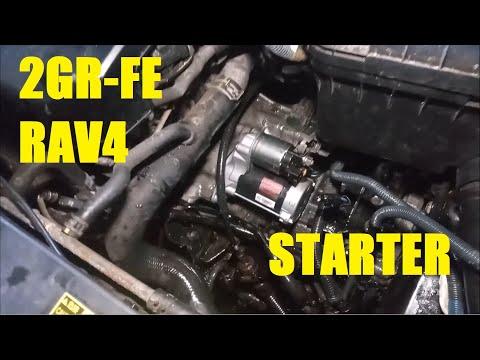
Step 4: Locate the Starter
- Use a shop light to look at the lower front side of the engine where the engine meets the transmission.
- The starter is a small cylindrical electric motor bolted to the transmission bellhousing.
- The bellhousing is the large rounded transmission section attached to the back of the engine.
Step 5: Remove the Starter Electrical Connections
- Use a small flathead screwdriver to release the locking tab on the small starter control connector.
- Pull the small connector straight off by the connector body, not the wires.
- Use a 12mm socket and 3/8-inch ratchet to remove the nut from the large starter power cable terminal.
- Move the large power cable aside and keep it from touching metal parts.
- A terminal is the threaded electrical post where the cable attaches.
Step 6: Remove the Starter Mounting Bolts
- Support the starter with one hand while loosening the bolts.
- Use a 14mm socket, 1/2-inch ratchet, and 1/2-inch extension set to remove the two starter mounting bolts.
- If access is tight, use the 3/8-inch ratchet and 3/8-inch extension set for better control.
- Pull the starter straight away from the transmission.
- Lower it carefully from the engine bay.
- Starters are heavier than they look.
Step 7: Compare the Old and New Starter
- Place both starters on a clean surface.
- Check that the mounting ears, electrical terminals, and nose shape match.
- Use a clean shop rag if needed to wipe the mounting surface on the transmission.
- If the new starter came with protective caps, remove them by hand before installation.
Step 8: Install the New Starter
- Lift the new starter into position by hand.
- Start both mounting bolts by hand first to prevent cross-threading.
- Use a 14mm socket, 1/2-inch ratchet, and 1/2-inch extension set to snug both starter mounting bolts evenly.
- Use a torque wrench 10-100 ft-lbs and 14mm socket to tighten the starter mounting bolts to Torque to 39 Nm (29 ft-lbs).
Step 9: Reconnect the Starter Wiring
- Install the large starter power cable onto the threaded terminal by hand.
- Use a 12mm socket and torque wrench 10-100 ft-lbs to tighten the starter terminal nut to Torque to 9.8 Nm (87 in-lbs).
- Push the small starter control connector on until it clicks.
- Use needle-nose pliers only if needed to guide wiring clips back into place.
- Do not overtighten electrical terminals.
Step 10: Reinstall the Lower Engine Covers
- Position the lower splash shield by hand.
- Use a flat trim clip remover to align the push clip holes if needed.
- Push the plastic clips in by hand until seated.
- Use a 10mm socket and 3/8-inch ratchet to install the splash shield bolts.
- Snug the splash shield bolts only; do not overtighten plastic cover hardware.
Step 11: Lower the Vehicle
- Use the floor jack rated 3-ton minimum to raise the front slightly off the jack stands.
- Remove the jack stands rated 3-ton minimum.
- Lower your Highlander slowly to the ground with the floor jack.
- Remove the wheel chocks after the vehicle is fully on the ground.
Step 12: Reconnect the Battery
- Place the negative battery cable back onto the negative battery post.
- Use a 10mm wrench to tighten the negative battery cable nut snugly.
- Apply battery terminal anti-corrosion protectant if the terminal is clean and dry.
- Do not overtighten the battery clamp; it only needs to be secure and not rotate by hand.
✅ After Repair
- Start your Highlander and listen for a normal, strong crank.
- If you hear a single click or no crank, recheck the battery terminals and starter cable connections.
- Confirm the battery warning light turns off after the engine starts.
- Check underneath for loose shields, hanging wires, or anything near the exhaust.
- Power windows or idle behavior may need a short relearn after battery disconnect; drive normally for a few minutes.
💰 DIY vs Shop Cost
Shop Cost: $650-$1,050 (parts + labor)
DIY Cost: $220-$450 (parts only)
You Save: $300-$700 by doing it yourself!
Shop labor rates vary but typically run $100-$150/hour. This repair takes a shop approximately 2-3 hours.
🎯 Ready to get started?
HowToo makes it easy: same-day/2-day shipping on every part, plus all the tools and specialty tools you need! Check out the parts and tools sections below to add everything to your cart.