









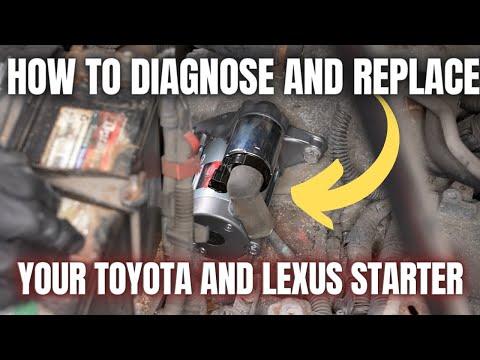







How to Replace the Starter Motor on a 2016 Lexus IS200t (Step-by-Step Guide)
Tools, parts, safety tips, wiring steps, and torque specs for a successful starter install for 2016, 2017
How to Replace the Starter Motor on a 2016 Lexus IS200t (Step-by-Step Guide)
Tools, parts, safety tips, wiring steps, and torque specs for a successful starter install for 2016, 2017


🔧 IS - Starter Motor Replacement
The starter motor spins the engine to begin combustion. On your IS, it’s mounted to the transmission bellhousing and can usually be reached from the top after removing the intake/air ducting for access.
Assumption: Stock intake layout; access is from the top with minor intake component removal. Some fastener locations can vary slightly by production date.
Difficulty Level: Intermediate | Estimated Time: 2-4 hours
⚠️ Safety & Precautions
- ⚠️ Disconnect the 12V battery before touching the starter wiring (the main cable is always “hot”).
- ⚠️ Let the engine cool fully; the turbo/heat shields can burn you.
- ⚠️ Support the car with jack stands if you go underneath; never rely on a jack alone.
- ⚠️ Keep metal tools away from the starter’s main power terminal.
- ⚠️ Battery disconnect is required for this job.
🔧 Required Tools
You'll need the following tools for this repair:
- Safety glasses
- Mechanic gloves
- Wheel chocks
- Floor jack (rated 3-ton minimum)
- Jack stands (rated 3-ton minimum)
- 10mm socket
- 12mm socket
- 14mm socket
- 3/8" drive ratchet
- 3/8" drive torque wrench
- 6" socket extension
- 12" socket extension
- 3/8" drive wobble extension
- Flathead screwdriver
- Trim clip remover
- Needle-nose pliers
- Pick tool
- Flashlight
- Fender cover
🔩 Required Parts
HowToo sells all the parts you need for this repair:
- Starter motor - Qty: 1
- Intake tube clamp(s) or damaged hose clamp replacements - Qty: 1-2 (as needed)
- Dielectric grease - Qty: 1
- Electrical contact cleaner - Qty: 1 (as needed)
- Zip ties - Qty: 1 pack (as needed)
📋 Before You Begin
- Park on level ground, shift to Park, and set the parking brake.
- Open the hood and install a fender cover to protect paint.
- Disconnect the battery: use a 10mm socket to remove the negative terminal and isolate it so it can’t spring back.
- Photo each connector before unplugging.
🔨 Step-by-Step Instructions
Follow these steps in order:
Step 1: Remove the engine cover and open up access
- Lift off the engine cover (it’s usually press-fit on grommets) using your hands; if tight, gently work it up evenly.
- Use a flashlight to locate the starter area at the rear/side of the engine near the transmission.
Step 2: Remove the air intake ducting/air box (access step)
- Unplug the intake sensor connectors by releasing the lock tab with a pick tool (a small hook used to lift plastic locks without breaking them).
- Loosen intake hose clamps using a flathead screwdriver or 10mm socket (whichever your clamp uses).
- Remove air box fasteners with a 10mm socket, then lift the air box/ducting out carefully.
- Release any plastic push-clips with a trim clip remover.
Step 3: Locate the starter and remove the wiring
- Find the starter motor: it’s a cylindrical motor bolted to the transmission bellhousing.
- Remove the small starter solenoid connector (signal wire) by pressing the tab and pulling it off by hand (use needle-nose pliers gently if needed).
- Remove the rubber boot over the main power terminal.
- Use a 12mm socket to remove the main power nut, then lift the cable off and tuck it aside.
- Do not let the cable touch metal.
Step 4: Remove the starter mounting bolts
- Use a 14mm socket with a 12" socket extension and wobble extension to break loose the starter mounting bolts.
- Remove the upper bolt first, then the lower bolt (keep one hand supporting the starter as the last bolt comes out).
- Lift the starter out of the engine bay. If it’s tight, rotate it slightly to clear hoses/wiring.
Step 5: Install the new starter
- Compare the old and new starter (mounting ears, electrical terminals, overall length).
- Set the new starter into position and hand-thread both mounting bolts to avoid cross-threading.
- Tighten the starter mounting bolts with a 14mm socket, then torque with a torque wrench: Torque to 39 Nm (29 ft-lbs).
Step 6: Reconnect the starter wiring
- Clean the cable ring terminal with electrical contact cleaner if dirty/corroded.
- Install the main power cable and nut using a 12mm socket: Torque to 9 Nm (80 in-lbs).
- Reinstall the rubber boot fully over the terminal.
- Reconnect the small solenoid connector until it clicks.
- Apply a small amount of dielectric grease to connector seals only (not on metal contact faces).
Step 7: Reinstall the intake/air box components
- Reinstall the air box/ducting and fasteners using a 10mm socket.
- Reconnect all intake sensor connectors (push until they click).
- Tighten intake clamps using a 10mm socket or flathead screwdriver (snug, do not strip).
- Reinstall any push-clips using your fingers or trim clip remover.
Step 8: Reconnect the battery
- Reconnect the negative battery terminal using a 10mm socket: Torque to 5 Nm (44 in-lbs).
- Make sure the terminal cannot rotate by hand when finished.
✅ After Repair
- Start the engine and confirm it cranks strongly with no grinding or clicking.
- Check for warning lights; if any appear, recheck every unplugged intake connector first.
- Listen for air hissing (vacuum/boost leak) around intake tubes; tighten clamps if needed.
- Reset the clock and any one-touch window function if it lost memory (hold window switch up for a few seconds after fully closed).
💰 DIY vs Shop Cost
Shop Cost: $700-$1,200 (parts + labor)
DIY Cost: $250-$500 (parts only)
You Save: $450-$700 by doing it yourself!
Shop labor rates vary but typically run $100-$150/hour. This repair takes a shop approximately 2-4 hours.
🎯 Ready to get started?
HowToo makes it easy: same-day/2-day shipping on every part, plus all the tools and specialty tools you need! Check out the parts and tools sections below to add everything to your cart.