









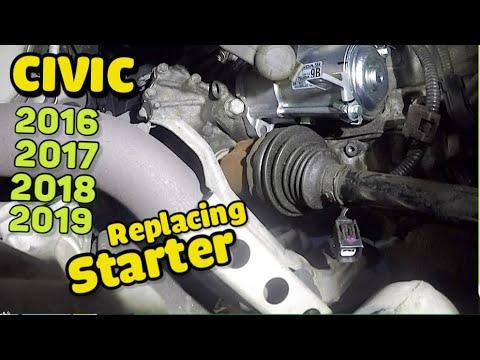







How to Replace the Starter Motor on a 2016-2021 Honda Civic (Step-by-Step Guide) (Engine: Inline 4 2.0L)
Tools, parts list, safety tips, and torque specs for starter wiring and mounting bolts
How to Replace the Starter Motor on a 2016-2021 Honda Civic (Step-by-Step Guide) (Engine: Inline 4 2.0L)
Tools, parts list, safety tips, and torque specs for starter wiring and mounting bolts for 2016, 2017, 2018, 2019, 2020, 2021


🔧 Civic - Starter Motor Replacement
The starter motor spins the engine so it can start. On your Civic, the starter is bolted to the transmission bellhousing and is easiest to reach from the top after moving the air intake parts out of the way.
Difficulty Level: Intermediate | Estimated Time: 1.5-3 hours
Assumption: stock intake/airbox; typical 2.0L starter access from above.
⚠️ Safety & Precautions
- ⚠️ Disconnect the battery negative cable first to prevent a short (the starter cable is always “hot”).
- ⚠️ Let the engine cool; you’ll work near hot parts.
- ⚠️ If you raise the car, support it with jack stands on solid points—never rely on a jack.
- ⚠️ Keep metal tools away from the positive starter terminal unless the battery is disconnected.
🔧 Required Tools
You'll need the following tools for this repair:
- Safety glasses
- Mechanic gloves
- Wheel chocks
- Floor jack (rated 2-ton minimum)
- Jack stands (rated 2-ton minimum)
- 10mm socket
- 12mm socket
- 14mm socket
- 3/8" ratchet
- 3/8" torque wrench (10–80 ft-lbs range)
- 6" extension (3/8")
- 12" extension (3/8")
- Universal joint adapter (3/8")
- Flat trim tool
- Needle-nose pliers
- Work light
🔩 Required Parts
HowToo sells all the parts you need for this repair:
- Starter motor - Qty: 1
- Starter electrical terminal nut (if damaged) - Qty: 1
- Battery terminal protectant (spray) - Qty: 1
📋 Before You Begin
- Park on level ground, shift to Park, and set the parking brake.
- Open the hood and keep your key fob away from the car.
- Disconnect the battery: use a 10mm socket to remove the negative (-) cable first, then isolate it so it can’t spring back.
- Take a quick photo of wiring before removal.
🔨 Step-by-Step Instructions
Follow these steps in order:
Step 1: Create working room at the top of the engine
- Remove the plastic engine cover (if equipped) by pulling up carefully; use a flat trim tool if clips are tight.
- Loosen the intake tube clamp(s) using a flat trim tool or by releasing the clamp hardware (varies by clamp style).
- Unclip/remove the air intake duct/airbox snorkel as needed to open space; use needle-nose pliers for any squeeze clamps.
- More room = fewer scraped knuckles.
Step 2: Locate the starter
- Use a work light and look toward the front side of the engine where it meets the transmission.
- The starter is a small motor with a thicker cable on a stud (battery cable) and a smaller plug/wire (signal wire).
Step 3: Disconnect the starter wiring
- Remove the starter terminal cover/boot (if present) by pulling it back by hand.
- Remove the small signal connector by pressing the lock tab and pulling straight off (don’t yank the wires).
- Remove the main battery cable nut using a 12mm socket, then lift the cable off the stud and tuck it aside.
- Torque spec (reinstall): Torque to 9 Nm (80 in-lbs)
Step 4: Remove the starter mounting bolts
- Support the starter with one hand while removing bolts with the other.
- Use a 14mm socket with a 6" extension (and a universal joint adapter (3/8") if needed) to remove the upper starter bolt.
- Use a 14mm socket with a 12" extension to remove the lower starter bolt.
- Pull the starter straight out from the bellhousing. If it’s stuck, wiggle it gently—don’t pry on aluminum surfaces.
- Torque spec (reinstall): Torque to 44 Nm (33 ft-lbs)
Step 5: Compare parts and transfer any brackets (if needed)
- Set old and new starters side-by-side and confirm the bolt holes and electrical studs match.
- If your starter has a heat shield or small bracket, transfer it using the correct socket (commonly 10mm socket).
Step 6: Install the new starter
- Position the starter into the bellhousing opening by hand until it seats flush.
- Start both mounting bolts by hand first (this prevents cross-threading).
- Tighten the mounting bolts using a 14mm socket and 3/8" ratchet, then finish with a 3/8" torque wrench.
- Torque to 44 Nm (33 ft-lbs)
- Hand-thread first—saves expensive threads.
Step 7: Reconnect the starter wiring
- Install the main battery cable onto the starter stud and thread the nut on by hand.
- Tighten the nut using a 12mm socket.
- Torque to 9 Nm (80 in-lbs)
- Reinstall the terminal boot/cover.
- Plug the small signal connector back in until it clicks.
Step 8: Reinstall intake/air ducting
- Reinstall the intake duct/airbox pieces you removed.
- Secure any clamps and clips fully; use needle-nose pliers for squeeze clamps.
- Double-check nothing is left loose near the radiator fan or belt area.
Step 9: Reconnect the battery
- Reconnect the negative (-) battery cable using a 10mm socket.
- Spray battery terminal protectant if desired.
✅ After Repair
- Start the engine and listen: cranking should be strong and smooth (no clicking, no grinding).
- Check that the intake tube is sealed and not whistling (a loose clamp can cause rough idle).
- If you had a radio preset loss or clock reset, set them back.
- Recheck for any warning lights after a short drive; if one appears, inspect connectors you moved.
💰 DIY vs Shop Cost
Shop Cost: $450-$850 (parts + labor)
DIY Cost: $150-$350 (parts only)
You Save: $300-$500 by doing it yourself!
Shop labor rates vary but typically run $100-$150/hour. This repair takes a shop approximately 1.5-3 hours.
🎯 Ready to get started?
HowToo makes it easy: same-day/2-day shipping on every part, plus all the tools and specialty tools you need! Check out the parts and tools sections below to add everything to your cart.
Guide for Starter Motor replace for these Honda vehicles
| Year Make Model | Sub Model | Engine | Body Style |
|---|---|---|---|
| 2021 Honda Civic | - | Inline 4 2.0L | - |
| 2020 Honda Civic | - | Inline 4 2.0L | - |
| 2019 Honda Civic | - | Inline 4 2.0L | - |
| 2018 Honda Civic | - | Inline 4 2.0L | - |
| 2017 Honda Civic | - | Inline 4 2.0L | - |
| 2016 Honda Civic | - | Inline 4 2.0L | - |