









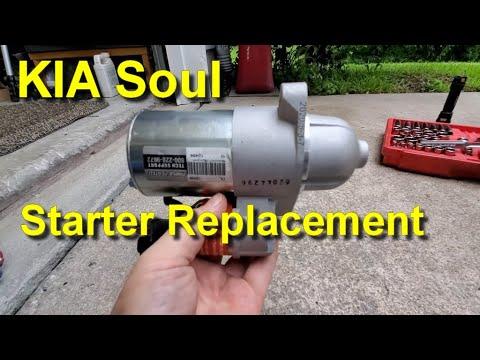







How to Replace the Starter Motor on a 2016-2021 Kia Soul (Step-by-Step Guide) (Engine: Inline 4 2.0L)
Tools, parts list, safety tips, and torque specs to remove and install the starter from underneath
How to Replace the Starter Motor on a 2016-2021 Kia Soul (Step-by-Step Guide) (Engine: Inline 4 2.0L)
Tools, parts list, safety tips, and torque specs to remove and install the starter from underneath for 2016, 2017, 2018, 2019, 2020, 2021


🔧 Soul - Starter Motor Replacement
The starter motor spins your engine to begin running. On your Soul, the starter sits at the transmission side of the engine and is accessed mostly from underneath after removing a small under-cover.
Difficulty Level: Intermediate | Estimated Time: 1.5-3.0 hours
⚠️ Safety & Precautions
- ⚠️ Disconnect the negative battery cable first to prevent an electrical short.
- ⚠️ Support the car on jack stands before working underneath; never rely on a jack.
- ⚠️ Let the exhaust/engine cool down; the starter area can be close to hot parts.
- ⚠️ Keep the key/fob away from the vehicle while working.
🔧 Required Tools
You'll need the following tools for this repair:
- Safety glasses
- Nitrile gloves
- Wheel chocks
- Floor jack (rated 3-ton minimum)
- Jack stands (rated 3-ton minimum)
- 10mm socket
- 12mm socket
- 14mm socket
- 3/8" drive ratchet
- 3/8" drive torque wrench (10–80 ft-lbs range)
- 6" extension (3/8" drive)
- 12" extension (3/8" drive)
- Flat trim clip tool
- Phillips screwdriver #2
- Needle-nose pliers
- Flashlight
🔩 Required Parts
HowToo sells all the parts you need for this repair:
- Starter motor - Qty: 1
- Starter electrical terminal nut kit - Qty: 1
- Under-cover push clips - Qty: 2-6
📋 Before You Begin
- Park on a level surface, shift to Park, and set the parking brake.
- Place wheel chocks behind the rear tires.
- Open the hood and make sure all accessories are OFF.
- Disconnect the battery: use a 10mm socket to remove the negative terminal and tuck it aside so it can’t spring back.
🔨 Step-by-Step Instructions
Follow these steps in order:
Step 1: Raise and support the front of the Soul
- Use a floor jack (rated 3-ton minimum) to lift the front at the center front jacking point.
- Set the car onto jack stands (rated 3-ton minimum) at the proper pinch-weld/support points.
- Give the car a gentle shake to confirm it’s stable. Stable first, tools second.
Step 2: Remove the lower engine cover (under-cover)
- Use a flat trim clip tool to pop out the plastic push-clips.
- Use a Phillips screwdriver #2 to remove any screws (some covers use a mix of clips/screws).
- Lower the cover and set it aside.
Step 3: Locate the starter and label the wires
- Use a flashlight and look up at the transmission/engine meeting point.
- You’ll see the starter body and two electrical connections: the large battery cable (B+) and the small control wire (signal).
- If helpful, take a quick photo before disconnecting anything. Photos prevent mix-ups later.
Step 4: Disconnect the starter electrical connections
- Remove the protective rubber boot from the large starter terminal by hand.
- Use a 12mm socket and 3/8" drive ratchet to remove the nut from the main battery cable (B+) terminal.
- Pull the cable off and move it aside so it can’t touch metal.
- For the small signal wire, use needle-nose pliers to release the connector tab (or pull straight off if it’s a push-on style).
Step 5: Remove the starter mounting bolts
- Use a 14mm socket, 3/8" drive ratchet, and a 6" extension.
- A “extension” is a straight bar that makes your ratchet reach farther into tight spaces.
- Remove the starter mounting bolts (typically 2 bolts). Support the starter with your free hand as the last bolt comes out.
Step 6: Remove the starter from the vehicle
- Wiggle the starter rearward to release it from the mounting surface.
- Angle it carefully and bring it down and out from underneath.
- Compare the old and new starters side-by-side (mounting ears, electrical studs, and nose length).
Step 7: Install the new starter
- Position the new starter into place by hand.
- Start the mounting bolts by hand first to avoid cross-threading.
- Tighten the starter mounting bolts using a 14mm socket and 3/8" drive torque wrench: Torque to 49 Nm (36 ft-lbs).
Step 8: Reconnect the starter wiring
- Install the main battery cable onto the B+ stud and thread the nut on by hand.
- Use a 12mm socket and 3/8" drive torque wrench: Torque to 12 Nm (9 ft-lbs).
- Reconnect the small signal wire until it clicks/fully seats (use needle-nose pliers only to guide it, not force it).
- Reinstall the rubber boot over the main terminal.
Step 9: Reinstall the under-cover and lower the vehicle
- Reinstall the under-cover using the Phillips screwdriver #2 and flat trim clip tool (replace broken clips as needed).
- Raise the car slightly with the floor jack (rated 3-ton minimum), remove the jack stands (rated 3-ton minimum), and lower the car.
Step 10: Reconnect the battery and verify operation
- Reconnect the negative battery terminal using a 10mm socket.
- Make sure tools are clear of the engine bay before starting.
✅ After Repair
- Start the engine and confirm it cranks strongly with no clicking or grinding noises.
- Check that no warning lights appear that weren’t there before.
- Do a quick recheck under the car for any dangling connectors or a loose under-cover.
- If you still have a no-crank, the next checks are battery condition and starter relay/fuse testing.
💰 DIY vs Shop Cost
Shop Cost: $450-$900 (parts + labor)
DIY Cost: $150-$450 (parts only)
You Save: $300-$450 by doing it yourself!
Shop labor rates vary but typically run $100-$150/hour. This repair takes a shop approximately 1.5-3.0 hours.
🎯 Ready to get started?
HowToo makes it easy: same-day/2-day shipping on every part, plus all the tools and specialty tools you need! Check out the parts and tools sections below to add everything to your cart.