















How to Replace the Starter Motor on a 2014 Jeep Grand Cherokee (Step-by-Step)
Tools, parts, safety tips, and installation notes for a successful starter replacement
How to Replace the Starter Motor on a 2014 Jeep Grand Cherokee (Step-by-Step)
Tools, parts, safety tips, and installation notes for a successful starter replacement


🔧 Grand Cherokee - Starter Motor Replacement
The starter motor spins the engine so it can begin running. On your Grand Cherokee EcoDiesel, the starter is mounted where the engine meets the transmission (the “bellhousing,” which is the housing around the transmission/engine connection), so access is usually from underneath.
Difficulty Level: Advanced | Estimated Time: 2-4 hours
⚠️ Safety & Precautions
- ⚠️ Disconnect the negative battery cable before touching the starter wiring (the main cable is always “hot” and can short to ground).
- ⚠️ Let the exhaust cool fully before working underneath.
- ⚠️ Support the SUV with jack stands; never rely on a floor jack alone.
- ⚠️ If equipped with an air suspension, keep the vehicle stable and do not work under it unless securely supported.
- ⚠️ Keep tools away from the battery positive terminal and the starter main stud.
🔧 Required Tools
You'll need the following tools for this repair:
- Safety glasses
- Mechanic gloves
- Wheel chocks
- Floor jack (rated 3-ton minimum)
- Jack stands (rated 3-ton minimum)
- Metric socket set (8mm-18mm)
- 3/8" drive ratchet
- 1/2" drive ratchet
- 3/8" drive extensions (3" and 6")
- 1/2" drive extension (6")
- Universal joint adapter (3/8" drive)
- Metric combination wrench set (8mm-18mm)
- Torque wrench (10-150 ft-lbs)
- Trim clip removal tool
- Flat-blade screwdriver
- Work light
- Paint marker
🔩 Required Parts
HowToo sells all the parts you need for this repair:
- Starter motor assembly - Qty: 1
- Starter electrical terminal nut kit - Qty: 1
- Battery terminal anti-corrosion felt washers - Qty: 1
📋 Before You Begin
- 🅿️ Park on a level surface, shift to Park, and set the parking brake.
- 🧱 Chock the rear wheels using wheel chocks.
- 🔋 Disconnect the battery negative cable using a metric socket (typically 10mm). Tuck it aside so it cannot spring back to the terminal.
- 🧰 If your Grand Cherokee has skid plates, plan to remove the front/center plate(s) for access.
🔨 Step-by-Step Instructions
Follow these steps in order:
Step 1: Raise and support the vehicle
- Use wheel chocks at the rear wheels.
- Use a floor jack (rated 3-ton minimum) at the correct front jack point and lift the front of the SUV.
- Set the vehicle down onto jack stands (rated 3-ton minimum) and gently shake-test for stability.
Step 2: Remove any skid plate(s) blocking access
- Use a work light to locate the skid plate fasteners.
- Remove bolts using a metric socket set and ratchet.
- Set the skid plate and hardware aside in order. Lay bolts out in a pattern.
Step 3: Locate the starter motor
- The starter sits near the rear of the engine on the passenger side, bolted to the transmission bellhousing.
- Use a work light to identify the starter’s large battery cable (thick cable) and the smaller trigger wire connector.
Step 4: Label and disconnect the starter wiring
- Use a paint marker to mark where each wire goes.
- Remove the starter main power cable nut using a metric socket (commonly 13mm) and pull the cable off the stud.
- Disconnect the starter trigger wire (small connector) by releasing the lock tab using a flat-blade screwdriver, then pull straight off.
- Do not pry on the wire itself.
Step 5: Remove the starter mounting bolts
- Support the starter with one hand.
- Remove the starter mounting bolts using a metric socket and ratchet with extensions and a universal joint adapter as needed.
- Carefully lower the starter out. It may be snug—wiggle gently while pulling straight back.
Step 6: Compare parts and transfer any shields/brackets
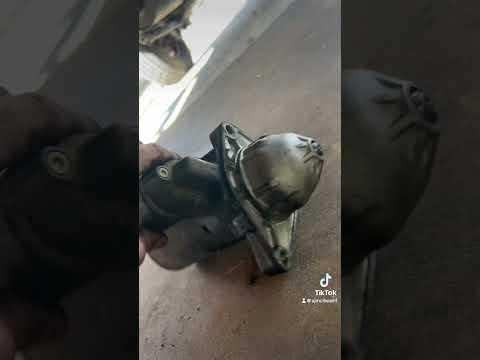
- Set the old and new starter side-by-side and confirm the mounting ears, electrical studs/connectors, and overall length match.
- If your starter has a heat shield or bracket, transfer it using a metric socket or wrench.
Step 7: Install the new starter
- Position the starter into the bellhousing opening by hand.
- Start all mounting bolts by hand first to avoid cross-threading.
- Tighten mounting bolts using a ratchet, then finish with a torque wrench: Torque to factory spec.
Step 8: Reconnect starter wiring
- Install the trigger wire connector until it clicks (verify the lock tab is engaged).
- Install the main battery cable onto the starter stud and tighten the nut using a torque wrench: Torque to factory spec.
- Ensure the cable boot/cover is seated so the stud is not exposed.
Step 9: Reinstall skid plate(s) and lower the vehicle
- Reinstall skid plate(s) using the metric socket set and ratchet.
- Tighten skid plate bolts with a torque wrench: Torque to factory spec.
- Raise slightly with the floor jack, remove jack stands, then lower fully.
Step 10: Reconnect the battery and verify operation
- Reconnect the negative battery cable using a metric socket.
- Tighten the terminal clamp with a torque wrench: Torque to factory spec.
✅ After Repair
- 🔍 Start the engine and confirm the starter engages cleanly (no grinding or slow-crank).
- 🔎 With the engine running, look underneath for any wiring that’s too close to the exhaust or moving parts.
- 🧪 If you see a battery light or charging warning after the repair, recheck battery terminal tightness and the starter main cable connection.
💰 DIY vs Shop Cost
Shop Cost: $650-$1,200 (parts + labor)
DIY Cost: $250-$650 (parts only)
You Save: $400-$550 by doing it yourself!
Shop labor rates vary but typically run $100-$150/hour. This repair takes a shop approximately 2-4 hours.
🎯 Ready to get started?
HowToo makes it easy: same-day/2-day shipping on every part, plus all the tools and specialty tools you need! Check out the parts and tools sections below to add everything to your cart.