









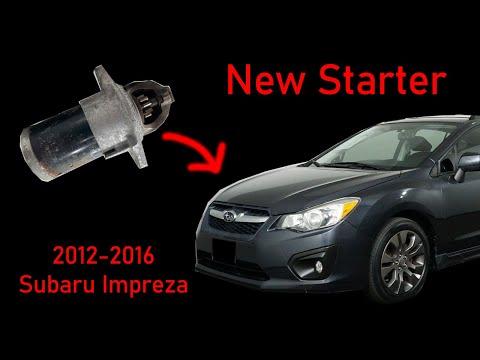






How to Replace the Starter Motor on a 2014-2018 Subaru Forester (Step-by-Step Guide)
Tools, parts list, safety tips, and torque specs for a smooth DIY starter replacement
How to Replace the Starter Motor on a 2014-2018 Subaru Forester (Step-by-Step Guide)
Tools, parts list, safety tips, and torque specs for a smooth DIY starter replacement for 2014, 2015, 2016, 2017, 2018


🔧 Forester - Starter Motor Replacement
The starter motor is what cranks your engine when you turn the key/start button. On your Forester, it sits on top of the transmission bellhousing, and you’ll typically remove the top-mount intercooler to reach it safely and comfortably.
Difficulty Level: Intermediate | Estimated Time: 1.5-3.0 hours
⚠️ Safety & Precautions
- 🛑 Disconnect the battery before touching the starter wiring (the main cable is always “live”).
- 🔥 Let the engine cool fully; the turbo/intercooler area gets very hot.
- 🧤 Wear gloves and safety glasses; you’ll work near sharp clamps and brackets.
- ⚡ Do not let a tool bridge between the starter power terminal and metal parts.
🔧 Required Tools
You'll need the following tools for this repair:
- Safety glasses
- Mechanic gloves
- Wheel chocks
- Fender cover
- 10mm socket
- 12mm socket
- 14mm socket
- 3/8" ratchet
- 3/8" torque wrench (10–80 Nm range)
- 6" extension
- 12" extension
- Flathead screwdriver
- Trim clip tool
- Needle-nose pliers
- Flashlight
- Magnetic pickup tool
🔩 Required Parts
HowToo sells all the parts you need for this repair:
- Starter motor - Qty: 1
- Dielectric grease - Qty: 1
- Anti-seize compound - Qty: 1
📋 Before You Begin
- Park on level ground, shift to Park, and set the parking brake.
- Open the hood and install a fender cover to protect paint.
- Have a small tray ready for bolts and hose clamps.
- Assumption: This procedure matches the common top-mount-intercooler layout on your Forester; torque values listed are typical—verify with a service manual if available.
🔨 Step-by-Step Instructions
Follow these steps in order:
Step 1: Disconnect the battery
- Use a 10mm socket to loosen the negative battery terminal clamp.
- Lift the negative cable off and tuck it aside so it cannot spring back.
- Tip: Wrap the terminal with a glove.
Step 2: Remove the intercooler (for access)
- Use a flathead screwdriver to loosen the hose clamps on the intercooler couplers (inlet/outlet).
- Use a 12mm socket and 3/8" ratchet to remove the intercooler mounting bolts/brackets.
- Use needle-nose pliers to release any small hose clamps (if equipped), then carefully pull the hoses off.
- Wiggle the intercooler up and out. Use a flashlight to confirm no hose is still attached.
- Tip: Cover open pipes with a clean rag.
Step 3: Locate the starter and identify the two connections
- Use a flashlight to find the starter on top of the transmission bellhousing.
- You’ll see:
- The thick battery cable on a stud (held by a nut).
- The small solenoid connector (a small plug that triggers the starter).
- Tip: Take a quick photo before disassembly.
Step 4: Disconnect the starter wiring
- Use a 12mm socket to remove the nut holding the main power cable to the starter.
- Remove the cable and set it aside so it cannot touch metal.
- Unplug the small solenoid connector by pressing the lock tab and pulling straight off (use needle-nose pliers gently if needed).
- Apply a thin dab of dielectric grease to the small connector seal during reassembly (helps prevent corrosion).
Step 5: Remove the starter mounting bolts
- Use a 14mm socket, 3/8" ratchet, and a 6" extension to remove the starter mounting bolts (typically 2 bolts).
- Support the starter with your free hand as the last bolt comes out.
- If a bolt drops, retrieve it with a magnetic pickup tool.
Step 6: Install the new starter
- Compare the old and new starter (same mounting ears, same electrical posts).
- Position the new starter, then hand-thread the mounting bolts to avoid cross-threading.
- Use a 14mm socket to snug the bolts, then use a 3/8" torque wrench: Torque to 39 Nm (29 ft-lbs).
- Apply a tiny amount of anti-seize compound to the bolt threads if desired (keep it off electrical contacts).
Step 7: Reconnect the starter wiring
- Install the main power cable onto the starter stud and start the nut by hand.
- Use a 12mm socket to tighten the nut securely (do not over-tighten the stud).
- Plug the small solenoid connector back in until it clicks.
- Use a flashlight to confirm cables are routed away from hot/rotating parts.
Step 8: Reinstall the intercooler
- Set the intercooler back into place, aligning the couplers.
- Use a 12mm socket to reinstall the intercooler mounting bolts/brackets.
- Use a flathead screwdriver to tighten the hose clamps.
- Double-check every clamp is tight; a loose clamp can cause a boost leak and poor performance.
Step 9: Reconnect the battery
- Install the negative terminal back onto the battery post.
- Use a 10mm socket to tighten the clamp until it won’t rotate by hand.
✅ After Repair
- Turn the ignition ON and verify no warning lights related to disconnected sensors/hoses (some lights may clear after a few drive cycles if no issue remains).
- Start the engine: it should crank strongly with no clicking or slow cranking.
- Listen for air hissing near the intercooler couplers (indicates a loose clamp).
- Take a short test drive and confirm normal power (no boost leak symptoms like sluggish acceleration).
💰 DIY vs Shop Cost
Shop Cost: ₹18,000-₹35,000 (parts + labor)
DIY Cost: ₹10,000-₹22,000 (parts only)
You Save: ₹8,000-₹13,000 by doing it yourself!
Shop labor rates in Panipat vary, but often run ₹800-₹1,500/hour. This repair takes a shop approximately 1.5-3.0 hours.
🎯 Ready to get started?
HowToo makes it easy: same-day/2-day shipping on every part, plus all the tools and specialty tools you need! Check out the parts and tools sections below to add everything to your cart.
Guide for Starter Motor replace for these Subaru vehicles
| Year Make Model | Sub Model | Engine | Body Style |
|---|---|---|---|
| 2018 Subaru Forester | - | - | - |
| 2017 Subaru Forester | - | - | - |
| 2016 Subaru Forester | - | - | - |
| 2015 Subaru Forester | - | - | - |
| 2014 Subaru Forester | - | - | - |