









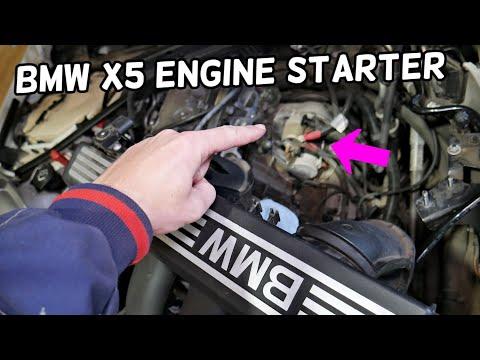







How to Replace the Starter Motor on a 2014-2018 BMW X5 (Intake Manifold Removal Guide) (Trim: sDrive35i | Engine: Inline 6 3.0L)
Step-by-step instructions with required tools, parts list, wiring tips, and key torque specs
How to Replace the Starter Motor on a 2014-2018 BMW X5 (Intake Manifold Removal Guide) (Trim: sDrive35i | Engine: Inline 6 3.0L)
Step-by-step instructions with required tools, parts list, wiring tips, and key torque specs for 2014, 2015, 2016, 2017, 2018


🔧 X5 - Starter Motor Replacement
On your X5, the starter motor is bolted to the transmission bellhousing and cranks the engine when you press the Start button. When it fails, you’ll usually get a slow/no crank, a single click, or intermittent starting.
Difficulty Level: Advanced | Estimated Time: 4-7 hours
Assumption: N55 layout—starter access requires intake manifold removal.
⚠️ Safety & Precautions
- 🛑 Disconnect the battery negative terminal before touching the starter cables (the main cable is always “hot”).
- 🔥 Let the engine cool fully; you’ll work near the turbo/charge piping.
- ⛽ Avoid sparks/open flames; you’ll be near fuel/EVAP lines while removing the intake.
- 🧤 Wear safety glasses and gloves; falling debris is common under the intake.
- 🧠 Label connectors/hoses as you unplug them to prevent misrouting.
🔧 Required Tools
You'll need the following tools for this repair:
- Safety glasses
- Nitrile gloves
- Floor jack (rated 3-ton minimum)
- Jack stands (rated 3-ton minimum)
- Wheel chocks
- 3/8" drive ratchet
- 1/4" drive ratchet
- 3/8" torque wrench (10–100 Nm range)
- 1/4" torque wrench (2–25 Nm range)
- Socket set 8mm, 10mm, 11mm, 13mm, 16mm
- E-Torx socket set E10, E12, E14
- Torx bit set T20, T25, T30
- Pick tool (small hook pick)
- Trim removal tool set (plastic)
- Flat-blade screwdriver (medium)
- Magnetic pickup tool
- Flashlight
- Shop towels
- Painters tape and marker
🔩 Required Parts
HowToo sells all the parts you need for this repair:
- Starter motor - Qty: 1
- Intake manifold gasket set - Qty: 1
- Throttle body gasket - Qty: 1
- Starter mounting bolts - Qty: 2
- Dielectric grease - Qty: 1
📋 Before You Begin
- Park on level ground, set the parking brake, and chock the rear wheels.
- Open the rear cargo area and access the battery compartment.
- Disconnect the battery negative terminal using a 10mm socket; isolate the cable so it can’t spring back.
- Use painters tape and marker to label every connector and hose you remove.
🔨 Step-by-Step Instructions
Follow these steps in order:
Step 1: Remove the engine cover and intake ducting
- Pull the engine cover upward to release the rubber grommets (no tools).
- Remove intake duct clamps using a flat-blade screwdriver or 8mm socket (varies by clamp style).
- Unplug any sensors in the ducting using a trim removal tool set (plastic) to lift locking tabs gently.
Step 2: Remove the charge pipe at the throttle body
- Loosen the clamp at the throttle body using an 8mm socket.
- Release the charge pipe locking clip with a pick tool (small hook pick).
- Pull the charge pipe off and move it aside; cover openings with shop towels. Keep dirt out of the intake.
Step 3: Remove the throttle body
- Unplug the throttle body connector by lifting the lock with a trim removal tool set (plastic).
- Remove throttle body bolts using a Torx T30 (or 10mm socket depending on fasteners).
- Remove the throttle body and old gasket; set aside.
- On reassembly: Torque to 10 Nm (7 ft-lbs).
Step 4: Disconnect intake manifold connections
- Disconnect vacuum lines/PCV lines using a pick tool (small hook pick) to help release clips (don’t pry hard).
- Unplug sensors/actuators along the manifold using a trim removal tool set (plastic).
- Disconnect the EVAP line quick-connector by pressing the tabs (use shop towels under it).
- Unbolt any support brackets using a 13mm socket and/or E10/E12 E-Torx socket as equipped.
Step 5: Remove the intake manifold
- Remove intake manifold fasteners using an E10 E-Torx socket (most common on this engine).
- Lift the manifold straight off; check for any hidden connectors/hoses still attached.
- Remove old intake manifold gaskets from the manifold.
- Cover the intake ports in the cylinder head with shop towels.
- On reassembly: Torque intake manifold fasteners to 15 Nm (11 ft-lbs).
Step 6: Access the starter motor and disconnect wiring
- Locate the starter near the bellhousing under the intake area; use a flashlight.
- Remove the starter power cable nut using a 13mm socket; move the cable aside.
- Unplug the small starter trigger connector by releasing the lock with a pick tool (small hook pick).
- Double-check battery is disconnected.
Step 7: Remove the starter mounting bolts and starter
- Remove the two starter mounting bolts using an E14 E-Torx socket (commonly E14; some setups use E12).
- Support the starter with one hand while removing the last bolt.
- Remove the starter from the bellhousing.
- On installation: install new bolts and Torque to 45 Nm (33 ft-lbs).
Step 8: Install the new starter and reconnect wiring
- Position the new starter and hand-start both mounting bolts to avoid cross-threading.
- Tighten with an E14 E-Torx socket and finish with a 3/8" torque wrench: Torque to 45 Nm (33 ft-lbs).
- Reconnect the trigger connector until it clicks.
- Reinstall the main power cable and nut using a 13mm socket: Torque to 12 Nm (9 ft-lbs).
- Apply a small amount of dielectric grease to connector seals only (not on threads).
Step 9: Reinstall the intake manifold with new gaskets
- Install new intake manifold gaskets into the manifold grooves (they should sit flat).
- Remove the shop towels from the intake ports.
- Set the manifold in place, start all fasteners by hand, then tighten using an E10 E-Torx socket.
- Final tighten with a 3/8" torque wrench: Torque to 15 Nm (11 ft-lbs).
- Reconnect all vacuum/EVAP lines and electrical connectors (match your labels).
Step 10: Reinstall throttle body and charge pipe
- Install a new throttle body gasket, reinstall throttle body bolts using a Torx T30: Torque to 10 Nm (7 ft-lbs).
- Reconnect the throttle body connector.
- Reinstall the charge pipe, lock the clip using a pick tool (small hook pick), and tighten the clamp using an 8mm socket.
Step 11: Reconnect the battery
- Reconnect the battery negative terminal using a 10mm socket.
- Snug the terminal securely (do not over-tighten): Torque to 5 Nm (44 in-lbs).
✅ After Repair
- Cycle ignition ON (do not start) for 10 seconds, then OFF, twice. This helps electronics “wake up” after battery disconnect.
- Start the engine and confirm normal cranking speed.
- Check for intake/boost leaks: listen for hissing, and confirm no “Drivetrain malfunction” messages.
- Verify no warning lights; if a check engine light appears, scan for codes (a loose connector is most common after intake work).
- Test drive gently, then recheck for any air leaks and recheck clamps.
💰 DIY vs Shop Cost
Shop Cost: $900-$1,600 (parts + labor)
DIY Cost: $250-$550 (parts only)
You Save: $650-$1,050 by doing it yourself!
Shop labor rates vary but typically run $100-$150/hour. This repair takes a shop approximately 4-7 hours.
🎯 Ready to get started?
HowToo makes it easy: same-day/2-day shipping on every part, plus all the tools and specialty tools you need! Check out the parts and tools sections below to add everything to your cart.
Guide for Starter Motor replace for these BMW vehicles
| Year Make Model | Sub Model | Engine | Body Style |
|---|---|---|---|
| 2018 BMW X5 | sDrive35i | Inline 6 3.0L | - |
| 2018 BMW X5 | xDrive35i | Inline 6 3.0L | - |
| 2017 BMW X5 | sDrive35i | Inline 6 3.0L | - |
| 2017 BMW X5 | xDrive35i | Inline 6 3.0L | - |
| 2016 BMW X5 | sDrive35i | Inline 6 3.0L | - |
| 2016 BMW X5 | xDrive35i | Inline 6 3.0L | - |
| 2015 BMW X5 | sDrive35i | Inline 6 3.0L | - |
| 2015 BMW X5 | xDrive35i | Inline 6 3.0L | - |
| 2014 BMW X5 | sDrive35i | Inline 6 3.0L | - |
| 2014 BMW X5 | xDrive35i | Inline 6 3.0L | - |