









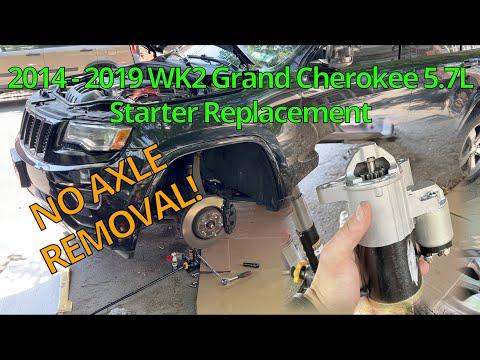







How to Replace the Starter Motor on a 2013 Jeep Grand Cherokee
Step-by-step instructions with required tools, parts list, safety tips, and torque spec guidance
How to Replace the Starter Motor on a 2013 Jeep Grand Cherokee
Step-by-step instructions with required tools, parts list, safety tips, and torque spec guidance


🔧 Grand Cherokee - Starter Motor Replacement
On your Grand Cherokee, the starter is mounted low on the engine and is accessed from underneath. Replacement is mostly remove-underbody-shields, disconnect the wiring, unbolt the starter, and install the new one.
Difficulty Level: Intermediate | Estimated Time: 1.5-3.0 hours
⚠️ Safety & Precautions
- ⚠️ Disconnect the negative battery cable before touching the starter wiring (the main cable is always “hot” and can short to ground).
- ⚠️ Support the SUV with jack stands; never work under a vehicle supported only by a jack.
- ⚠️ Let the exhaust cool completely; the starter area can be close to hot components.
- ⚠️ Wear eye protection when removing splash shields (dirt/debris falls straight down).
🔧 Required Tools
You'll need the following tools for this repair:
- Floor jack (rated 3-ton minimum)
- Jack stands (rated 3-ton minimum)
- Wheel chocks
- Safety glasses
- Nitrile gloves
- Socket set (metric)
- Ratchet (3/8")
- Ratchet (1/2")
- Extensions set (3/8")
- Swivel adapter (3/8")
- Torque wrench (3/8")
- Torque wrench (1/2")
- Trim clip remover
- Flat-blade screwdriver
- Shop light
🔩 Required Parts
HowToo sells all the parts you need for this repair:
- Starter motor assembly - Qty: 1
- Starter mounting bolts - Qty: 1 set
- Starter electrical terminal nut(s) - Qty: 1 set
📋 Before You Begin
- Park on level ground, set the parking brake, and chock the rear wheels.
- Open the hood and disconnect the battery negative terminal first. (The “negative terminal” is the black cable clamp on the battery.)
- Raise the front of the SUV with a floor jack and set it securely on jack stands at the approved lift points.
- Quick check: Look under the front and note whether you have a full-width belly pan/splash shield covering the starter area.
🔨 Step-by-Step Instructions
Follow these steps in order:
Step 1: Confirm the exact starter mounting style (so torque specs match)
- Use a shop light and look up at the starter.
- Count the starter mounting bolts going into the engine/transmission area (typically 2, sometimes 3 depending on build/config).
- Please reply with: “2 bolts” or “3 bolts”, and tell me if you have a full belly pan or small shields.
- This prevents wrong torque specs.
Step 2: Remove the lower splash shield(s)
- Use a trim clip remover and flat-blade screwdriver to remove plastic push-clips.
- Use your socket set (metric) and ratchet (3/8") to remove shield bolts.
- Set the shield hardware aside in a small tray so nothing gets lost.
Step 3: Disconnect the starter wiring
- Double-check the battery negative is disconnected.
- On the starter, remove the small signal wire connector first (it may be a push-on or small nut style).
- Then remove the main battery cable nut using the appropriate socket from your socket set (metric) with a ratchet (3/8").
- Move cables aside so they cannot touch metal.
Step 4: Remove the starter mounting bolts
- Support the starter with one hand while loosening bolts with a ratchet (1/2"), extensions set (3/8"), and swivel adapter (3/8") as needed.
- Remove the bolts completely and lower the starter out.
Step 5: Install the new starter
- Position the new starter into place by hand.
- Start all mounting bolts by hand first to avoid cross-threading (cross-threading means the bolt goes in crooked and damages threads).
- Once you reply with the bolt count/shield style, I’ll give you the exact factory torque values and tightening sequence for your configuration.
Step 6: Reconnect the wiring
- Install the main battery cable onto the starter terminal and snug the nut using a socket set (metric) and ratchet (3/8").
- Reconnect the small signal wire connector.
- After you reply, I’ll provide the correct terminal nut torque to prevent loose connections or stud damage.
Step 7: Reinstall splash shield(s) and lower the SUV
- Reinstall shields using the socket set (metric), ratchet (3/8"), trim clip remover, and flat-blade screwdriver.
- Remove tools from under the SUV, raise slightly with the floor jack (rated 3-ton minimum), remove jack stands (rated 3-ton minimum), then lower to the ground.
✅ After Repair
- Reconnect the battery negative terminal under the hood.
- Start the engine and listen: the starter should crank smoothly with no grinding.
- Check under the SUV for any loose shield hardware and verify wiring is not touching the exhaust.
💰 DIY vs Shop Cost
Shop Cost: $450-$900 (parts + labor)
DIY Cost: $180-$450 (parts only)
You Save: $270-$450 by doing it yourself!
Shop labor rates vary but typically run $100-$150/hour. This repair takes a shop approximately 1.5-3.0 hours.
🎯 Ready to get started?
HowToo makes it easy: same-day/2-day shipping on every part, plus all the tools and specialty tools you need! Check out the parts and tools sections below to add everything to your cart.
Quick questions (so I can give you the exact torque specs):
- How many starter mounting bolts do you see on your Grand Cherokee: 2 or 3?
- Do you have a full belly pan or just small shields?
Guide for replace for these Jeep vehicles
| Year Make Model | Sub Model | Engine | Body Style |
|---|