









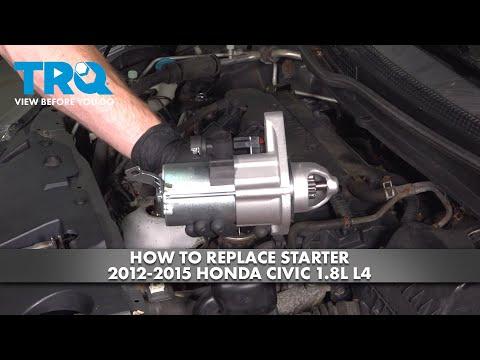





How to Replace the Starter Motor on a 2012 Honda Civic (Step-by-Step Guide)
Tools, parts, safety tips, and torque specs for a smooth DIY starter replacement
How to Replace the Starter Motor on a 2012 Honda Civic (Step-by-Step Guide)
Tools, parts, safety tips, and torque specs for a smooth DIY starter replacement


🔧 Starter Motor - Replacement
The starter motor spins your engine fast enough to start. On your Civic, it’s mounted to the transmission bellhousing and is reached from the top after moving a few intake parts out of the way.
Difficulty Level: Intermediate | Estimated Time: 1.5-3 hours
⚠️ Safety & Precautions
- ⚠️ Disconnect the battery negative cable first to prevent sparks and electrical shorts.
- ⚠️ Work on a cool engine; the exhaust and radiator area can burn you.
- ⚠️ Keep tools off the battery positive terminal and starter power stud at all times.
- ⚠️ If you raise the front of the car, support it with jack stands on solid ground.
🔧 Required Tools
You'll need the following tools for this repair:
- 10mm socket
- 12mm socket
- 14mm socket
- 3/8" ratchet
- 6" socket extension
- 12" socket extension
- Torque wrench (10-80 ft-lbs range)
- Flat trim tool
- Phillips screwdriver
- Needle-nose pliers
- Floor jack (rated 2-ton minimum)
- Jack stands (rated 2-ton minimum)
- Wheel chocks
- Mechanic gloves
- Safety glasses
🔩 Required Parts
HowToo sells all the parts you need for this repair:
- Starter motor assembly - Qty: 1
- Starter electrical terminal nut set - Qty: 1
- Intake tube clamp (optional) - Qty: 1
📋 Before You Begin
- 🅿️ Park on level ground, set the parking brake, and place wheel chocks behind the rear wheels.
- 🔑 Remove the key from the ignition so the car can’t be started accidentally.
- 🔋 Plan to disconnect the battery: negative cable first, reconnect it last.
🔨 Step-by-Step Instructions
Follow these steps in order:
Step 1: Disconnect the battery
- Use a 10mm socket and 3/8" ratchet to loosen the battery negative (-) terminal clamp and remove it from the battery post.
- Move the cable aside so it cannot spring back onto the battery.
- Use a torque wrench for reassembly: Torque to 5 N·m (44 in-lb).
Step 2: Remove the intake ducting for access
- Use a Phillips screwdriver (or 10mm socket, depending on clamp style) to loosen the hose clamps on the intake tube.
- Unclip/remove any small hose or resonator fasteners using a flat trim tool.
- Lift the intake tube/ducting out of the way.
- Take a quick photo before removing hoses.
Step 3: Locate the starter and unplug the small connector
- Find the starter on the front side of the engine/transmission area (it looks like a small motor with a cylinder on top).
- Press the lock tab and unplug the small starter solenoid connector by hand; use needle-nose pliers gently if needed.
Step 4: Remove the main power cable from the starter
- Pull back the rubber boot on the starter’s large power stud.
- Use a 12mm socket with a 6" socket extension and 3/8" ratchet to remove the nut and lift the cable off the stud.
- Reassembly spec with a torque wrench: Torque to 9 N·m (80 in-lb).
- Keep the cable end from touching metal.
Step 5: Remove the starter mounting bolts
- Use a 14mm socket, 12" socket extension, and 3/8" ratchet to remove the two starter mounting bolts.
- Support the starter with your free hand as the last bolt comes out (it’s heavier than it looks).
- Reassembly spec with a torque wrench: Torque to 44 N·m (33 ft-lb).
Step 6: Remove the starter from the engine bay
- Wiggle the starter free and lift it out from the top.
- If space is tight, slightly rotate the starter nose down and pull it toward you.
Step 7: Install the new starter
- Position the new starter in place by hand.
- Start both mounting bolts by hand first (this prevents cross-threading, which means damaging the threads).
- Use a 14mm socket to snug the bolts, then use a torque wrench: Torque to 44 N·m (33 ft-lb).
Step 8: Reconnect the wiring
- Install the main power cable onto the starter stud and tighten with a 12mm socket; finish with a torque wrench: Torque to 9 N·m (80 in-lb).
- Reinstall the rubber boot over the power stud.
- Plug in the small solenoid connector until it clicks.
Step 9: Reinstall the intake ducting
- Reinstall the intake tube/ducting and any clips you removed.
- Use a Phillips screwdriver (or 10mm socket) to tighten the hose clamps securely.
Step 10: Reconnect the battery
- Reconnect the battery negative (-) terminal using a 10mm socket.
- Use a torque wrench: Torque to 5 N·m (44 in-lb).
✅ After Repair
- 🧪 Start the engine and listen for a strong, smooth crank (no clicking or grinding).
- 🔎 Check that the intake tube is fully seated and there are no hissing sounds (vacuum leak).
- 🔌 Recheck the starter power cable boot is covering the stud.
💰 DIY vs Shop Cost
Shop Cost: $450-$850 (parts + labor)
DIY Cost: $120-$300 (parts only)
You Save: $330-$550 by doing it yourself!
Shop labor rates vary but typically run $100-$150/hour. This repair takes a shop approximately 1.5-2.5 hours.
🎯 Ready to get started?
HowToo makes it easy: same-day/2-day shipping on every part, plus all the tools and specialty tools you need! Check out the parts and tools sections below to add everything to your cart.