









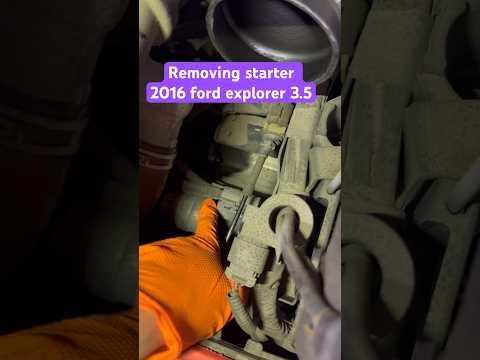







How to Replace the Starter Motor on a 2011-2019 Ford Explorer (Step-by-Step DIY Guide) (Trim: Limited | Engine: V6 3.5L | Body: Sport Utility)
Tools, parts list, safety tips, and torque specs for starter removal and installation
How to Replace the Starter Motor on a 2011-2019 Ford Explorer (Step-by-Step DIY Guide) (Trim: Limited | Engine: V6 3.5L | Body: Sport Utility)
Tools, parts list, safety tips, and torque specs for starter removal and installation for 2011, 2012, 2013, 2014, 2015, 2016, 2017, 2018, 2019


🔧 Explorer - Starter Motor Replacement
The starter motor is what cranks your engine when you turn the key/push the start button. If it’s failing, you may get a single click, slow cranking, or no crank at all. On your Explorer, the starter is mounted to the transmission bellhousing and is usually accessed from underneath.
Difficulty Level: Intermediate | Estimated Time: 1.5-3.0 hours
Assumption: Factory starter location/access for the 3.5L NA AWD; access is from below after removing the splash shield.
⚠️ Safety & Precautions
- ⚠️ Disconnect the battery negative cable first to prevent electrical shorts.
- ⚠️ Support the SUV with jack stands on solid, level ground; never rely on a floor jack alone.
- ⚠️ Let the exhaust/catalyst area cool before working underneath.
- ⚠️ Keep the key fob away from the vehicle so it can’t accidentally try to start.
🔧 Required Tools
You'll need the following tools for this repair:
- Floor jack (rated 3-ton minimum)
- Jack stands (rated 3-ton minimum)
- Wheel chocks
- Safety glasses
- Nitrile gloves
- 8mm socket
- 10mm socket
- 13mm socket
- 15mm socket
- 3/8" ratchet
- 3/8" torque wrench (10–80 Nm range)
- 6" extension (3/8" drive)
- 12" extension (3/8" drive)
- Trim clip remover
- Flathead screwdriver
- Needle-nose pliers
- Work light
🔩 Required Parts
HowToo sells all the parts you need for this repair:
- Starter motor - Qty: 1
- Starter electrical terminal nut kit - Qty: 1
- Dielectric grease - Qty: 1
📋 Before You Begin
- Park on level ground, shift to Park, and set the parking brake.
- Place wheel chocks behind the rear tires.
- Open the hood and make sure all accessories are off.
- Disconnect the battery: use a 10mm socket to remove the negative (-) cable and isolate it so it can’t spring back.
🔨 Step-by-Step Instructions
Follow these steps in order:
Step 1: Raise and support the front of your Explorer
- Use a floor jack (rated 3-ton minimum) to lift the front jacking point.
- Set the vehicle onto jack stands (rated 3-ton minimum) at the proper support points.
- Give the vehicle a gentle shake to confirm it’s stable before crawling underneath.
Step 2: Remove the lower engine splash shield
- Use an 8mm socket and 10mm socket to remove shield bolts/screws.
- Use a trim clip remover (a forked pry tool for plastic fasteners) for any push-clips.
- Set all fasteners aside in a tray so nothing gets lost.
Step 3: Locate the starter motor
- Use a work light and look where the engine meets the transmission (bellhousing area).
- The starter is a small cylindrical motor with a smaller solenoid attached and a thick battery cable going to it.
Step 4: Disconnect the starter wiring
- Use a 10mm socket to remove the nut for the thick battery cable at the starter terminal.
- If there’s a small signal wire connector, remove it carefully using needle-nose pliers or your fingers (don’t yank the wire).
- Apply a tiny amount of dielectric grease to the connector seals during reassembly to help prevent corrosion.
- Torque on reassembly: Battery cable terminal nut to 10 Nm (89 in-lbs)
Step 5: Remove the starter mounting bolts
- Support the starter with one hand while you remove bolts with a 13mm socket, 3/8" ratchet, and a 6" extension (3/8" drive).
- If access is tight, swap to a 12" extension (3/8" drive) to reach the upper bolt.
- Lower the starter down and out carefully.
- Tip: Keep one bolt threaded a few turns.
- Torque on reassembly: Starter mounting bolts to 35 Nm (26 ft-lbs)
Step 6: Install the new starter motor
- Compare the old and new starter side-by-side (same mounting ears, same electrical terminals).
- Position the new starter into place and hand-thread the mounting bolts to avoid cross-threading.
- Use a 3/8" torque wrench (10–80 Nm range) (a wrench that tightens to a precise setting) with a 13mm socket to tighten bolts: Torque to 35 Nm (26 ft-lbs).
Step 7: Reconnect the starter wiring
- Reconnect the small signal wire connector fully until it seats.
- Install the thick battery cable and nut using a 10mm socket: Torque to 10 Nm (89 in-lbs).
- Double-check the cable routing so it can’t rub on the axle, exhaust, or any sharp edges.
Step 8: Reinstall the splash shield
- Lift the shield into position.
- Reinstall bolts with an 8mm socket / 10mm socket and push-clips with the trim clip remover.
Step 9: Reconnect the battery and lower the vehicle
- Reconnect the negative (-) battery cable using a 10mm socket.
- Remove the jack stands and lower the vehicle with the floor jack.
- Remove the wheel chocks.
✅ After Repair
- Start the engine and confirm it cranks strongly and starts normally.
- Listen for abnormal grinding/whining; if heard, shut it off and recheck starter seating and bolt tightness.
- Check that no warning lights appear and that the battery cable is tight and not heating up.
- Take a short test drive and recheck under the vehicle for any loose shield fasteners.
💰 DIY vs Shop Cost
Shop Cost: $600-$1,050 (parts + labor)
DIY Cost: $160-$420 (parts only)
You Save: $440-$630 by doing it yourself!
Shop labor rates vary but typically run $100-$150/hour. This repair takes a shop approximately 1.5-3.0 hours.
🎯 Ready to get started?
HowToo makes it easy: same-day/2-day shipping on every part, plus all the tools and specialty tools you need! Check out the parts and tools sections below to add everything to your cart.
Guide for Starter Motor replace for these Ford vehicles
| Year Make Model | Sub Model | Engine | Body Style |
|---|---|---|---|
| 2019 Ford Explorer | Base | V6 3.5L | Sport Utility |
| 2019 Ford Explorer | Limited | V6 3.5L | Sport Utility |
| 2019 Ford Explorer | XLT | V6 3.5L | Sport Utility |
| 2019 Ford Explorer | Sport | V6 3.5L | Sport Utility |
| 2019 Ford Explorer | Platinum | V6 3.5L | Sport Utility |
| 2018 Ford Explorer | Base | V6 3.5L | Sport Utility |
| 2018 Ford Explorer | Limited | V6 3.5L | Sport Utility |
| 2018 Ford Explorer | XLT | V6 3.5L | Sport Utility |
| 2018 Ford Explorer | Sport | V6 3.5L | Sport Utility |
| 2018 Ford Explorer | Platinum | V6 3.5L | Sport Utility |
| 2017 Ford Explorer | Base | V6 3.5L | Sport Utility |
| 2017 Ford Explorer | Limited | V6 3.5L | Sport Utility |
| 2017 Ford Explorer | XLT | V6 3.5L | Sport Utility |
| 2017 Ford Explorer | Sport | V6 3.5L | Sport Utility |
| 2017 Ford Explorer | Platinum | V6 3.5L | Sport Utility |
| 2016 Ford Explorer | Base | V6 3.5L | Sport Utility |
| 2016 Ford Explorer | Limited | V6 3.5L | Sport Utility |
| 2016 Ford Explorer | XLT | V6 3.5L | Sport Utility |
| 2016 Ford Explorer | Sport | V6 3.5L | Sport Utility |
| 2016 Ford Explorer | Platinum | V6 3.5L | Sport Utility |
| 2015 Ford Explorer | Base | V6 3.5L | Sport Utility |
| 2015 Ford Explorer | Limited | V6 3.5L | Sport Utility |
| 2015 Ford Explorer | XLT | V6 3.5L | Sport Utility |
| 2015 Ford Explorer | Sport | V6 3.5L | Sport Utility |
| 2014 Ford Explorer | Base | V6 3.5L | Sport Utility |
| 2014 Ford Explorer | Limited | V6 3.5L | Sport Utility |
| 2014 Ford Explorer | XLT | V6 3.5L | Sport Utility |
| 2014 Ford Explorer | Sport | V6 3.5L | Sport Utility |
| 2013 Ford Explorer | Base | V6 3.5L | Sport Utility |
| 2013 Ford Explorer | Limited | V6 3.5L | Sport Utility |
| 2013 Ford Explorer | XLT | V6 3.5L | Sport Utility |
| 2013 Ford Explorer | Sport | V6 3.5L | Sport Utility |
| 2012 Ford Explorer | Base | V6 3.5L | Sport Utility |
| 2012 Ford Explorer | Limited | V6 3.5L | Sport Utility |
| 2012 Ford Explorer | XLT | V6 3.5L | Sport Utility |
| 2011 Ford Explorer | Base | V6 3.5L | Sport Utility |
| 2011 Ford Explorer | Limited | V6 3.5L | Sport Utility |
| 2011 Ford Explorer | XLT | V6 3.5L | Sport Utility |