









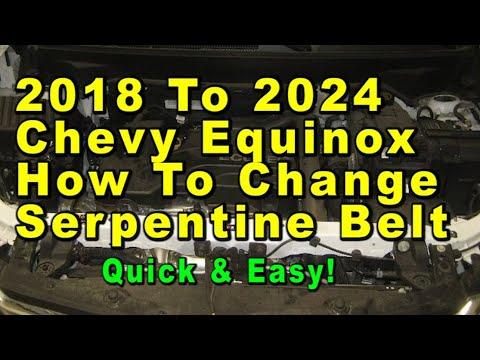






How to Replace the Serpentine Belt on a 2019 Chevrolet Equinox
Step-by-step DIY guide with tools, parts list, torque specs, safety tips, and cost savings
How to Replace the Serpentine Belt on a 2019 Chevrolet Equinox
Step-by-step DIY guide with tools, parts list, torque specs, safety tips, and cost savings


🔧 Equinox - Serpentine Belt Replacement
The serpentine belt on your Equinox drives the alternator, A/C compressor, and other accessories. You’ll remove belt tension using the spring-loaded tensioner, slip the old belt off, and route a new one following the factory diagram.
Difficulty Level: Intermediate | Estimated Time: 1-2 hours
⚠️ Safety & Precautions
- 🔹Always work on a cold engine; a hot engine can burn you.
- 🔹Disconnect the negative battery cable to prevent accidental cranking.
- 🔹Support the vehicle with jack stands; never rely only on a floor jack.
- 🔹Keep hands and tools clear of pulleys and the tensioner when moving the belt.
- 🔹Do not start the engine until all tools are removed from the engine bay.
🔧 Required Tools
You'll need the following tools for this repair:
- 🔹Floor jack (rated 3-ton minimum)
- 🔹Jack stands (rated 3-ton minimum)
- 🔹Wheel chocks
- 🔹Ratchet 3/8-inch drive
- 🔹Ratchet 1/2-inch drive
- 🔹15mm socket
- 🔹10mm socket
- 🔹7mm socket
- 🔹Torx T20 screwdriver
- 🔹Breaker bar 1/2-inch drive
- 🔹Serpentine belt tool (low-profile) (specialty)
- 🔹Flat trim removal tool (plastic)
- 🔹Torque wrench 3/8-inch drive
- 🔹Torque wrench 1/2-inch drive
- 🔹Needle-nose pliers
- 🔹Work light or headlamp
- 🔹Mechanic’s gloves
- 🔹Safety glasses
🔩 Required Parts
HowToo sells all the parts you need for this repair:
- 🔹Serpentine drive belt (1.6L diesel) - Qty: 1
- 🔹Serpentine belt tensioner assembly - Qty: 1 (optional but recommended)
- 🔹Idler pulley - Qty: 1 (optional but recommended)
- 🔹Plastic splash shield push clips - Qty: 4-6 (in case originals break)
- 🔹Dielectric grease (small tube) - Qty: 1 (optional for battery terminal)
📋 Before You Begin
- Park the Equinox on level ground, set the parking brake, and place wheel chocks behind the rear wheels.
- Open the hood and locate the serpentine belt routing diagram sticker (usually on the radiator support or underside of the hood). If missing, take a clear photo of the belt routing.
- Use a 10mm socket to disconnect the negative battery terminal and move the cable aside so it cannot spring back.
- Gather all tools and parts so you don’t have to search mid-job. Lay parts out in order.
🔨 Step-by-Step Instructions
Follow these steps in order:
Step 1: Lift and secure the front right side
- Loosen the front right wheel lug nuts 1 turn using a 19mm socket and 1/2-inch drive ratchet or breaker bar (do not remove yet). Just crack them loose.
- Position the floor jack under the front right jacking point (pinch weld behind the wheel) and lift until the tire is off the ground.
- Place jack stands under the recommended support points and slowly lower the vehicle onto the stands using the floor jack.
- Remove the front right wheel completely using the 19mm socket.
- Later, when reinstalling the wheel, tighten the lug nuts to Torque to 140 Nm (103 ft-lbs) using the 1/2-inch drive torque wrench.
Step 2: Remove the right front wheel well splash shield
- Use the flat trim removal tool to pop out plastic push clips holding the front part of the inner fender liner/splash shield.
- Use the 7mm socket and Torx T20 screwdriver to remove any screws along the edge of the liner.
- Carefully pull back the front part of the inner fender liner to expose the side of the engine and the serpentine belt area.
- When reinstalling these screws, snug them with the 7mm socket or Torx T20 screwdriver to about Torque to 3 Nm (27 in-lbs) using the 3/8-inch drive torque wrench.
Step 3: Familiarize yourself with the belt routing
- Use the work light to look through the wheel well and from above the engine to see the entire belt path.
- Compare what you see to the factory belt routing diagram sticker or your photo.
- If needed, draw a simple sketch showing each pulley and the belt path. Simple drawings help a lot.
Step 4: Locate the serpentine belt tensioner
- The tensioner is a spring-loaded pulley that keeps the belt tight; it usually has a smooth pulley and a cast arm.
- From the wheel well, use the work light to find the pulley that moves when you push on the belt—this is the tensioner.
- On your Equinox, there is a hex fitting on the tensioner (usually for a 15mm socket or the serpentine belt tool).
Step 5: Relieve tension and remove the old belt
- Place the 15mm socket on a 1/2-inch drive breaker bar or serpentine belt tool and fit it onto the tensioner hex.
- Rotate the tensioner in the direction that loosens the belt (usually clockwise when viewed from the front on this engine). Move slowly and smoothly.
- While holding the tensioner in the released position, slide the belt off the nearest smooth pulley (often the idler pulley) using your free hand.
- Slowly let the tensioner return to its resting position; do not let it snap back.
- Remove the belt fully from all pulleys and pull it out through the wheel well.
Step 6: Inspect pulleys and tensioner
- Spin each accessible pulley (idler, tensioner, alternator, A/C compressor) by hand.
- Check for roughness, grinding noises, or wobble. If you feel any of these, replace that pulley or the tensioner assembly.
- Check the tensioner arm for smooth spring action by moving it again with the 15mm socket and breaker bar; it should move smoothly and return firmly.
Step 7: Install a new tensioner or idler (if you are replacing them)
- If you are replacing the tensioner: use the 15mm socket and 3/8-inch drive ratchet to remove its mounting bolt(s). Note the orientation.
- Install the new tensioner in the same position and start the bolt(s) by hand to avoid cross-threading.
- Tighten the tensioner mounting bolt(s) to Torque to 50 Nm (37 ft-lbs) using the 3/8-inch drive torque wrench and 15mm socket.
- If replacing the idler pulley: use the appropriate socket (often 15mm) to remove the center bolt, swap the pulley, then tighten the bolt to Torque to 40 Nm (30 ft-lbs).
Step 8: Route the new belt
- Lay the new belt next to the old one on the ground to confirm the length and rib count match.
- Following the diagram or your sketch, route the new belt around all pulleys except one easy-to-reach smooth pulley near the tensioner.
- Make sure all belt ribs sit fully in the grooves of each grooved pulley. Ribs must sit perfectly centered.
Step 9: Apply tension to seat the new belt
- Again place the 15mm socket and serpentine belt tool or breaker bar on the tensioner hex.
- Rotate the tensioner to the released position to create slack in the belt.
- With your other hand, slide the belt over the final smooth pulley.
- Slowly release the tensioner so it takes up the slack and tightens the belt.
- Visually check from above and from the wheel well that the belt is centered on every pulley and not one groove off anywhere.
Step 10: Reinstall the splash shield and wheel
- Reposition the inner fender liner/splash shield to its original place.
- Reinstall the 7mm screws and T20 Torx screws snugly using the 7mm socket and Torx T20 screwdriver, then torque to Torque to 3 Nm (27 in-lbs) with the 3/8-inch drive torque wrench.
- Reinstall the plastic push clips by pressing them back into their holes. Replace any broken clips with new ones.
- Reinstall the wheel and hand-tighten the lug nuts in a crisscross pattern.
- Raise the vehicle slightly with the floor jack, remove the jack stands, then lower the vehicle to the ground.
- Use the 1/2-inch drive torque wrench and 19mm socket to tighten lug nuts in a crisscross pattern to Torque to 140 Nm (103 ft-lbs).
Step 11: Reconnect battery and test
- Reconnect the negative battery cable using the 10mm socket and snug the nut to Torque to 6 Nm (53 in-lbs) with the 3/8-inch drive torque wrench.
- Visually inspect the belt one more time from above, making sure it is fully seated in all grooves.
- Remove all tools and rags from the engine bay and wheel area.
- Start the engine and watch the belt for 30–60 seconds. It should run smoothly with no wobble or squeal.
✅ After Repair
- Listen for any squeaking, chirping, or grinding noises from the belt area; if present, shut off the engine and recheck belt routing and pulleys.
- Check that the charging system warning light is off and that the A/C and power steering feel normal.
- After a short drive (5–10 km), shut off the engine and re-check belt alignment and wheel lug nut torque.
💰 DIY vs Shop Cost
Shop Cost: $250-$400 (parts + labor)
DIY Cost: $40-$120 (belt only, more if adding tensioner/idler)
You Save: $130-$300 by doing it yourself!
Shop labor rates vary but typically run $100-$150/hour. This repair takes a shop approximately 1-1.5 hours.
🎯 Ready to get started?
HowToo makes it easy: same-day/2-day shipping on every part, plus all the tools and specialty tools you need! Check out the parts and tools sections below to add everything to your cart.