









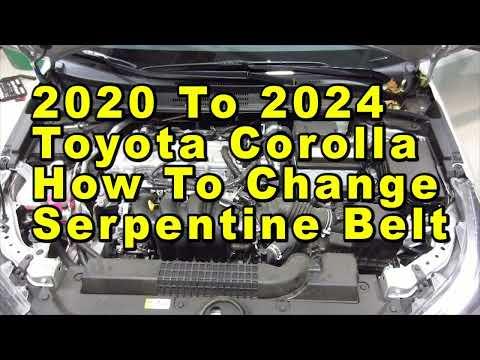







How to Replace the Serpentine Belt on a 2019-2023 Toyota Corolla 2.0L (Engine: Inline 4 2.0L)
Step-by-step DIY guide with tools, parts list, torque specs, safety tips, and cost savings
How to Replace the Serpentine Belt on a 2019-2023 Toyota Corolla 2.0L (Engine: Inline 4 2.0L)
Step-by-step DIY guide with tools, parts list, torque specs, safety tips, and cost savings for 2019, 2020, 2021, 2022, 2023


🔧 Corolla - Serpentine Belt Replacement
You’ll be replacing the serpentine belt that drives the alternator, A/C compressor, and other accessories on your Corolla. Over time these belts crack, glaze, or stretch and can squeal or fail, leaving you stranded.
Difficulty Level: Intermediate | Estimated Time: 1–2 hours
⚠️ Safety & Precautions
- ⚠️ Always support the car with jack stands, never rely only on a floor jack.
- ⚠️ Turn the engine off and remove the key; never work near a running engine.
- ⚠️ Let the engine cool if it was just running; hot parts can burn you.
- ⚠️ Keep hands, hair, clothing, and tools away from pulleys and the radiator fan.
- ⚠️ Disconnecting the battery is recommended to avoid accidental cranking: remove the negative cable first.
- ⚠️ Work on level ground and set the parking brake firmly.
🔧 Required Tools
You'll need the following tools for this repair:
- 🛠️ Floor jack (rated 3-ton minimum)
- 🛠️ Jack stands (rated 3-ton minimum)
- 🛠️ Wheel chocks
- 🛠️ 21mm socket
- 🛠️ 3/8" drive ratchet
- 🛠️ 3/8" drive torque wrench (10–150 ft-lbs range)
- 🛠️ 10mm socket
- 🛠️ 12mm socket
- 🛠️ 14mm socket
- 🛠️ 6" socket extension
- 🛠️ Serpentine belt tool (low-profile 3/8" drive bar) (specialty)
- 🛠️ Flathead screwdriver (medium)
- 🛠️ Trim clip removal tool (plastic fastener remover) (specialty)
- 🛠️ Work light or flashlight
- 🛠️ Mechanic’s gloves
- 🛠️ Safety glasses
🔩 Required Parts
HowToo sells all the parts you need for this repair:
- 🔩 Serpentine (accessory drive) belt for 2.0L engine - Qty: 1
- 🔩 Plastic splash shield push clips - Qty: 4–6
- 🔩 Dielectric grease (small packet) - Qty: 1
📋 Before You Begin
- Park the Corolla on level ground, set the parking brake, and place wheel chocks behind the rear wheels.
- Open the hood and locate the belt on the passenger side of the engine bay.
- Use a phone to take a clear picture of the belt routing before removal. Picture prevents routing mistakes
- Disconnect the negative battery terminal using a 10mm socket and set the cable aside so it cannot spring back.
- Loosen the front passenger wheel lug nuts slightly with a 21mm socket before jacking the car.
🔨 Step-by-Step Instructions
Follow these steps in order:
Step 1: Raise and support the front passenger side
- Place the floor jack under the front pinch weld or factory jack point on the passenger side.
- Lift the car until the front passenger wheel is off the ground.
- Position a jack stand under the pinch weld and lower the car gently onto the stand.
- Double-check stability by lightly rocking the car by hand.
Step 2: Remove the front passenger wheel
- Use a 21mm socket and ratchet to remove the lug nuts.
- Remove the wheel and set it aside.
- Later, when reinstalling, tighten lug nuts to 140 Nm (103 ft-lbs) using a torque wrench.
Step 3: Remove the lower splash shield / inner fender liner access
- Turn the steering so the passenger wheel hub area is open toward you.
- Use a trim clip removal tool or flathead screwdriver to carefully pop out the plastic clips holding the front part of the inner fender liner and lower splash shield.
- Remove any 10mm bolts with a 10mm socket and ratchet.
- Pull back the liner to create a clear window to the belt and pulleys.
- Keep clips and bolts grouped so none are lost
Step 4: Study and record the belt routing
- From the wheel well and from the top, use a work light to view all pulleys the belt touches.
- Take a clear photo or draw a simple diagram of how the belt snakes around each pulley.
- Look for the spring-loaded tensioner pulley (small pulley on an arm that moves).
Step 5: Rotate the belt tensioner to release tension
- The M20A 2.0L engine uses a spring tensioner with a hex or square drive boss.
- From the wheel well, fit a 14mm socket on the tensioner bolt, attached to your serpentine belt tool or a long ratchet.
- Rotate the tensioner in the direction that moves the pulley away from the belt (usually clockwise when viewed from the wheel well). Go slowly and steadily
- While holding tension off, slide the belt off the nearest smooth pulley using your free hand.
- Gently let the tensioner return to its rest position under spring pressure.
Step 6: Remove the old belt
- From both the top and wheel well, pull the belt out of the engine bay, unlooping it from each pulley.
- Compare the old belt to the new one: length, width, and number of ribs should match.
- Check the old belt for cracks or missing ribs to confirm it needed replacement.
Step 7: Route the new belt over the lower pulleys
- Using your routing photo or diagram, start feeding the new belt in from the top.
- From the wheel well, loop the belt around the crankshaft pulley at the bottom first, then any lower accessories (like A/C pulley).
- Keep the ribbed side of the belt in the grooves of ribbed pulleys, and the smooth side only against smooth pulleys.
- Make sure belt ribs sit fully in pulley grooves
Step 8: Route the new belt over the upper pulleys, leaving one pulley free
- From the top, place the belt over the alternator and any idler pulleys, following your diagram.
- Leave one easy-to-access smooth pulley (often an idler) for last; the belt will not be on that pulley yet.
- Check that the belt is correctly seated in all other pulley grooves.
Step 9: Apply tension and slip the belt onto the last pulley
- From the wheel well, again place the 14mm socket and serpentine belt tool on the tensioner bolt.
- Rotate the tensioner to remove slack from the belt.
- While holding the tensioner, use your other hand (from the most accessible side) to slip the belt over the last pulley.
- Carefully release the tensioner so it takes up the slack and tightens the belt.
Step 10: Double-check belt routing and alignment
- Inspect every pulley from both top and wheel well with the work light.
- Confirm the belt is centered on each pulley and all ribs are in grooves, with no twist anywhere.
- Misalignment will cause squeal or belt damage
Step 11: Reinstall the inner fender liner and splash shield
- Reposition the liner and lower shield in their original locations.
- Install any bolts using a 10mm socket and ratchet and snug them (about 7–9 Nm (5–7 ft-lbs) is enough).
- Reinstall the plastic clips; replace any broken ones with new clips.
Step 12: Reinstall the wheel and lower the car
- Place the wheel back on the hub and hand-thread the lug nuts.
- Use a 21mm socket and ratchet to snug the lug nuts in a star pattern.
- Raise the car slightly with the floor jack, remove the jack stand, then lower the car fully.
- Use a torque wrench with the 21mm socket to tighten lug nuts to 140 Nm (103 ft-lbs) in a star pattern.
Step 13: Reconnect the battery
- Reconnect the negative battery cable using a 10mm socket and tighten the nut to about 5–7 Nm (4–5 ft-lbs) (just snug, not over-tight).
- You can apply a small amount of dielectric grease to the terminal to reduce corrosion.
✅ After Repair
- Start the engine and watch the belt from above; it should run smoothly with no wobble, hopping, or fraying.
- Listen for any squealing or slapping sounds; if you hear any, shut off the engine and re-check belt routing and seating.
- Turn on A/C and headlights to load the system and confirm the belt runs quietly under load.
- After a short test drive, recheck the belt visually and re-torque wheel lug nuts to 140 Nm (103 ft-lbs).
💰 DIY vs Shop Cost
Shop Cost: $220–$350 (parts + labor)
DIY Cost: $35–$70 (parts only)
You Save: $150–$280 by doing it yourself!
Shop labor rates vary but typically run $100–$150/hour. This repair takes a shop approximately 0.8–1.0 hours.
🎯 Ready to get started?
HowToo makes it easy: same-day/2-day shipping on every part, plus all the tools and specialty tools you need! Check out the parts and tools sections above to add everything to your cart.
Guide for Serpentine Belt replace for these Toyota vehicles
| Year Make Model | Sub Model | Engine | Body Style |
|---|---|---|---|
| 2023 Toyota Corolla | - | Inline 4 2.0L | - |
| 2022 Toyota Corolla | - | Inline 4 2.0L | - |
| 2021 Toyota Corolla | - | Inline 4 2.0L | - |
| 2020 Toyota Corolla | - | Inline 4 2.0L | - |
| 2019 Toyota Corolla | - | Inline 4 2.0L | - |