









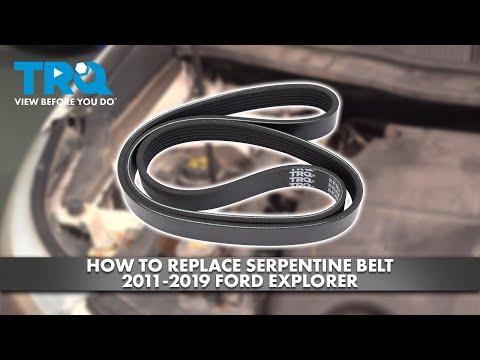







How to Replace the Serpentine Belt on a 2018 Ford Explorer (Drive Belt Guide)
Step-by-step instructions with belt routing tips, required tools/parts, and A/C stretch belt notes
How to Replace the Serpentine Belt on a 2018 Ford Explorer (Drive Belt Guide)
Step-by-step instructions with belt routing tips, required tools/parts, and A/C stretch belt notes


🔧 Explorer - Serpentine Belt Replacement
You’ll remove the old drive belt and install a new one, making sure it’s routed correctly on every pulley. A worn belt can squeal, slip, or crack, and if it breaks you can lose charging and cooling.
Difficulty Level: Intermediate | Estimated Time: 0.5-1.0 hours
⚠️ Safety & Precautions
- ⚠️ Work on a cool engine; belts/pulleys can burn you.
- ⚠️ Keep fingers, hair, and sleeves away from pulleys.
- ⚠️ Key off and keep the key/fob away so nobody can start it.
- ⚠️ If you’ll unplug the MAF sensor, disconnect the negative battery cable first (prevents a check engine light).
🔧 Required Tools
You'll need the following tools for this repair:
- Safety glasses
- Nitrile gloves
- 3/8" drive ratchet
- 3/8" drive breaker bar (18"-24")
- 3/8" drive 15mm socket
- 1/4" drive ratchet
- 8mm socket
- 10mm socket
- Flat-blade screwdriver
- Flashlight
- Belt installation tool (specialty)
🔩 Required Parts
HowToo sells all the parts you need for this repair:
- Serpentine belt - Qty: 1
- A/C stretch belt - Qty: 1 (if equipped)
📋 Before You Begin
- 🧭 Park on level ground, shift to Park, and set the parking brake.
- 🔎 Find the belt routing diagram sticker (usually near the radiator support). If it’s missing, take a clear photo of the current routing.
- 🔌 If you plan to unplug any sensors: use a 10mm socket to disconnect the negative battery cable and isolate it.
🔨 Step-by-Step Instructions
Follow these steps in order:
Step 1: Remove the engine cover (if equipped)
- Pull up firmly by hand to release the cover from its grommets.
- Set it aside where it won’t get stepped on.
Step 2: Open up access to the belt (intake tube as needed)
- Use an 8mm socket or flat-blade screwdriver to loosen the air intake hose clamps.
- If a connector is in the way, unplug it only after battery negative is disconnected; then press the tab and pull straight off.
- Move the intake tube/air ducting enough to clearly see the belt and the tensioner.
Step 3: Identify the belt tensioner
- Look for the spring-loaded arm with a smooth pulley (this is the automatic tensioner).
- The tensioner has a bolt head you’ll turn to relieve belt tension.
- Tensioner = spring-loaded belt “tightener”.
Step 4: Relieve tension and remove the old belt
- Install a 15mm socket on a 3/8" breaker bar and place it on the tensioner bolt head.
- Rotate the tensioner to relieve belt tension (you’ll feel spring resistance).
- While holding the tensioner rotated, slide the belt off one easy-to-reach pulley (often the alternator).
- Slowly release the tensioner back to its resting position (don’t let it snap back).
- Remove the belt from the remaining pulleys and take it out.
Step 5: Inspect pulleys and tensioner
- Spin the idler pulley and tensioner pulley by hand; they should spin smoothly and quietly.
- Check for wobble or grinding. If you feel roughness, that pulley may need replacement.
Step 6: Route the new belt
- Compare the new belt to the old belt for matching length and rib count.
- Route the new belt following the under-hood routing diagram (or your photo).
- Make sure the ribbed side of the belt sits in the grooved pulleys, and the smooth side sits on smooth pulleys.
- Leave the belt off one top pulley last (again, alternator is often easiest).
- Ribs must sit perfectly in grooves.
Step 7: Apply tension and fully seat the belt
- Use the 15mm socket and 3/8" breaker bar to rotate the tensioner again.
- Slide the belt onto the last pulley.
- Slowly release the tensioner.
- Use a flashlight to confirm the belt is centered on every pulley and not riding on an edge.
Step 8: If equipped: replace the separate A/C stretch belt
- Some Explorers may have a separate “stretch belt” for the A/C compressor (no tensioner).
- Use a belt installation tool (specialty) to install it without damaging the belt.
- Do not use a screwdriver to “walk” it on; that can cut the belt.
- Stretch belts are one-time-use on removal.
Step 9: Reinstall intake/cover
- Reinstall the intake tube and tighten clamps with an 8mm socket or flat-blade screwdriver.
- Reconnect any electrical connectors you unplugged.
- Reinstall the engine cover by pressing it down into the grommets.
- If disconnected, reconnect the battery negative using a 10mm socket.
✅ After Repair
- 🔍 Start your Explorer and watch the belt for 30-60 seconds; it should run smoothly with no wandering.
- 👂 Listen for chirping/squealing. If present, shut it off and re-check routing and pulley alignment.
- 🧪 Turn on A/C and headlights to add load and confirm no belt slip noise.
- 🧰 Re-check clamp tightness and that no tools are left in the engine bay.
💰 DIY vs Shop Cost
Shop Cost: $150-$280 (parts + labor)
DIY Cost: $35-$85 (parts only)
You Save: $115-$195 by doing it yourself!
Shop labor rates vary but typically run $100-$150/hour. This repair takes a shop approximately 0.6-1.0 hours.
🎯 Ready to get started?
HowToo makes it easy: same-day/2-day shipping on every part, plus all the tools and specialty tools you need! Check out the parts and tools sections below to add everything to your cart.