









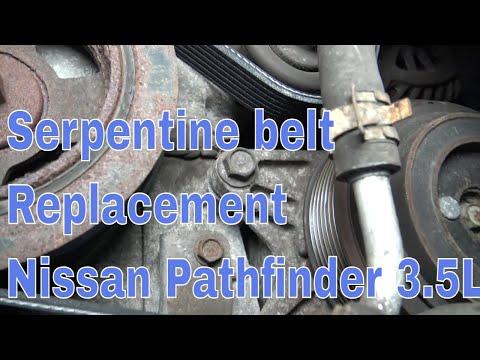







How to Replace the Serpentine Belt on a 2016 Nissan Pathfinder (Step-by-Step Guide)
Tools, belt routing tips, tensioner release steps, safety precautions, and final belt alignment checks for 2013, 2014, 2015, 2016, 2017, 2018, 2019
How to Replace the Serpentine Belt on a 2016 Nissan Pathfinder (Step-by-Step Guide)
Tools, belt routing tips, tensioner release steps, safety precautions, and final belt alignment checks for 2013, 2014, 2015, 2016, 2017, 2018, 2019


🔧 Pathfinder - Serpentine Belt Replacement
The serpentine belt is the single belt that drives accessories like the alternator and A/C. Replacing it is mostly about gaining access, rotating the spring-loaded tensioner (the pulley that keeps the belt tight), and routing the new belt correctly.
Difficulty Level: Beginner | Estimated Time: 0.8-1.5 hours
⚠️ Safety & Precautions
- 🧤 Work on a cool engine; hot pulleys and radiator fans can burn you.
- 🛑 Support the vehicle with jack stands; never rely on a floor jack alone.
- ⚡ Keep fingers/hair/clothing away from the belt path; do not start the engine during removal.
- 🔋 Battery disconnect is not required, but keep tools away from the positive terminal area.
🔧 Required Tools
You'll need the following tools for this repair:
- Floor jack (rated 3-ton minimum)
- Jack stands (rated 3-ton minimum)
- Wheel chocks
- 21mm socket
- 1/2-inch drive breaker bar
- 3/8-inch drive ratchet
- 14mm socket
- 6-inch socket extension (3/8-inch drive)
- 10mm socket
- Trim clip removal tool
- Flathead screwdriver
- Flashlight
- Nitrile gloves
- Safety glasses
🔩 Required Parts
HowToo sells all the parts you need for this repair:
- Serpentine belt - Qty: 1
- Splash shield clips (assorted) - Qty: 1 set
📋 Before You Begin
- 🧭 Park on level ground, shift to Park, and set the parking brake.
- 🧱 Place wheel chocks behind the rear tires.
- 🗺️ Find the belt routing diagram (usually on the radiator support/underhood area). If it’s missing, take a clear photo of the current routing before removal.
🔨 Step-by-Step Instructions
Follow these steps in order:
Step 1: Raise and secure the front-right corner
- Use a floor jack (rated 3-ton minimum) to lift the front-right jacking point.
- Place jack stands (rated 3-ton minimum) under a solid support point and lower the vehicle onto the stands.
- Keep the wheel chocks in place.
Step 2: Remove the front-right wheel
- Use a 21mm socket with a 1/2-inch drive breaker bar to loosen the lug nuts, then remove them.
- Remove the wheel and set it flat under the vehicle as an extra safety backup.
- Reinstall later: Torque to 133 Nm (98 ft-lbs)
Step 3: Remove the right-side lower splash shield/inner liner access
- Use a trim clip removal tool and flathead screwdriver to pop out plastic clips.
- Use a 10mm socket with a 3/8-inch drive ratchet to remove any 10mm bolts.
- Peel the liner/splash shield back enough to clearly see the belt and tensioner pulley.
- Tip: Keep clips grouped by location.
Step 4: Identify the belt tensioner
- Use a flashlight to locate the tensioner pulley (a smooth pulley on a spring arm). This is what you rotate to release belt tension.
- Confirm the tool contact point: on your A/C/alternator belt setup, you typically rotate the tensioner using the pulley bolt head.
Step 5: Relieve tension and remove the old belt
- Place a 14mm socket with a 3/8-inch drive ratchet and 6-inch socket extension (3/8-inch drive) on the tensioner pulley bolt.
- Rotate the tensioner to relieve tension (it will feel strong because it’s spring-loaded).
- While holding the tensioner rotated, slide the belt off the nearest easy pulley (usually an upper smooth pulley).
- Slowly let the tensioner return to its resting position, then remove the belt from the remaining pulleys.
- Tip: Move slowly; spring tension snaps back fast.
Step 6: Route the new belt
- Compare the new serpentine belt to the old one for matching length and rib count.
- Route the belt around the pulleys following the underhood routing diagram.
- Make sure the belt ribs sit fully inside the grooved pulleys, and the belt sits centered on smooth pulleys.
- Tip: Leave an easy pulley for last.
Step 7: Apply tension and verify alignment
- Use the 14mm socket, ratchet, and extension to rotate the tensioner again.
- Slip the belt onto the last pulley, then slowly release the tensioner.
- Use the flashlight to check every pulley: no ribs hanging off, no belt riding on a pulley lip.
Step 8: Reinstall splash shield and wheel
- Reposition the liner/splash shield and reinstall bolts using a 10mm socket and ratchet.
- Reinstall clips using a trim clip removal tool (and flathead screwdriver if needed to seat the centers).
- Mount the wheel and hand-thread lug nuts.
- Lower the vehicle, then use a 21mm socket to tighten lug nuts in a star pattern: Torque to 133 Nm (98 ft-lbs)
✅ After Repair
- 🔍 Before starting, do one final visual check that the belt is seated in every pulley groove.
- 🚗 Start the engine and watch the belt for 20-30 seconds; it should run straight with no wobble or squeal.
- 👂 If you hear chirping/squealing, shut off and re-check alignment (most common issue is one rib off on a grooved pulley).
- 🧰 If the tensioner arm bounces a lot, consider replacing the tensioner and/or idler pulleys soon.
💰 DIY vs Shop Cost
Shop Cost: ₹3,500-₹8,000 (parts + labor)
DIY Cost: ₹1,200-₹3,000 (parts only)
You Save: ₹2,300-₹5,000 by doing it yourself!
Panipat-area rates vary; most shops book ~0.8-1.2 hours for this.
🎯 Ready to get started?
HowToo makes it easy: same-day/2-day shipping on every part, plus all the tools and specialty tools you need! Check out the parts and tools sections below to add everything to your cart.