













How to Replace the Serpentine Belt on a 2016 Ford F-150 5.0L
Step-by-step DIY serpentine belt replacement with tools, routing diagram tips, torque specs, and safety guidance
How to Replace the Serpentine Belt on a 2016 Ford F-150 5.0L
Step-by-step DIY serpentine belt replacement with tools, routing diagram tips, torque specs, and safety guidance


F-150 - Serpentine Belt Replacement 🔧
I’ll lay this out step-by-step for your 2016 5.0L so it’s beginner-friendly.
Tools & Parts Needed 🧰
- 🔧 Serpentine belt (correct length for 5.0L with your options – match by engine & A/C at the parts counter)
- 🔧 3/8" or 1/2" drive ratchet (the handle you attach sockets to)
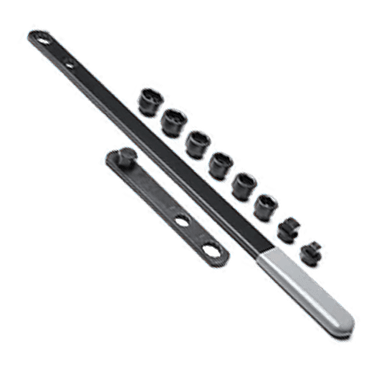
- 🔧 Serpentine belt tool or long breaker bar (a long handle that gives extra leverage to move the tensioner)
- 🔧 Socket set (metric; 8–15 mm will cover what you need)
- 🔧 Flat trim tool or flat screwdriver (to pop plastic clips if needed)
- 🔧 Work light (seeing the pulleys clearly is important)
- 🔧 Gloves & safety glasses
Safety First ⚠️
- ⚠️ Engine OFF and cool – never work around the belt with the engine running.
- ⚠️ Battery negative cable disconnected is a good idea if you’re new:
- Use a 10 mm wrench, loosen the negative (-) terminal, and move it aside.
- ⚠️ Keep fingers and clothing clear of pulleys and sharp edges.
F-150 - Belt Routing Overview 🧵
From the factory there is usually a belt routing diagram sticker on the radiator support or underside of the hood.
- 🔍 If you see it, take a clear photo before starting.
- 🔍 If not, draw a simple sketch of how the belt runs over/under each pulley:
- Smooth pulleys = belt runs on the smooth back side.
- Ribbed pulleys = belt ribs sit in the grooves.
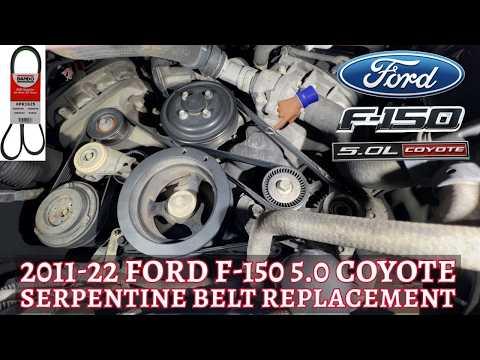
On the 5.0L, the belt runs around: crankshaft pulley, alternator, power steering, A/C compressor, idler(s), and automatic tensioner.
Step 1 – Access the Belt 👀
- 🧰 Park on level ground, set the parking brake, and open the hood.
- 🧰 Remove any plastic engine cover if fitted:
- Usually pulls up off rubber grommets; if bolts are present, remove with 8–10 mm socket.
- 🧰 If needed for space, remove the air intake tube from the airbox to the throttle body:
- Loosen the hose clamps (usually 7–8 mm or flat screwdriver).
- Unplug the MAF sensor connector carefully (press tab and pull).
- Lift the tube out and set aside.
Step 2 – Locate the Belt Tensioner 🔄
The belt tensioner is a spring-loaded pulley that keeps the belt tight.
- 🔍 On the 5.0L, it’s on the front of the engine, slightly toward the passenger side, with a pulley and a square hole or bolt head for your tool.
- 🔍 Look for:
- Either a 3/8" or 1/2" square hole in the arm (for your ratchet/belt tool), or
- A bolt head in the center of the pulley (often 15 mm) where you put your socket.
Step 3 – Relieve Tension and Remove Old Belt 🧯
- 🧰 Insert your ratchet or belt tool into the tensioner:
- Use the correct square hole or socket on the pulley bolt.
- 🧰 Rotate the tensioner in the direction that loosens the belt:
- On this engine, you typically pull the handle toward the driver side (but watch the belt – you’ll see it slacken).
- 🧰 While holding the tensioner released, slide the belt off one easy-to-reach smooth pulley (often an idler at the top).
- 🧰 Slowly let the tensioner return to its rest position. Don’t let it snap back hard.
- 🧰 Now remove the belt completely from all pulleys and pull it out of the engine bay.
Step 4 – Compare Old and New Belt 📏
- 📌 Lay the old and new belts side by side on the ground.
- 📌 Check:
- Same number of ribs (grooves).
- Very similar length (a tiny difference is normal; big difference is wrong part).
Step 5 – Route the New Belt (Except One Pulley) 🧩
- 🧰 Using your diagram/photo, start routing the new belt:
- Begin at the crankshaft pulley (big one at the bottom).
- Work your way around the lower accessories (A/C, power steering).
- Then around the alternator and idler pulleys.
- 🧰 Make sure:
- Belt ribs sit fully in the grooves on ribbed pulleys.
- The back (smooth side) runs on smooth pulleys.
- 🧰 Leave the belt off one easy-to-reach smooth pulley at the top (often an idler). This will be your last pulley to slip it over.
Step 6 – Apply Tension and Seat the Belt 💪
- 🧰 Reinstall your ratchet/belt tool on the tensioner.
- 🧰 Rotate the tensioner again to create slack in the belt.
- 🧰 With your other hand, slip the belt onto the last pulley you left for last.
- 🧰 Slowly release the tensioner so it tightens the belt.
- 🧰 Double-check:
- Belt is centered on every pulley.
- No ribs hanging off the edge.
- Routing matches your diagram exactly.
Step 7 – Reassemble and Final Checks ✅
- 🧰 Reinstall the air intake tube:
- Slide onto throttle body and airbox.
- Tighten hose clamps snug (about 35–45 in-lb – firm but not crushing).
- Reconnect the MAF sensor plug until it clicks.
- 🧰 Reinstall engine cover if removed (push onto grommets or tighten bolts snug).
- 🧰 Reconnect the battery negative terminal and tighten the 10 mm nut snug (around 62 in-lb / ~7 N·m – don’t overtighten).
- 🧰 Before starting, visually inspect the belt one more time.
- 🧰 Start the engine and let it idle:
- Watch the belt for 30–60 seconds.
- It should run smooth, no wobble, no squeal.
Torque & Notes 📎
- 🔧 Tensioner pulley bolt – if you had to remove it (usually you don’t): about 35–40 ft-lb (Ford spec varies slightly by supplier; snug plus a bit more with a 3/8" ratchet if you don’t have a torque wrench).
- 🔧 Any bracket/cover bolts – typically 7–9 ft-lb for small 8–10 mm bolts.
Tips & Tricks 💡
- 💡 If the belt keeps slipping off while routing, use a small bungee cord or a helper to hold it on one pulley while you work around.
- 💡 If you hear squealing after install, recheck that the belt is fully seated in every groove and that no pulley is oily or dirty.
- 💡 A long serpentine belt tool makes this job much easier than a short ratchet because of the extra leverage.
If you want, tell me if your truck has A/C and I can confirm the exact belt routing and part style you need. HowToo makes it easy: same-day/2-day shipping on every part, plus all the tools and specialty tools you need!