









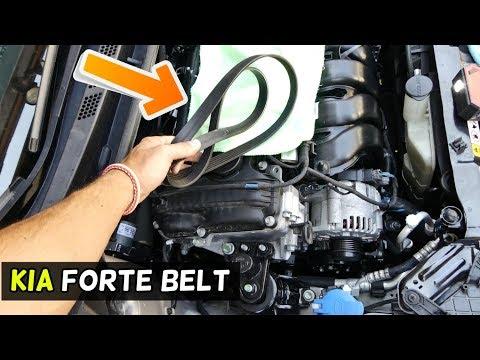







How to Replace the Serpentine Belt on a 2015 Kia Forte (DIY Guide)
Step-by-step instructions with tools list, belt routing tips, safety checks, and wheel lug torque specs
How to Replace the Serpentine Belt on a 2015 Kia Forte (DIY Guide)
Step-by-step instructions with tools list, belt routing tips, safety checks, and wheel lug torque specs


🔧 Forte - Serpentine Belt Replacement
The serpentine belt drives key accessories like the alternator and A/C. Replacing it is mostly about safely accessing the belt and rotating the automatic tensioner to slip the belt off and on.
Difficulty Level: Intermediate | Estimated Time: 0.8-1.5 hours
Assumption: stock accessory drive with A/C (most EX models).
⚠️ Safety & Precautions
- 🧤 Work on a cool engine; hot pulleys and radiator fans can injure you.
- 🧯 Keep hands/clothes clear of the belt path at all times.
- 🛑 Support the car with jack stands; never rely only on a floor jack.
- 🔋 Battery disconnect is not required, but keep the key off and do not start the engine during the job.
🔧 Required Tools
You'll need the following tools for this repair:
- Floor jack (rated 2-ton minimum)
- Jack stands (rated 2-ton minimum)
- Wheel chocks
- Lug wrench or 21mm socket
- Ratchet (3/8")
- Socket set (8mm, 10mm, 12mm, 14mm, 17mm)
- Serpentine belt tool or breaker bar (specialty)
- Trim clip remover
- Flathead screwdriver
- Torque wrench (10-150 ft-lbs)
- Work light
- Safety glasses
- Mechanic gloves
🔩 Required Parts
HowToo sells all the parts you need for this repair:
- Serpentine belt - Qty: 1
- Plastic splash shield clips (assorted) - Qty: 1 set
📋 Before You Begin
- 🅿️ Park on level ground, shift to Park, and set the parking brake.
- 🧱 Place wheel chocks behind the rear wheels.
- 📸 Find the belt routing diagram (often on a label under the hood). If you don’t see one, take a clear photo of the current belt routing before removal.
- 💡 Set up a work light at the passenger-side wheel well for visibility.
🔨 Step-by-Step Instructions
Follow these steps in order:
Step 1: Lift the front-right corner safely
- Place wheel chocks behind the rear wheels.
- Use a floor jack (rated 2-ton minimum) on the proper front jacking point and raise the passenger-front corner.
- Set the car down onto jack stands (rated 2-ton minimum).
Step 2: Remove the front-right wheel
- Use a lug wrench or 21mm socket to remove the lug nuts and remove the wheel.
- When reinstalling later: Torque to 90-110 Nm (66-81 ft-lbs).
Step 3: Remove the passenger-side splash shield (inner fender)
- Use a trim clip remover and flathead screwdriver to remove plastic clips.
- Use an 8mm socket or 10mm socket (as equipped) to remove any small bolts/screws.
- Pull the splash shield back to expose the belt, crank pulley, and tensioner.
- A clip remover prevents breaking fasteners.
Step 4: Relieve belt tension using the automatic tensioner
- Locate the belt tensioner. It’s a spring-loaded arm with a pulley.
- Put a 14mm socket (or 17mm socket, whichever fits your tensioner) on the tensioner’s hex/bolt head.
- Use a serpentine belt tool or breaker bar (specialty) to rotate the tensioner and relieve tension. (A breaker bar is a long-handled bar that gives you extra leverage.)
- While holding the tensioner rotated, slide the belt off the easiest-to-reach smooth pulley (often the tensioner or idler).
Step 5: Remove the old belt and compare lengths
- Slowly release the tensioner back to its resting position using the serpentine belt tool or breaker bar (specialty).
- Pull the belt out through the wheel-well opening.
- Lay the old and new belt side-by-side to confirm the length and rib count match.
- If it’s not the same, don’t force it.
Step 6: Route the new belt correctly
- Route the new belt following the under-hood diagram (or your photo).
- Make sure the belt ribs sit fully in the grooves of ribbed pulleys (like the alternator). Smooth pulleys ride on the flat back of the belt.
- Leave the belt off one easy pulley last (usually the tensioner or a top idler) so you can slip it on after rotating the tensioner.
Step 7: Apply tension and seat the belt
- Rotate the tensioner again using the 14mm socket or 17mm socket with the serpentine belt tool or breaker bar (specialty).
- Slip the belt onto the last pulley, then slowly release the tensioner.
- Visually check every pulley: the belt must be centered and fully seated in grooves.
Step 8: Reinstall splash shield and wheel
- Reposition the splash shield and reinstall fasteners using an 8mm socket or 10mm socket.
- Reinstall clips using the trim clip remover (to line them up) and press them in by hand.
- Reinstall the wheel using a lug wrench or 21mm socket.
- Lower the car using the floor jack (rated 2-ton minimum) and remove the jack stands (rated 2-ton minimum).
- Final-tighten lug nuts with a torque wrench (10-150 ft-lbs): Torque to 90-110 Nm (66-81 ft-lbs).
✅ After Repair
- 👀 Before starting, do a final visual sweep to confirm the belt is on every pulley and not riding on an edge.
- 🔊 Start the engine and watch the belt for 30-60 seconds. It should run smooth with no wandering, squeal, or flapping.
- 🛑 If you hear squealing or see the belt walking off a pulley, shut the engine off immediately and re-check routing and seating.
💰 DIY vs Shop Cost
Shop Cost: $150-$300 (parts + labor)
DIY Cost: $25-$70 (parts only)
You Save: $125-$230 by doing it yourself!
Shop labor rates vary but typically run $100-$150/hour. This repair takes a shop approximately 0.8-1.3 hours.
🎯 Ready to get started?
HowToo makes it easy: same-day/2-day shipping on every part, plus all the tools and specialty tools you need! Check out the parts and tools sections below to add everything to your cart.