









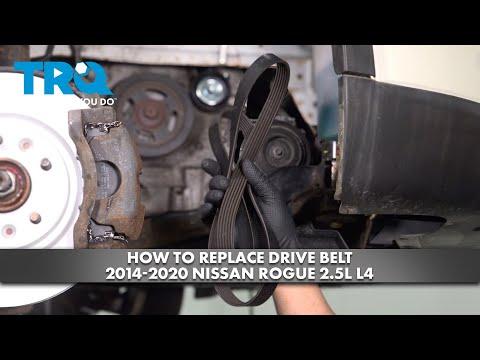






How to Replace the Serpentine Belt on a 2014-2021 Nissan Rogue 2.5L (Engine: Inline 4 2.5L)
Step-by-step DIY serpentine belt replacement with tools, parts list, safety tips, and torque specs for your 2019 Nissan Rogue
How to Replace the Serpentine Belt on a 2014-2021 Nissan Rogue 2.5L (Engine: Inline 4 2.5L)
Step-by-step DIY serpentine belt replacement with tools, parts list, safety tips, and torque specs for your 2019 Nissan Rogue for 2014, 2015, 2016, 2017, 2018, 2019, 2020, 2021


🔧 Rogue - Serpentine Belt Replacement
You’ll be replacing the serpentine belt that drives the alternator, A/C compressor, and other accessories on your Rogue. The belt runs on pulleys at the front of the engine and is held tight by an automatic tensioner.
Difficulty Level: Beginner-Intermediate | Estimated Time: 1–1.5 hours
⚠️ Safety & Precautions
- 🛑 Always support the vehicle with jack stands. Never work under or near a car supported only by a jack.
- 🛑 Turn engine off, remove the key, and let the engine cool before working near the belt and pulleys.
- 🛑 Keep fingers, hair, clothing, and jewelry away from pulleys and the belt at all times.
- 🛑 Do not start the engine until all tools are removed from the engine bay and wheel well area.
- 🛑 If you disconnect the battery, you may lose radio presets and clock settings, but it is not required for this job.
🔧 Required Tools
You'll need the following tools for this repair:
- 🧰 Floor jack (rated 3-ton minimum)
- 🧰 Jack stands (rated 3-ton minimum)
- 🧰 Wheel chocks
- 🧰 21mm socket (for wheel lug nuts)
- 🧰 1/2" drive breaker bar (for loosening wheel lug nuts)
- 🧰 3/8" drive ratchet
- 🧰 14mm socket (for belt tensioner and pulleys)
- 🧰 10mm socket (for splash shield fasteners if bolted)
- 🧰 Phillips screwdriver (for plastic clips, if equipped)
- 🧰 Trim clip removal tool (specialty) (for plastic push clips)
- 🧰 Serpentine belt tool (long-handled) (specialty) – a thin, long bar that makes it easier to rotate the tensioner in tight spaces
- 🧰 Flashlight or work light
- 🧰 Mechanic gloves
- 🧰 Safety glasses
🔩 Required Parts
HowToo sells all the parts you need for this repair:
- 🧱 Serpentine drive belt - Qty: 1
- 🧱 Serpentine belt tensioner assembly - Qty: 1 (optional but recommended if mileage is high)
- 🧱 Idler pulley - Qty: 1 (optional, replace if noisy or rough)
- 🧱 Plastic splash shield clips - Qty: 6–10 (replace any broken)
- 🧱 Anti-seize compound - Qty: small tube (for wheel lug nuts, optional)
📋 Before You Begin
- 🚗 Park your Rogue on level ground, set the parking brake, and place wheel chocks behind the rear wheels.
- 🚗 Loosen (but do not remove) the front right wheel lug nuts slightly with the 21mm socket and 1/2" breaker bar before lifting the vehicle.
- ⚡ Battery disconnection is not required, but you can disconnect the negative terminal with a 10mm socket if you prefer extra safety.
- 📸 Take a clear photo of the existing belt routing before removal. This is your backup diagram.
🔨 Step-by-Step Instructions
Follow these steps in order:
Step 1: Lift and support the front right side
- Use the 21mm socket and 1/2" breaker bar to crack the front right lug nuts loose about one turn while the Rogue is still on the ground.
- Position the floor jack under the front right jacking point (pinch weld under the door area) and raise the vehicle until the tire is off the ground.
- Place jack stands under the recommended support point near the front right corner and slowly lower the Rogue onto the stands using the floor jack.
- Remove the front right wheel completely using the 21mm socket.
- Give the car a push test to confirm stability.
Step 2: Remove the right front splash shield access
- Turn your flashlight toward the inner wheel well and locate the plastic splash shield that covers the front of the engine and belt area.
- Use the trim clip removal tool to pop out the plastic push clips holding the small access panel or front part of the inner fender.
- If there are screws, remove them with a Phillips screwdriver or 10mm socket.
- Pull the shield or access panel back carefully to expose the serpentine belt and pulleys.
- Keep clips and screws in a small container.
Step 3: Study and record the belt routing
- With the shield pulled back, aim your flashlight at the belt and pulleys.
- Look for a belt routing diagram sticker under the hood; if present, study it. If not, your photo from earlier will help.
- Take another close-up photo or sketch how the belt wraps around the crankshaft pulley, alternator, A/C compressor, water pump, idler pulley, and tensioner pulley.
- More photos now equals less confusion later.
Step 4: Release tension from the belt
- Locate the belt tensioner pulley; on the Rogue’s 2.5L, it’s a small pulley mounted on a spring-loaded arm near the middle/front of the engine.
- Place a 14mm socket on the tensioner pulley bolt using your 3/8" ratchet or serpentine belt tool.
- Rotate the tensioner in the direction that loosens the belt (usually clockwise when viewed from the wheel well on this engine). It will take firm, steady pressure.
- While holding the tensioner in the released position, slide the belt off one easy-to-reach smooth pulley (usually the idler or alternator pulley).
- Slowly release the tensioner back to its rest position with the ratchet or belt tool.
- Do not let the tensioner snap back suddenly.
Step 5: Remove the old belt
- From the wheel well opening and from above the engine bay if needed, pull the belt off the remaining pulleys by hand.
- Note any shiny, cracked, or missing ribs on the old belt; this confirms it needed replacement.
- Compare the old belt to the new one: lengths should match closely, and the number of ribs should be the same.
Step 6: Inspect the tensioner and pulleys
- Spin the idler pulley and tensioner pulley by hand. They should spin smoothly and quietly with no grinding or wobble.
- If a pulley feels rough or loose, plan to replace that pulley or the whole tensioner assembly.
- Check around the area for any oil or coolant leaks that might shorten belt life.
Step 7: Route the new belt (except one pulley)
- Using your photo or diagram, start routing the new belt around the lower crankshaft pulley first. Keep the ribs fully seated in the grooves.
- Continue routing the belt around the A/C compressor pulley, water pump, and alternator as per the original path.
- Leave the easiest-to-reach smooth pulley (often the idler) for last; the belt will be resting just off of it for now.
- Make sure the belt ribs are seated properly on every grooved pulley before applying tension.
- A mis-seated rib will cause noise and damage.
Step 8: Apply tension and fully install the belt
- Place the 14mm socket and serpentine belt tool or 3/8" ratchet back on the tensioner bolt.
- Rotate the tensioner again in the direction that loosens the belt (usually clockwise from wheel well view) to create slack.
- With your other hand, slide the belt over the last smooth pulley (idler or alternator) while holding the tensioner rotated.
- Once the belt is on, slowly release the tensioner so it tightens the belt automatically.
- Visually inspect from multiple angles to ensure the belt is centered and fully seated on all pulley grooves.
Step 9: Final visual checks
- From both the wheel well and from above the engine bay, check each pulley again:
- Belt ribs in all grooves.
- No twists or overlaps.
- Belt sits straight, not walking off any pulley edges.
- If anything looks off, release tension again and correct the routing or seating.
Step 10: Reinstall splash shield and wheel
- Reposition the inner fender splash shield or access panel back into place.
- Reinstall the plastic clips using the trim clip removal tool as needed, and any screws with the Phillips screwdriver or 10mm socket.
- Mount the front right wheel back on the hub and hand-thread all lug nuts.
- Use the floor jack to raise the Rogue slightly, remove the jack stands, then lower the vehicle fully to the ground.
- Use the 21mm socket and 1/2" breaker bar (or torque wrench, if available) to tighten the lug nuts in a star pattern to about 113 Nm (83 ft-lbs).
Step 11: Start engine and listen
- Remove all tools from the engine bay and wheel well area.
- Start the engine and let it idle while you listen near the belt area (stay clear of moving parts).
- You should hear smooth operation with no squealing, chirping, or slapping noises.
- If you hear a new noise, shut off the engine and recheck belt routing and pulley condition.
✅ After Repair
- 🔊 With the engine idling, briefly turn on the A/C and headlights to put some load on the belt and ensure it runs smoothly.
- 👀 Recheck the belt visually with the engine off after a short test drive to confirm it is still properly seated.
- 📆 Note the mileage and date of belt replacement for future maintenance records.
- 🔧 If you replaced the tensioner or pulleys, listen for any remaining bearing noise; none should be present.
💰 DIY vs Shop Cost
Shop Cost: $220–$340 (parts + labor)
DIY Cost: $35–$90 (parts only)
You Save: $130–$300 by doing it yourself!
Shop labor rates vary but typically run $100–$150/hour. This repair takes a shop approximately 0.8–1.0 hours.
🎯 Ready to get started?
HowToo makes it easy: same-day/2-day shipping on every part, plus all the tools and specialty tools you need! Check out the parts and tools sections above to add everything to your cart.
Guide for Serpentine Belt replace for these Nissan vehicles
| Year Make Model | Sub Model | Engine | Body Style |
|---|---|---|---|
| 2021 Nissan Rogue | - | Inline 4 2.5L | - |
| 2020 Nissan Rogue | - | Inline 4 2.5L | - |
| 2019 Nissan Rogue | - | Inline 4 2.5L | - |
| 2019 Nissan Rogue | - | Inline 4 2.0L | - |
| 2018 Nissan Rogue | - | Inline 4 2.5L | - |
| 2018 Nissan Rogue | - | Inline 4 2.0L | - |
| 2017 Nissan Rogue | - | Inline 4 2.5L | - |
| 2017 Nissan Rogue | - | Inline 4 2.0L | - |
| 2016 Nissan Rogue | - | Inline 4 2.5L | - |
| 2015 Nissan Rogue | - | Inline 4 2.5L | - |
| 2014 Nissan Rogue | - | Inline 4 2.5L | - |