









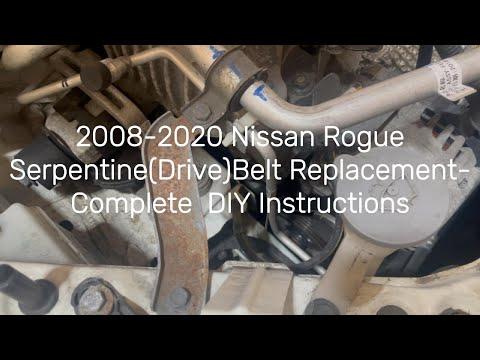







How to Replace the Serpentine Belt on a 2014-2021 Nissan Rogue 2.0L Hybrid (Engine: Inline 4 2.0L)
Step-by-step DIY serpentine belt replacement with tools, parts list, torque specs, safety tips, and cost savings
How to Replace the Serpentine Belt on a 2014-2021 Nissan Rogue 2.0L Hybrid (Engine: Inline 4 2.0L)
Step-by-step DIY serpentine belt replacement with tools, parts list, torque specs, safety tips, and cost savings for 2014, 2015, 2016, 2017, 2018, 2019, 2020, 2021


🔧 Rogue - Serpentine Belt Replacement
The serpentine belt on your Rogue drives the alternator, A/C compressor, and other accessories from the crankshaft. You’ll remove tension from the automatic tensioner, slip the old belt out, then route and install a new belt. Access is mainly through the right front wheel well.
Difficulty Level: Intermediate | Estimated Time: 1–2 hours
⚠️ Safety & Precautions
- ⚠️ Always support the vehicle with jack stands, never rely only on a jack.
- ⚠️ Hybrid system: do not touch orange high-voltage cables or connectors.
- ⚠️ Let the engine cool fully before working near belts and pulleys.
- ⚠️ Keep fingers, hair, and clothing away from pulleys; never start the engine with tools or hands in the belt area.
- ⚠️ Disconnect the 12V battery negative terminal before working near the belt to prevent accidental starts.
🔧 Required Tools
You'll need the following tools for this repair:
- 🛠️ Floor jack (rated 2-ton or higher)
- 🛠️ Jack stands (rated 2-ton or higher)
- 🛠️ Wheel chocks
- 🛠️ Lug wrench or 21mm socket
- 🛠️ 3/8" drive ratchet
- 🛠️ 1/2" drive ratchet
- 🛠️ 14mm socket
- 🛠️ 10mm socket
- 🛠️ Socket extension 6"
- 🛠️ Serpentine belt tool or long breaker bar (1/2" drive) (specialty)
- 🛠️ Trim clip removal tool (specialty)
- 🛠️ Flathead screwdriver (medium)
- 🛠️ Torque wrench 10–100 ft-lb range
- 🛠️ Work light or LED lamp
- 🛠️ Mechanic’s gloves
- 🛠️ Safety glasses
- 🛠️ Fender cover or old towel
🔩 Required Parts
HowToo sells all the parts you need for this repair:
- 🔩 Serpentine drive belt (accessory drive belt), 2.0L hybrid - Qty: 1
- 🔩 Belt tensioner assembly - Qty: 1 (optional but recommended if noisy or old)
- 🔩 Idler pulley - Qty: 1 (optional but recommended if rough or noisy)
- 🔩 Plastic push clips for right front fender liner - Qty: 4–6
- 🔩 Dielectric-safe engine cleaner or degreaser - Qty: 1
- 🔩 Shop towels or rags - Qty: 1 pack
📋 Before You Begin
- Park the Rogue on level ground, select P (Park), and set the parking brake.
- Turn the ignition OFF, remove the key or fob from the vehicle, and wait at least 5 minutes.
- Open the hood and support it securely.
- Disconnect the 12V battery negative terminal using a 10mm socket and move the cable aside so it cannot spring back.
- Lay out the new belt and compare length and rib count with the old one before removing the old belt.
- If no belt routing sticker is under the hood, take a clear photo of the belt route before removal.
🔨 Step-by-Step Instructions
Follow these steps in order:
Step 1: Prepare and lift the vehicle
- Loosen the right front wheel lug nuts 1/2 turn using the 21mm socket and breaker bar while the vehicle is still on the ground.
- Position the floor jack under the front jacking point or subframe (front center) and raise the front of the Rogue.
- Place jack stands under the proper front support points and slowly lower the vehicle onto them.
- Remove the right front wheel completely using the 21mm socket and set it aside.
- Torque to spec note: No final torque yet; re-torque lugs later after reinstall.
Step 2: Remove right front inner fender liner access
- Turn your work light toward the inner fender area ahead of the wheel hub.
- Use the trim clip removal tool or flathead screwdriver to remove the plastic clips holding the front section of the right inner fender liner.
- Remove any 10mm bolts securing the liner using a 10mm socket and ratchet.
- Peel back the liner toward the suspension so you can see the crankshaft pulley and belt system from the side.
- Torque to spec: These small liner bolts are snug only, about 3–5 Nm (2–4 ft-lb) during reassembly.
Step 3: Study and record the belt routing
- From the wheel well and from above the engine bay, look at how the belt snakes around the crank pulley, alternator, A/C compressor, and idler/tensioner pulleys.
- Take clear photos from several angles with your phone.
- Optionally, draw a simple diagram on paper showing each pulley and how the belt wraps around it.
- Torque to spec: Not applicable for this step (no fasteners adjusted).
Step 4: Locate the belt tensioner
- The automatic belt tensioner is a spring-loaded pulley assembly that keeps the belt tight. It will have either a bolt head in the center of the pulley or a “square” hole for a tool.
- From the wheel well, locate the tensioner pulley and its center bolt. On the 2.0L hybrid it typically uses a 14mm bolt.
- Confirm you have enough room to get a 14mm socket on that bolt using the 3/8" or 1/2" ratchet and an extension.
- Torque to spec: You are only rotating the tensioner; do not loosen the bolt, so no torque spec needed here.
Step 5: Relieve tension from the belt
- Fit the 14mm socket onto the tensioner bolt using a breaker bar or serpentine belt tool for extra leverage.
- Rotate the tensioner in the direction that loosens the belt (usually clockwise when viewing from the wheel well, but confirm by slightly moving it and watching belt slack).
- While holding the tensioner rotated, slip the belt off one easy-to-reach smooth pulley (often the idler or alternator) using your free hand.
- Slowly and gently let the tensioner return to its resting position with the breaker bar still attached. Do not let it snap back.
- Torque to spec: None; bolt is not being loosened or tightened.
Step 6: Remove the old belt
- From the wheel well and from above, pull the belt off each pulley and remove it completely from the engine bay.
- Compare the old belt to the new one: same width, same number of ribs, and very similar length.
- If the old belt has missing ribs, cracks, or glazing (shiny surface), you confirmed it needed replacement.
- Torque to spec: Not applicable; no fasteners involved.
Step 7: Inspect pulleys and tensioner
- Spin each accessible idler and tensioner pulley by hand; they should spin smoothly and quietly, with no roughness or wobble.
- If any pulley feels rough, noisy, or loose, plan to replace that pulley or the entire tensioner assembly now, using the same access path.
- Check the crankshaft pulley (harmonic balancer) for any wobble or separated rubber.
- Wipe off any oil or coolant from pulley surfaces with a shop towel and degreaser.
- Torque to spec: If you did not remove any pulleys, no torque is required here.
Step 8: Route the new belt (dry-fit first)
- Following your photos/diagram, route the new belt around all lower pulleys first (crankshaft and A/C), leaving one upper smooth pulley for last.
- Make sure the belt ribs sit perfectly in the grooves of each grooved pulley; no ribs should hang off the edge.
- Do a “dry fit” with the belt loosely in place to confirm the path is correct before applying tension.
- Torque to spec: Not applicable; only belt positioning.
Step 9: Install the belt under tension
- Place the belt on every pulley except the chosen last smooth pulley (usually an idler that’s easy to reach from the wheel well or top).
- Again, use the 14mm socket and breaker bar on the tensioner bolt and rotate the tensioner to create slack.
- With the tensioner held back, slip the belt over the last pulley using your free hand. You may need to adjust belt position slightly on other pulleys to gain a little slack.
- Once the belt is fully seated, slowly release the tensioner so it applies tension to the belt.
- Torque to spec: Still not tightening the bolt; no torque spec required.
Step 10: Double-check belt alignment
- From both above and through the wheel well, inspect each pulley to ensure the belt is centered and fully seated in all grooves.
- Look specifically at the crankshaft pulley: make sure the belt is not one rib off.
- If anything is misaligned, re-rotate the tensioner and reposition the belt until perfect.
- Take your time here to avoid squeaks later.
- Torque to spec: Not applicable; inspection only.
Step 11: Reinstall fender liner and wheel
- Fold the right front inner fender liner back into place.
- Install the 10mm bolts with a 10mm socket and tighten them to about 3–5 Nm (2–4 ft-lb) (snug, do not over-tighten).
- Reinstall the plastic clips by pushing them firmly into their holes.
- Reinstall the right front wheel onto the hub and hand-thread all lug nuts.
- Raise the Rogue slightly with the floor jack, remove the jack stands, then lower the vehicle to the ground.
- Use the torque wrench and 21mm socket to tighten lug nuts in a star pattern to 110 Nm (80 ft-lb).
Step 12: Reconnect battery and test
- Reconnect the 12V battery negative cable using the 10mm socket and snug it down to about 5–7 Nm (4–5 ft-lb) (just firmly tight; do not strip).
- Start the engine and watch the belt for one full minute with the hood open.
- Check that the belt runs smoothly, with no wobble, jumping, or walking off any pulley.
- Listen for any squealing or chirping sounds. If heard, shut off the engine and re-check belt alignment and pulley condition.
✅ After Repair
- Let the engine idle for 5–10 minutes while you watch the belt and listen for noises.
- Turn the A/C ON and OFF and watch that the belt still runs smoothly when the compressor engages.
- After a short test drive (5–10 km), re-open the hood and re-check belt alignment and condition.
- Re-check wheel lug torque to 110 Nm (80 ft-lb) after the test drive.
💰 DIY vs Shop Cost
Shop Cost: $220–$350 (parts + labor)
DIY Cost: $30–$80 (belt only, more if you add pulleys/tensioner)
You Save: $140–$300 by doing it yourself!
Shop labor rates vary but typically run $100–$150/hour. This repair takes a shop approximately 0.8–1.2 hours.
🎯 Ready to get started?
HowToo makes it easy: same-day/2-day shipping on every part, plus all the tools and specialty tools you need! Check out the parts and tools sections above to add everything to your cart.
Guide for Serpentine Belt replace for these Nissan vehicles
| Year Make Model | Sub Model | Engine | Body Style |
|---|---|---|---|
| 2021 Nissan Rogue | - | Inline 4 2.5L | - |
| 2020 Nissan Rogue | - | Inline 4 2.5L | - |
| 2019 Nissan Rogue | - | Inline 4 2.5L | - |
| 2019 Nissan Rogue | - | Inline 4 2.0L | - |
| 2018 Nissan Rogue | - | Inline 4 2.5L | - |
| 2018 Nissan Rogue | - | Inline 4 2.0L | - |
| 2017 Nissan Rogue | - | Inline 4 2.5L | - |
| 2017 Nissan Rogue | - | Inline 4 2.0L | - |
| 2016 Nissan Rogue | - | Inline 4 2.5L | - |
| 2015 Nissan Rogue | - | Inline 4 2.5L | - |
| 2014 Nissan Rogue | - | Inline 4 2.5L | - |