









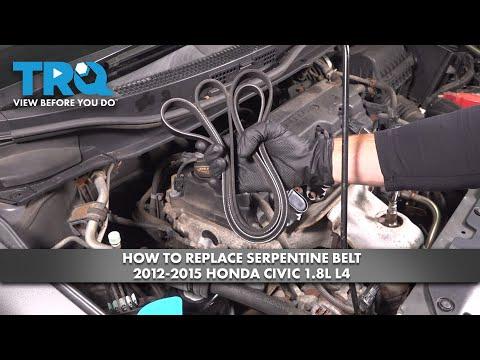







How to Replace the Serpentine Belt on a 2012 Honda Civic (Drive Belt Guide)
Step-by-step instructions with required tools/parts, belt routing tips, and safety checks to prevent squeal
How to Replace the Serpentine Belt on a 2012 Honda Civic (Drive Belt Guide)
Step-by-step instructions with required tools/parts, belt routing tips, and safety checks to prevent squeal


🔧 Civic - Serpentine Belt Replacement
The serpentine belt (also called the drive belt) turns key accessories like the alternator and A/C. On your Civic, the belt is kept tight by an automatic tensioner, so the job is mainly about safely releasing tension, swapping the belt, and confirming the routing is correct.
Difficulty Level: Intermediate | Estimated Time: 0.5-1.5 hours
⚠️ Safety & Precautions
- 🧯 Work on a cool engine; keep hands away from hot parts.
- 🧯 Keep fingers clear of the belt path and pulleys when releasing the tensioner (spring-loaded).
- 🧯 Support the car with jack stands; never rely on a floor jack alone.
- 🧯 No battery disconnect is required, but keep the key out and the engine OFF.
🔧 Required Tools
You'll need the following tools for this repair:
- Floor jack (rated 2-ton minimum)
- Jack stands (rated 2-ton minimum)
- Wheel chocks
- 19mm socket
- 1/2" drive breaker bar
- 14mm combination wrench
- 10mm socket
- Ratchet (3/8" drive)
- Trim clip remover tool
- Flathead screwdriver
- Flashlight
- Mechanic gloves
- Safety glasses
🔩 Required Parts
HowToo sells all the parts you need for this repair:
- Serpentine belt (drive belt) - Qty: 1
- Right-front splash shield clips - Qty: 1 set
📋 Before You Begin
- 🧰 Park on level ground, set the parking brake, and place wheel chocks behind the rear wheels.
- 🧰 Let the engine cool completely.
- 🧰 Take a quick photo of the belt routing, or sketch it before removal.
- 🧰 “Splash shield” means the plastic cover inside the fender that keeps water/dirt off the belt area.
🔨 Step-by-Step Instructions
Follow these steps in order:
Step 1: Loosen the right-front wheel
- Use 19mm socket and 1/2" drive breaker bar to crack loose the right-front lug nuts 1/2 turn (don’t remove them yet).
Step 2: Raise and support the car
- Use the floor jack (rated 2-ton minimum) to lift the right-front corner at the proper jacking point.
- Place jack stands (rated 2-ton minimum) under a solid support point and lower the car onto the stands.
- Keep wheel chocks in place.
Step 3: Remove the right-front wheel
- Use the 19mm socket to remove the lug nuts, then remove the wheel.
Step 4: Remove the right-front splash shield access
- Use the trim clip remover tool and flathead screwdriver to remove the plastic clips/screws holding the lower/side splash shield back.
- Pull the splash shield aside enough to clearly see the belt and pulleys. Don’t force it; clips break easily.
Step 5: Locate the belt tensioner
- Use a flashlight to find the automatic tensioner (spring-loaded arm with a pulley).
- The tensioner has a bolt head on the arm you can turn to release belt tension.
Step 6: Release belt tension
- Place the 14mm combination wrench on the tensioner’s hex/bolt head.
- Pull the wrench smoothly to rotate the tensioner and take tension off the belt.
- While holding the tensioner released, slide the belt off the nearest easy pulley (usually the alternator pulley) by hand.
- Slowly let the tensioner return to its resting position. Let it back slowly—don’t snap it.
Step 7: Remove the old belt
- Pull the belt out through the wheel well opening.
- Compare the old belt to the new one (length and rib count should match).
Step 8: Install the new belt (verify routing)
- Route the new belt around the pulleys following your photo/sketch (make sure the ribbed side sits in ribbed pulleys, and the smooth side rides on smooth pulleys).
- Leave the easiest pulley for last (commonly the alternator) so you have room to slip it on.
- Use the 14mm combination wrench to rotate the tensioner again, then slip the belt fully onto the last pulley.
- Slowly release the tensioner so it tightens the belt.
- Use the flashlight to confirm the belt is centered on every pulley and not one rib off. One-rib-off will shred the belt.
Step 9: Reinstall splash shield and wheel
- Reposition the splash shield and reinstall clips using the trim clip remover tool and flathead screwdriver.
- Install the wheel and hand-thread the lug nuts.
- Lower the car off the stands using the floor jack (rated 2-ton minimum).
- Tighten lug nuts in a star pattern using the 19mm socket.
- Torque to 108 Nm (80 ft-lbs).
✅ After Repair
- 🧪 Start the engine and watch the belt for 30-60 seconds; it should run smooth with no wandering.
- 🧪 Listen for squealing or slapping noises (often caused by misrouting or not fully seated ribs).
- 🧪 Turn A/C on and headlights on to add load and confirm no noise.
- 🧪 Recheck visually through the wheel well to confirm the belt is still centered.
💰 DIY vs Shop Cost
Shop Cost: $150-$300 (parts + labor)
DIY Cost: $25-$60 (parts only)
You Save: $125-$240 by doing it yourself!
Shop labor rates vary but typically run $100-$150/hour. This repair takes a shop approximately 0.7-1.2 hours.
🎯 Ready to get started?
HowToo makes it easy: same-day/2-day shipping on every part, plus all the tools and specialty tools you need! Check out the parts and tools sections below to add everything to your cart.