









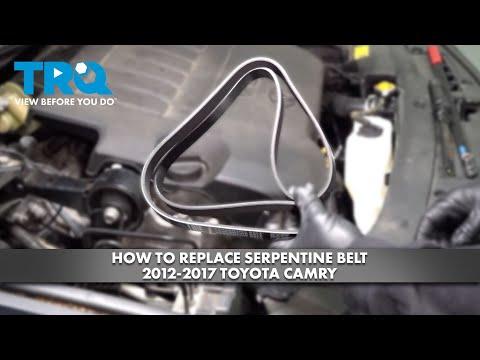







How to Replace the Serpentine Belt on a 2012-2017 Toyota Camry 2.5L (Engine: V6 3.5L)
Step-by-step DIY serpentine belt replacement with tools, parts list, torque specs, and safety tips for your 2013 Camry
How to Replace the Serpentine Belt on a 2012-2017 Toyota Camry 2.5L (Engine: V6 3.5L)
Step-by-step DIY serpentine belt replacement with tools, parts list, torque specs, and safety tips for your 2013 Camry for 2012, 2013, 2014, 2015, 2016, 2017


🔧 Camry - Serpentine Belt Replacement
You’ll be replacing the serpentine belt that drives your alternator, A/C compressor, and power steering on your Camry. The job mainly involves releasing the belt tensioner, removing the old belt, and routing a new belt correctly.
Difficulty Level: Beginner/Intermediate | Estimated Time: 1-1.5 hours
⚠️ Safety & Precautions
- ⚠️ Work on a completely cool engine; a hot engine can burn you.
- ⚠️ Turn the ignition off and remove the key; do not work with the engine running.
- ⚠️ Keep fingers and tools away from pulleys once the belt is off; edges can be sharp.
- ⚠️ If you lift the front of the car, always use jack stands; never rely only on the jack.
- ⚠️ Set the parking brake and chock the rear wheels so the car cannot roll.
- The battery does not have to be disconnected for this job, but do not let tools touch both the battery positive post and metal body at the same time.
🔧 Required Tools
You'll need the following tools for this repair:
- 🛠️ Floor jack (rated 2-ton or higher)
- 🛠️ Jack stands (rated 2-ton or higher, Qty: 2)
- 🛠️ Wheel chocks
- 🛠️ Torque wrench (10-100 ft-lbs range)
- 🛠️ 19mm socket
- 🛠️ 3/8" drive ratchet
- 🛠️ 1/2" drive breaker bar
- 🛠️ 3/8" to 1/2" adapter
- 🛠️ 10mm socket
- 🛠️ 12mm socket
- 🛠️ 14mm socket
- 🛠️ Socket extension (3"-6")
- 🛠️ Flathead screwdriver (medium size)
- 🛠️ Trim clip removal tool (specialty)
- 🛠️ Needle-nose pliers
- 🛠️ Work light or flashlight
- 🛠️ Mechanic gloves
- 🛠️ Safety glasses
- 🛠️ White paint marker or chalk
🔩 Required Parts
HowToo sells all the parts you need for this repair:
- 🔩 Serpentine drive belt (2.5L engine, with A/C) - Qty: 1
- 🔩 Belt tensioner assembly - Qty: 1 (optional but recommended if mileage is high)
- 🔩 Idler pulley - Qty: 1 (optional but recommended if pulley is noisy or rough)
- 🔩 Plastic splash shield push clips - Qty: 4-6 (to replace any broken clips)
- 🔩 Dielectric grease - Qty: 1 small tube (optional for pulley bolts)
📋 Before You Begin
- Park the Camry on level ground, set the parking brake, and place wheel chocks behind the rear wheels.
- Loosen the front passenger wheel lug nuts 1/2 turn with the car still on the ground.
- Raise the front passenger side with the floor jack and support it securely on a jack stand under the pinch weld or frame point.
- Remove the front passenger wheel for better side access to the belt area.
- Place your tools and new belt where you can reach them easily.
🔨 Step-by-Step Instructions
Follow these steps in order:
Step 1: Remove the passenger front wheel and splash shield
- Use the 21mm socket on your lug nuts (if not listed above, use the correct size socket that matches your lug nuts) and remove the front passenger wheel completely.
- Use a flathead screwdriver or trim clip removal tool to pop out the plastic clips and/or small screws holding the inner fender splash shield in place near the crank pulley area.
- Remove or fold back the splash shield to expose the lower pulleys and the belt path. Use needle-nose pliers if a clip is stubborn.
- Keep clips and screws in a small container.
Step 2: Note the belt routing
- On most Camrys there is a belt routing diagram sticker under the hood. If present, study it briefly.
- If there is no sticker, use your phone camera to take clear photos of how the belt is routed over each pulley from both the top and side.
- Use a white paint marker or chalk to mark the belt’s direction of rotation if you plan to compare routing later.
- Good photos save big headaches later.
Step 3: Locate the belt tensioner
- Look from the passenger wheel well and from the top of the engine bay to find the belt tensioner. It’s a spring-loaded arm with a pulley on the end.
- On the 2.5L engine, there is a hex head (for a socket) on the tensioner, usually taking a 19mm socket.
- Confirm that you can fit the 19mm socket and breaker bar onto that hex from either the top or wheel well.
Step 4: Release tension from the belt
- Install a 19mm socket on your breaker bar and place it on the tensioner hex.
- Rotate the tensioner in the direction that loosens the belt (usually clockwise when viewed from the front of the car). It will take firm pressure.
- While holding the breaker bar, slip the belt off the easiest pulley to access, usually the alternator or idler pulley, using your free hand.
- Slowly and gently let the tensioner return to its resting position while keeping control of the breaker bar.
- Never let the tensioner snap back freely.
Step 5: Remove the old belt
- With tension released, pull the belt off each pulley by hand from the top and from the wheel well.
- Remove the belt completely from the engine bay.
- Lay the old belt flat on the ground and place the new belt next to it to make sure length and rib count match.
- If they don’t match, do not install.
Step 6: Inspect pulleys and tensioner
- Spin each accessible pulley (idler, tensioner, alternator, A/C) by hand.
- If a pulley feels rough, makes noise, or has play, plan to replace that pulley or the entire tensioner assembly.
- If you are replacing the tensioner or idler now, you will need to remove their bolts.
Step 7 (optional): Replace belt tensioner and/or idler pulley
- To remove the idler pulley, use a 14mm socket and ratchet to remove its center bolt.
- Install the new idler pulley and tighten the bolt with a torque wrench and 14mm socket to 40 Nm (30 ft-lbs).
- To remove the belt tensioner assembly, remove the bolts holding it to the engine block using a 14mm socket.
- Install the new tensioner assembly, start all bolts by hand, then tighten with a torque wrench and 14mm socket to 40 Nm (30 ft-lbs).
- Snug first, then torque to spec.
Step 8: Route the new belt (without tension yet)
- Using your earlier photos or the under-hood diagram, start routing the new belt around the crankshaft pulley at the bottom.
- Route the belt around the non-tensioned pulleys (A/C compressor, alternator, idler, water pump) following the exact original pattern.
- Leave the easiest upper pulley (often the alternator or idler) for last, so that this is where you’ll slip the belt on once tension is released again.
- Make sure all ribs sit properly in the grooves on each ribbed pulley.
Step 9: Apply tension and seat the belt
- Again place the 19mm socket and breaker bar on the tensioner.
- Rotate the tensioner to the “loose” position to create slack in the belt.
- With your other hand, slide the belt onto the final pulley (alternator or idler).
- Double-check that the belt is fully seated in the grooves on all pulleys.
- Slowly release the tensioner so it applies tension to the belt.
- Take your time, don’t force the belt.
Step 10: Final belt alignment check
- From the top and from the wheel well, visually inspect the belt on each pulley.
- The belt ribs should sit centered in each grooved pulley; no part of the belt should hang off an edge.
- Gently push on the longest span of belt with your fingers; it should move a bit but feel firm. The tensioner sets the tension automatically.
Step 11: Reinstall splash shield and wheel
- Reposition the inner fender splash shield and line up the holes.
- Reinstall the plastic clips and any screws using your trim clip removal tool and flathead screwdriver.
- Reinstall the front passenger wheel and spin on the lug nuts by hand.
- Lower the car off the jack stand with the floor jack.
- With the car on the ground, tighten the lug nuts in a star pattern using a torque wrench and correct size socket to 103 Nm (76 ft-lbs).
Step 12: Start engine and observe
- Make sure all tools are out of the engine bay and wheel well.
- Start the engine and let it idle while you watch the belt from the top.
- The belt should run smoothly with no wobble, squeal, or visible misalignment.
- Turn on the A/C and headlights to put some load on the belt, and listen again.
✅ After Repair
- Check that the belt is tracking correctly and there are no noises (squealing, chirping, or grinding).
- Verify that the alternator is charging (no battery warning light on the dash).
- Confirm A/C blows cold and steering effort feels normal during a short test drive.
- After your first drive (5-10 km), recheck the belt visually to ensure it’s still centered on all pulleys.
💰 DIY vs Shop Cost
Shop Cost: $180-$320 (parts + labor)
DIY Cost: $25-$60 (belt only) or $70-$140 (belt + tensioner/idler)
You Save: $110-$250 by doing it yourself!
Shop labor rates vary but typically run $100-$150/hour. This repair takes a shop approximately 0.7-1.0 hours.
🎯 Ready to get started?
HowToo makes it easy: same-day/2-day shipping on every part, plus all the tools and specialty tools you need! Check out the parts and tools sections above to add everything to your cart.
Guide for Serpentine Belt replace for these Toyota vehicles
| Year Make Model | Sub Model | Engine | Body Style |
|---|---|---|---|
| 2017 Toyota Camry | - | Inline 4 2.5L | - |
| 2016 Toyota Camry | - | Inline 4 2.5L | - |
| 2015 Toyota Camry | - | Inline 4 2.5L | - |
| 2014 Toyota Camry | - | Inline 4 2.5L | - |
| 2013 Toyota Camry | - | Inline 4 2.5L | - |
| 2012 Toyota Camry | - | Inline 4 2.5L | - |