















How to Replace the Rear Wheel Bearing on a 2015 Toyota Highlander
Step-by-step rear hub assembly guide with tools, parts, torque specs, and safety tips for 2014, 2015, 2016, 2017, 2018, 2019, 2020, 2021, 2022, 2023, 2024, 2025
How to Replace the Rear Wheel Bearing on a 2015 Toyota Highlander
Step-by-step rear hub assembly guide with tools, parts, torque specs, and safety tips for 2014, 2015, 2016, 2017, 2018, 2019, 2020, 2021, 2022, 2023, 2024, 2025


🔧 Rear Wheel Bearing - Replacement
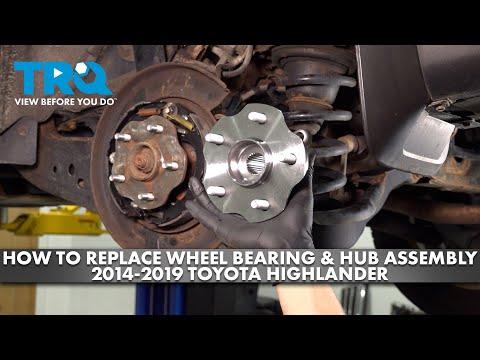
On your Highlander, the rear wheel bearing is serviced as a complete rear hub and bearing assembly. You will remove the rear wheel, brake caliper, rotor, and hub assembly, then install the new hub.
Difficulty Level: Intermediate | Estimated Time: 2-3 hours per side
⚠️ Safety & Precautions
- ⚠️ Work on a flat, solid surface and support your Highlander with jack stands before removing a wheel.
- ⚠️ Never rely on a floor jack alone. A floor jack lifts the vehicle; jack stands hold it safely.
- ⚠️ The rear brake caliper must be supported with wire or a bungee cord so the brake hose is not stretched.
- ⚠️ If the brake rotor is stuck, do not hammer the wheel studs directly because this can damage them.
- ⚠️ If your Highlander has an ABS wheel speed sensor near the hub, keep dirt and metal shavings away from it.
- ⚠️ Battery disconnect is not normally required for this repair.
🔧 Required Tools
You'll need the following tools for this repair:
- Floor jack (rated 3-ton minimum)
- Jack stands (rated 3-ton minimum)
- Wheel chocks
- 21mm lug nut socket
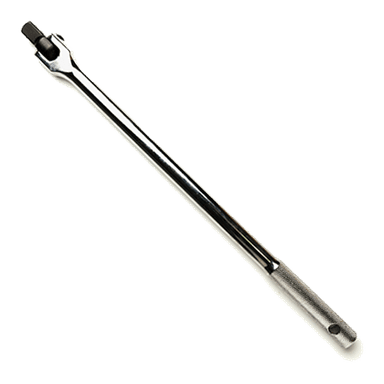
- Breaker bar 1/2-inch drive
- Torque wrench 1/2-inch drive
- 14mm socket
- 17mm socket
- Ratchet 1/2-inch drive
- Ratchet 3/8-inch drive
- Socket extension 3/8-inch drive 6-inch
- Flathead screwdriver medium
- Rubber mallet
- Ball-peen hammer 16 oz
- M8 x 1.25 bolts 40mm length
- Wire brush
- Needle-nose pliers
- Bungee cord
- Brake cleaner spray
- Nitrile gloves
- Safety glasses
🔩 Required Parts
HowToo sells all the parts you need for this repair:
- Rear wheel hub and bearing assembly - Qty: 1 per side
- Rear hub mounting bolts - Qty: 4 per side
- Brake cleaner - Qty: 1 can
- Anti-seize compound - Qty: 1 small tube
📋 Before You Begin
- 🚗 Park your Highlander on level ground and shift to Park.
- 🧱 Place wheel chocks in front of the front wheels. Wheel chocks are wedges that stop the vehicle from rolling.
- 🅿️ Leave the parking brake released after the vehicle is safely chocked, because the rear rotor may not come off if the parking brake is applied.
- 🔩 Slightly loosen the rear lug nuts before lifting the vehicle.
- 📌 This procedure is for one rear side. Repeat the same steps on the opposite rear side if replacing both.
🔨 Step-by-Step Instructions
Follow these steps in order:
Step 1: Loosen the Rear Wheel
- Use the 21mm lug nut socket and breaker bar 1/2-inch drive to loosen the rear wheel lug nuts about one turn.
- Do not remove the lug nuts yet.
- Loosen first, lift second.
Step 2: Lift and Support the Vehicle
- Use the floor jack (rated 3-ton minimum) to lift the rear of your Highlander at the proper rear lift point.
- Place jack stands (rated 3-ton minimum) under the rear support points.
- Slowly lower the vehicle onto the jack stands.
- Gently push the vehicle by hand to confirm it is stable before working underneath or beside it.
Step 3: Remove the Rear Wheel
- Use the 21mm lug nut socket and ratchet 1/2-inch drive to remove the loosened lug nuts.
- Remove the wheel and set it flat on the ground.
- Slide the wheel partly under the vehicle as a backup safety measure.
Step 4: Remove the Brake Caliper
- Use the 14mm socket and ratchet 3/8-inch drive to remove the two rear brake caliper slide pin bolts.
- Lift the brake caliper off the rotor.
- Hang the caliper from the suspension using the bungee cord.
- Do not let the caliper hang by the rubber brake hose.
Step 5: Remove the Brake Caliper Bracket
- Use the 17mm socket, ratchet 1/2-inch drive, and breaker bar 1/2-inch drive if needed to remove the two caliper bracket bolts.
- Remove the caliper bracket and set it aside.
- During reassembly, tighten the caliper bracket bolts to Torque to 79 Nm (58 ft-lbs).
Step 6: Remove the Rear Brake Rotor
- Make sure the parking brake is released.
- Pull the rotor straight off by hand.
- If the rotor is stuck, thread two M8 x 1.25 bolts 40mm length evenly into the threaded holes on the rotor face.
- Use the ratchet 3/8-inch drive to turn each bolt a little at a time until the rotor pops loose.
- If needed, tap the rotor hat lightly with the rubber mallet.
- Even turns prevent rotor binding.
Step 7: Inspect the Parking Brake Area
- Use the safety glasses and brake cleaner spray to clean light brake dust from the parking brake shoe area.
- Do not breathe brake dust.
- Use the flathead screwdriver medium only if you need to gently move the parking brake shoes away from the hub area.
Step 8: Disconnect or Move the ABS Sensor Harness if Needed
- Look behind the hub for the ABS wheel speed sensor wiring. ABS means anti-lock braking system.
- If the harness clips are attached near the hub, use needle-nose pliers to release the clips carefully.
- Move the harness out of the way so it cannot be pulled or pinched.
- Do not pry on the plastic sensor body unless removal is required.
Step 9: Remove the Rear Hub and Bearing Assembly
- From the back side of the knuckle, use the 14mm socket, socket extension 3/8-inch drive 6-inch, and ratchet 3/8-inch drive to remove the four rear hub mounting bolts.
- If the bolts are tight, use the breaker bar 1/2-inch drive with the correct socket setup for extra leverage.
- Support the hub with one hand as the last bolt comes out.
- Pull the hub assembly straight out of the knuckle.
- If the hub is stuck from rust, tap around the hub flange with the ball-peen hammer 16 oz until it loosens.
Step 10: Clean the Mounting Surface
- Use the wire brush to clean rust and debris from the knuckle mounting face.
- Spray the area with brake cleaner spray and wipe it clean.
- Apply a very thin film of anti-seize compound to the hub center bore area only.
- Do not put anti-seize on the bolt threads unless the replacement instructions allow it.
Step 11: Install the New Rear Hub and Bearing Assembly
- Position the new rear wheel hub and bearing assembly into the knuckle by hand.
- Install the four rear hub mounting bolts by hand first to avoid cross-threading.
- Use the 14mm socket, socket extension 3/8-inch drive 6-inch, and ratchet 3/8-inch drive to snug the bolts evenly in a crisscross pattern.
- Use the torque wrench 1/2-inch drive and 14mm socket to tighten the hub bolts to Torque to 80 Nm (59 ft-lbs).
Step 12: Reposition the ABS Sensor Harness
- Use your hands and needle-nose pliers if needed to reinstall the ABS harness clips into their original positions.
- Make sure the wiring is not twisted, stretched, or touching the brake rotor area.
Step 13: Reinstall the Rear Brake Rotor
- Slide the brake rotor onto the new hub by hand.
- If the rotor does not sit flat, remove it and check that the parking brake shoes are centered.
- Use brake cleaner spray to clean oily fingerprints from the rotor surface.
Step 14: Reinstall the Caliper Bracket
- Place the caliper bracket back over the rotor.
- Start both bracket bolts by hand.
- Use the 17mm socket and ratchet 1/2-inch drive to snug the bolts.
- Use the torque wrench 1/2-inch drive and 17mm socket to tighten the bracket bolts to Torque to 79 Nm (58 ft-lbs).
Step 15: Reinstall the Brake Caliper
- Remove the bungee cord and slide the caliper back over the rotor and pads.
- Install the two slide pin bolts by hand.
- Use the 14mm socket and ratchet 3/8-inch drive to snug the bolts.
- Use the torque wrench 1/2-inch drive and 14mm socket to tighten the caliper slide pin bolts to Torque to 34 Nm (25 ft-lbs).
Step 16: Reinstall the Wheel
- Place the wheel back on the hub.
- Install the lug nuts by hand with the tapered side facing the wheel.
- Use the 21mm lug nut socket and ratchet 1/2-inch drive to snug the lug nuts in a star pattern.
Step 17: Lower and Torque the Wheel
- Use the floor jack (rated 3-ton minimum) to lift the vehicle slightly off the jack stands.
- Remove the jack stands (rated 3-ton minimum).
- Lower your Highlander until the tire touches the ground and cannot spin.
- Use the torque wrench 1/2-inch drive and 21mm lug nut socket to tighten the lug nuts in a star pattern to Torque to 103 Nm (76 ft-lbs).
- Lower the vehicle completely.
✅ After Repair
- ✅ Pump the brake pedal several times until it feels firm before moving your Highlander.
- ✅ Set and release the parking brake to confirm normal operation.
- ✅ Drive slowly at first and listen for grinding, scraping, humming, or clicking.
- ✅ Check that the ABS warning light stays off after a short drive.
- ✅ Recheck the lug nut torque after 25-50 miles: Torque to 103 Nm (76 ft-lbs).
💰 DIY vs Shop Cost
Shop Cost: $450-$750 per rear side (parts + labor)
DIY Cost: $120-$280 per rear side (parts only)
You Save: $330-$470 per rear side by doing it yourself!
Shop labor rates vary but typically run $100-$150/hour. This repair takes a shop approximately 1.5-2.5 hours.
🎯 Ready to get started?
HowToo makes it easy: same-day/2-day shipping on every part, plus all the tools and specialty tools you need! Check out the parts and tools sections below to add everything to your cart.