














How to Replace the Rear Wheel Bearing on a 2012-2017 Toyota Camry (Engine: V6 3.5L)
Step-by-step hub assembly replacement with tools, parts, torque specs, and safety tips
How to Replace the Rear Wheel Bearing on a 2012-2017 Toyota Camry (Engine: V6 3.5L)
Step-by-step hub assembly replacement with tools, parts, torque specs, and safety tips for 2012, 2013, 2014, 2015, 2016, 2017


🔧 Rear Wheel Bearings - Hub Assembly Replacement
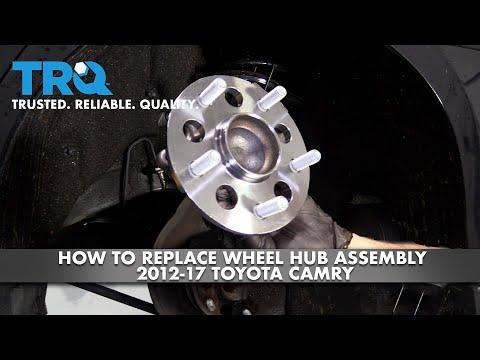
On your Camry, the rear wheel bearing is replaced as a hub and bearing assembly. This job involves removing the wheel, brake components, and the rear hub unit, then installing the new assembly and torquing everything back to spec.
Difficulty Level: Intermediate | Estimated Time: 2-3 hours per side
⚠️ Safety & Precautions
- Support the car securely on jack stands before removing any rear suspension or brake parts.
- Engage the parking brake before lifting, then release it only when you need to remove the rear rotor or hub parts.
- If the brake rotor is stuck, do not pry against the backing plate or ABS sensor area.
- Do not let the brake caliper hang by the hose.
- Keep dirt and metal debris away from the ABS wheel speed sensor and tone ring.
- Battery disconnect is not required for this repair.
🔧 Required Tools
You'll need the following tools for this repair:
- Floor jack (rated 3-ton minimum)
- Jack stands
- Wheel chocks
- 21mm lug wrench or socket
- 14mm socket
- 17mm socket
- 10mm socket
- Ratchet
- Breaker bar
- Torque wrench
- Flat blade screwdriver
- Needle-nose pliers
- Rubber mallet
- Penetrating oil
- Brake cleaner
- Safety glasses
- Mechanic gloves
🔩 Required Parts
HowToo sells all the parts you need for this repair:
- Rear wheel hub and bearing assembly - Qty: 1 per side
- Rear hub mounting bolts - Qty: 4 per side
- Rear brake caliper bracket bolts - Qty: 2 if damaged or corroded
- Rear brake pads - Qty: 1 set if wear is near limit
- Rear brake rotor - Qty: 1 per side if worn or damaged
- Brake cleaner - Qty: 1 can
📋 Before You Begin
- Park on level ground and chock the front wheels.
- Set the parking brake before lifting the rear of the car.
- If you are replacing one side only, the opposite side can stay assembled.
- Soak the hub bolts and caliper bolts with penetrating oil before starting if they are rusty.
- Rusty bolts move easier after a few minutes.
🔨 Step-by-Step Instructions
Follow these steps in order:
Step 1: Lift and secure the car
- Use a floor jack to raise the rear of the car at the proper lift point.
- Support it with jack stands under the rear support points.
- Remove the wheel using a 21mm lug wrench or socket.
- Torque wheel lug nuts to 103 Nm (76 ft-lbs) during reassembly.
Step 2: Remove the brake caliper and bracket
- Use a 14mm socket to remove the caliper slide bolts.
- Lift the caliper off and hang it with wire or a hook so the hose is not stressed.
- Use a 17mm socket to remove the caliper bracket bolts.
- Torque caliper bracket bolts to 102 Nm (75 ft-lbs) on reassembly.
- Do not let the caliper dangle.
Step 3: Remove the brake rotor
- Pull the rotor straight off the hub.
- If it is stuck, use a rubber mallet and tap around the rotor hat.
- If needed, back off the parking brake slightly to free the rotor.
- Set the rotor aside on a clean surface.
Step 4: Disconnect the ABS wheel speed sensor if needed
- Locate the rear ABS sensor harness and connector.
- Use a 10mm socket if a sensor bracket bolt must be removed for access.
- Unclip the harness carefully with needle-nose pliers if needed.
- Do not pull on the wire itself.
Step 5: Remove the hub and bearing assembly
- Use a 14mm socket to remove the hub mounting bolts from the back side of the knuckle.
- If the hub is stuck in the knuckle, spray penetrating oil around the seam.
- Tap the hub assembly out gently with a rubber mallet.
- Remove the hub assembly from the knuckle.
- Work evenly so the hub comes out straight.
Step 6: Clean the mounting surface
- Use a wire brush if available and brake cleaner to clean the knuckle mounting surface.
- Make sure there is no rust or debris where the new hub sits.
- Inspect the ABS sensor area for damage or buildup.
Step 7: Install the new hub and bearing assembly
- Position the new hub assembly into the knuckle by hand.
- Start all hub bolts by hand first.
- Use a 14mm socket to tighten the hub bolts evenly in a crisscross pattern.
- Torque hub bolts to 70 Nm (52 ft-lbs).
Step 8: Reinstall the rotor, bracket, and caliper
- Slide the rotor back onto the hub.
- Reinstall the caliper bracket using a 17mm socket.
- Torque caliper bracket bolts to 102 Nm (75 ft-lbs).
- Reinstall the caliper using a 14mm socket.
- Torque caliper slide bolts to 34 Nm (25 ft-lbs).
Step 9: Reinstall the wheel and lower the car
- Put the wheel back on and hand-tighten the lug nuts.
- Lower the car with the floor jack.
- Use a 21mm lug wrench or socket to torque the lug nuts in a star pattern.
- Torque wheel lug nuts to 103 Nm (76 ft-lbs).
✅ After Repair
- Pump the brake pedal several times before moving the car.
- Check that the wheel spins freely with no scraping.
- Road test at low speed first and listen for noise.
- Recheck lug nut torque after the test drive.
- If the ABS light is on, scan for wheel speed sensor faults.
💰 DIY vs Shop Cost
Shop Cost: $350-$700 per side (parts + labor)
DIY Cost: $120-$280 per side (parts only)
You Save: $230-$420 by doing it yourself!
Shop labor rates vary but typically run $100-$150/hour. This repair takes a shop approximately 1.5-2.5 hours per side.
🎯 Ready to get started?
HowToo makes it easy: same-day/2-day shipping on every part, plus all the tools and specialty tools you need! Check out the parts and tools sections below to add everything to your cart.
Guide for Wheel Bearing and Hub Assembly replace for these Toyota vehicles
| Year Make Model | Sub Model | Engine | Body Style |
|---|---|---|---|
| 2017 Toyota Camry | - | Inline 4 2.5L | - |
| 2017 Toyota Camry | - | V6 3.5L | - |
| 2016 Toyota Camry | - | Inline 4 2.5L | - |
| 2016 Toyota Camry | - | V6 3.5L | - |
| 2015 Toyota Camry | - | Inline 4 2.5L | - |
| 2015 Toyota Camry | - | V6 3.5L | - |
| 2014 Toyota Camry | - | Inline 4 2.5L | - |
| 2014 Toyota Camry | - | V6 3.5L | - |
| 2013 Toyota Camry | - | Inline 4 2.5L | - |
| 2013 Toyota Camry | - | V6 3.5L | - |
| 2012 Toyota Camry | - | Inline 4 2.5L | - |
| 2012 Toyota Camry | - | V6 3.5L | - |