









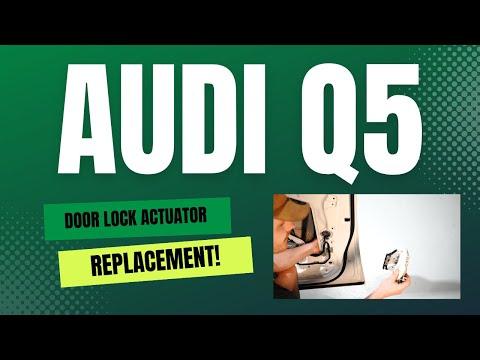







How to Replace the Rear Door Lock Actuator (Latch) on a 2018 Audi Q5
Step-by-step rear door panel removal, latch swap, required tools/parts, torque specs, and airbag safety tips
How to Replace the Rear Door Lock Actuator (Latch) on a 2018 Audi Q5
Step-by-step rear door panel removal, latch swap, required tools/parts, torque specs, and airbag safety tips


🔧 Q5 - Rear Door Lock Actuator Replacement
The rear door lock actuator is built into the door latch assembly on your Q5. Replacing it means removing the inner door panel, peeling back the moisture barrier, swapping the latch/actuator unit, and then testing the central locking and handle operation.
Difficulty Level: Intermediate | Estimated Time: 1.5-3.0 hours (first time DIY)
⚠️ Safety & Precautions
- ⚠️ The rear door contains an airbag; disconnect the battery before unplugging door wiring.
- ⚠️ After disconnecting the battery, wait 10 minutes before working near airbag connectors.
- ⚠️ Do not turn the ignition ON with the door airbag connector unplugged, or you may set an airbag fault light.
- ⚠️ Support the door panel while unplugging connectors so it doesn’t fall and crack.
🔧 Required Tools
You'll need the following tools for this repair:
- Safety glasses
- Mechanic gloves
- 10mm socket
- 1/4" drive ratchet
- 3" extension (1/4")
- Torque wrench (2–25 Nm range)
- Torx T20 bit
- Torx T25 bit
- Torx T30 bit
- Small flat trim pick
- Plastic trim removal tool set
- Needle-nose pliers
- Painter’s tape
- Magnetic pickup tool
🔩 Required Parts
HowToo sells all the parts you need for this repair:
- Rear door lock actuator / latch assembly (left or right rear, match your door) - Qty: 1
- Rear door trim panel clips - Qty: 6-10
- Butyl sealant rope (for resealing moisture barrier) - Qty: 1
📋 Before You Begin
- Park on level ground, ignition OFF, key away from the vehicle.
- Lower the window slightly, then raise it fully (this helps confirm smooth operation later).
- Use 10mm socket to disconnect the negative battery terminal, then wait 10 minutes.
- Apply painter’s tape along painted edges near the door panel to prevent scratches.
🔨 Step-by-Step Instructions
Follow these steps in order:
Step 1: Remove trim covers and door panel screws
- Use a plastic trim removal tool set to pop off the small trim cover(s) in the pull handle and near the inner door release area.
- Use a Torx T20 bit and 1/4" drive ratchet to remove the exposed screws.
- Use a Torx T25 bit to remove any additional lower-edge door panel screws (some panels use a mix of T20/T25).
Step 2: Release the door panel clips
- Use a plastic trim removal tool set to work around the outer edge of the panel and pop the clips free.
- Lift the panel straight up to unhook it from the top window channel.
- Go slow—clips break easily.
Step 3: Disconnect wiring and the interior handle cable
- Support the panel with one hand while you disconnect connectors using a small flat trim pick to lift lock tabs.
- If equipped, disconnect the door light and speaker connectors using the small flat trim pick.
- Disconnect the interior door handle cable:
- Use needle-nose pliers to rotate the cable housing out of its bracket.
- Then unhook the cable end from the handle lever.
Step 4: Peel back the moisture barrier
- The moisture barrier is the plastic sheet that keeps water off the cabin-side electronics.
- Use a plastic trim removal tool set to carefully peel it back only as much as needed to access the latch area.
- If the sticky sealant stretches, you’ll reseal it later using butyl sealant rope (butyl is a sticky sealing putty used on door membranes).
Step 5: Remove the rear door latch/actuator from the door edge
- At the trailing edge of the door (latch side), use a Torx T30 bit with 1/4" drive ratchet and 3" extension (1/4") to remove the latch mounting bolts (typically 3).
- Keep one hand on the latch inside the door so it doesn’t drop.
- Torque to 8 Nm (71 in-lbs) during reinstallation.
Step 6: Disconnect the latch electrical connector and handle cables
- Use a small flat trim pick to release the latch electrical connector lock tab, then unplug it.
- Disconnect the exterior handle cable (and any secondary link/cable for child-safety/lock function if equipped):
- Use needle-nose pliers to rotate the cable housing out of its bracket.
- Unhook the cable end from the latch lever.
- Take a photo before unhooking cables.
Step 7: Remove and replace the latch/actuator assembly
- Maneuver the latch assembly out through the access opening (rotate as needed).
- Install the new latch/actuator in the same orientation.
- Reconnect the electrical connector (make sure the lock tab clicks).
- Reconnect all cables and confirm each cable housing is fully seated in its bracket.
Step 8: Bolt the latch in place
- Start all latch bolts by hand to avoid cross-threading.
- Use a Torx T30 bit to tighten them evenly.
- Use a torque wrench (2–25 Nm range) to finish tightening: Torque to 8 Nm (71 in-lbs).
Step 9: Reseal the moisture barrier and reinstall the door panel
- Press the moisture barrier back into place; add butyl sealant rope anywhere the original seal is damaged or no longer sticky.
- Reconnect all door panel electrical connectors using the small flat trim pick to ensure lock tabs are fully seated.
- Reconnect the interior handle cable using needle-nose pliers to seat the cable housing.
- Hang the door panel on the top edge first, then press clips in around the perimeter by hand.
- Reinstall screws using Torx T20 bit / Torx T25 bit as removed, then reinstall trim covers.
Step 10: Reconnect the battery
- Use a 10mm socket to reconnect the negative battery terminal.
- Snug the terminal clamp securely (do not over-tighten).
✅ After Repair
- With the door open, use the key fob to lock/unlock and confirm the latch moves correctly.
- Check inside and outside handles: confirm the door opens smoothly and doesn’t “double-pull” or stick.
- Check child safety lock operation (rear door) if equipped.
- Confirm the window, speaker, and door light work.
- If an airbag light appears because the ignition was turned on during the job, it will require a scan tool to clear.
💰 DIY vs Shop Cost
Shop Cost: $450-$900 (parts + labor)
DIY Cost: $140-$320 (parts only)
You Save: $310-$580 by doing it yourself!
Shop labor rates vary but typically run $100-$150/hour. This repair takes a shop approximately 1.5-2.5 hours.
🎯 Ready to get started?
HowToo makes it easy: same-day/2-day shipping on every part, plus all the tools and specialty tools you need! Check out the parts and tools sections below to add everything to your cart.