








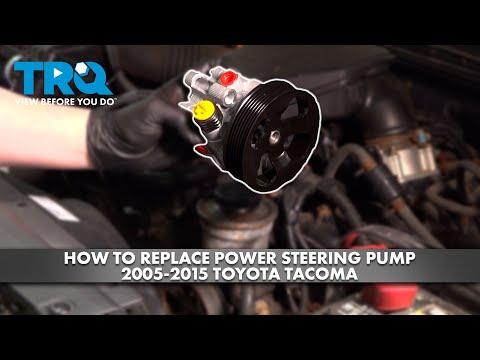




How to Replace the Power Steering Pump on a 2005-2015 Toyota Tacoma (Trim: Base | Engine: V6 4.0L)
Step-by-step DIY guide with tools, parts, torque specs, bleeding tips, and safety checks
How to Replace the Power Steering Pump on a 2005-2015 Toyota Tacoma (Trim: Base | Engine: V6 4.0L)
Step-by-step DIY guide with tools, parts, torque specs, bleeding tips, and safety checks for 2005, 2006, 2007, 2008, 2009, 2010, 2011, 2012, 2013, 2014, 2015


🔧 Tacoma - Power Steering Pump Replacement
Replacing the power steering pump on your Tacoma involves removing the drive belt, disconnecting the pressure and return lines, unbolting the pump, then bleeding air out of the system after installation. A failing pump may whine, leak, feel heavy when turning, or create foamy fluid.
Difficulty Level: Intermediate | Estimated Time: 2-3 hours
⚠️ Safety & Precautions
- ⚠️ Work on a cool engine only. The power steering pump sits near hot engine parts.
- ⚠️ Wear safety glasses and gloves. Power steering fluid can irritate skin and eyes.
- ⚠️ Disconnect the negative battery cable before working near the engine accessory drive.
- ⚠️ Do not start the engine with power steering lines disconnected.
- ⚠️ Keep the serpentine belt routing correct. A misrouted belt can damage accessories.
- ⚠️ Power steering fluid is slippery. Clean spills immediately to avoid falls and belt contamination.
🔧 Required Tools
You'll need the following tools for this repair:
- 10mm socket
- 12mm socket
- 14mm socket
- 17mm socket
- 3/8-inch ratchet
- 3/8-inch extension set
- 14mm combination wrench
- 17mm flare nut wrench
- 19mm wrench
- Serpentine belt tool (specialty)
- Power steering pulley puller and installer kit (specialty)
- Torque wrench rated 10-100 ft-lbs
- Flat-blade screwdriver
- Hose pinch-off pliers
- Drain pan
- Shop rags
- Turkey baster or fluid transfer syringe
- Floor jack rated 3-ton minimum
- Jack stands rated 3-ton minimum
- Wheel chocks
- Nitrile gloves
- Safety glasses
🔩 Required Parts
HowToo sells all the parts you need for this repair:
- Power steering pump - Qty: 1
- Power steering pump O-ring seal kit - Qty: 1
- Power steering pressure line sealing washers - Qty: 2
- Automatic transmission fluid Dexron II or Dexron III equivalent - Qty: 2 quarts
- Serpentine belt - Qty: 1
📋 Before You Begin
- 🚗 Park your Tacoma on level ground, shift into neutral, set the parking brake, and chock the rear wheels.
- 🔋 Use a 10mm socket to disconnect the negative battery cable. Move the cable aside so it cannot spring back onto the terminal.
- 🧴 Use a turkey baster or fluid transfer syringe to remove as much old fluid as possible from the power steering reservoir.
- 📝 Take a clear photo of the serpentine belt routing before removal. This helps during reassembly.
- 🛞 Raise the front of your Tacoma with a floor jack and support it securely on jack stands. This makes bleeding the steering system easier.
- 📌 A flare nut wrench grips more sides of a line fitting than a normal wrench, which helps prevent rounding the fitting.
- 📌 A pulley puller/installer removes and installs the pressed-on power steering pump pulley without bending it.
🔨 Step-by-Step Instructions
Follow these steps in order:
Step 1: Remove the Engine Splash Shield
- Use a 10mm socket and 3/8-inch ratchet to remove the lower engine splash shield fasteners, if equipped.
- Set the shield and fasteners aside in order.
- Use a small tray for bolts.
Step 2: Relieve Belt Tension
- Use a serpentine belt tool or 19mm wrench on the belt tensioner to rotate the tensioner and release belt tension.
- Slide the serpentine belt off the power steering pump pulley.
- Slowly release the tensioner. Do not let it snap back.
- If replacing the belt, remove it fully from the remaining pulleys.
Step 3: Drain and Control Fluid Spillage
- Place a drain pan under the power steering pump area.
- Use hose pinch-off pliers to gently clamp the rubber return hose.
- Use shop rags around the pump fittings to catch fluid.
- Power steering fluid spreads fast.
Step 4: Disconnect the Return Hose
- Use pliers or a flat-blade screwdriver to release the clamp on the rubber return hose at the pump reservoir fitting.
- Twist the hose gently by hand to break it loose, then pull it off the fitting.
- Drain the hose into the drain pan.
- Plug or raise the hose end to reduce dripping.
Step 5: Disconnect the Pressure Line
- Use a 17mm flare nut wrench to loosen the high-pressure power steering line fitting at the pump.
- Once loose, finish removing the fitting by hand if possible.
- Remove and discard the old sealing washers or O-ring, depending on the fitting style supplied on your Tacoma.
- Keep dirt out of the open line and pump ports.
- Do not force the fitting.
Step 6: Remove the Power Steering Pump Mounting Bolts
- Use a 12mm socket, 14mm socket, 3/8-inch ratchet, and extension as needed to remove the power steering pump mounting bolts.
- Support the pump with one hand while removing the final bolt.
- Lift the pump out of the engine bay carefully.
Step 7: Transfer the Pulley to the New Pump
- Place the old pump on a stable work surface.
- Use the power steering pulley puller from the pulley puller and installer kit to remove the pulley from the old pump shaft.
- Inspect the pulley for cracks, bent grooves, or wobble. Replace it if damaged.
- Use the pulley installer from the kit to press the pulley onto the new pump shaft until it is aligned with the original pulley position.
- Do not hammer the pulley onto the shaft. Hammering can ruin the new pump bearing.
Step 8: Install the New Power Steering Pump
- Position the new pump on the mounting bracket.
- Start all mounting bolts by hand first to avoid cross-threading.
- Use a 12mm socket or 14mm socket to snug the mounting bolts evenly.
- Use a torque wrench to tighten the pump mounting bolts to Torque to 39 Nm (29 ft-lbs).
Step 9: Reconnect the Pressure Line
- Install new sealing washers or O-ring from the power steering pump O-ring seal kit.
- Thread the pressure line fitting into the new pump by hand first.
- Use a 17mm flare nut wrench to tighten the fitting.
- Use a torque wrench with a suitable adapter if available and tighten the pressure fitting to Torque to 36 Nm (27 ft-lbs).
- If using a crowfoot adapter, keep it at 90 degrees to the torque wrench handle for best accuracy.
Step 10: Reconnect the Return Hose
- Slide the rubber return hose fully onto the pump reservoir fitting by hand.
- Use pliers or a flat-blade screwdriver to reinstall the hose clamp in its original position.
- Remove the hose pinch-off pliers.
- Wipe the area clean with shop rags so leaks are easy to spot later.
Step 11: Reinstall the Serpentine Belt
- Route the serpentine belt over the pulleys using your belt routing photo.
- Use the serpentine belt tool or 19mm wrench to rotate the tensioner.
- Slip the belt over the final pulley, then slowly release the tensioner.
- Check that the belt ribs sit fully inside every pulley groove.
- One rib off can shred the belt.
Step 12: Fill the Reservoir
- Use automatic transmission fluid Dexron II or Dexron III equivalent only for the power steering system.
- Fill the reservoir to the COLD level mark.
- Leave the cap off for the first part of bleeding.
Step 13: Bleed the System With Engine Off
- Keep the front wheels off the ground on jack stands.
- With the engine OFF, slowly turn the steering wheel from full left to full right 15-20 times.
- Do not hold the wheel hard against the stops.
- Check the reservoir often and add fluid as the level drops.
- Watch for bubbles or foam in the reservoir.
Step 14: Bleed the System With Engine Running
- Reconnect the negative battery cable with a 10mm socket.
- Start the engine and let it idle.
- Slowly turn the steering wheel left and right several times using both hands.
- Do not hold the wheel at full lock for more than 2 seconds.
- Top off the reservoir to the correct level as needed.
- If the fluid becomes foamy, shut the engine off and let the bubbles settle for 10-15 minutes.
Step 15: Reinstall the Splash Shield and Lower the Truck
- Use a 10mm socket and 3/8-inch ratchet to reinstall the lower splash shield fasteners.
- Use the floor jack to raise the front slightly, remove the jack stands, then lower your Tacoma to the ground.
- Remove the wheel chocks after the truck is safely on the ground.
✅ After Repair
- ✅ Check the reservoir level with the engine off and fluid settled. Add Dexron II or Dexron III equivalent if needed.
- ✅ Start the engine and listen for whining. A little noise at first can happen, but it should fade as air leaves the system.
- ✅ Turn the steering wheel slowly both directions and confirm assist feels smooth.
- ✅ Inspect the pressure fitting, return hose, pump body, and reservoir area for leaks.
- ✅ Road test at low speed first. Recheck fluid level and leaks afterward.
- ✅ If steering remains noisy or jerky, repeat the bleeding process. Air trapped in the system is the most common cause.
💰 DIY vs Shop Cost
Shop Cost: $550-$950 (parts + labor)
DIY Cost: $160-$420 (parts only)
You Save: $390-$530 by doing it yourself!
Shop labor rates vary but typically run $100-$150/hour. This repair takes a shop approximately 1.8-2.5 hours.
🎯 Ready to get started?
HowToo makes it easy: same-day/2-day shipping on every part, plus all the tools and specialty tools you need! Check out the parts and tools sections below to add everything to your cart.
Guide for Power Steering Pump replace for these Toyota vehicles
| Year Make Model | Sub Model | Engine | Body Style |
|---|---|---|---|
| 2015 Toyota Tacoma | Base | V6 4.0L | - |
| 2015 Toyota Tacoma | Pre Runner | V6 4.0L | - |
| 2014 Toyota Tacoma | Base | V6 4.0L | - |
| 2014 Toyota Tacoma | Pre Runner | V6 4.0L | - |
| 2013 Toyota Tacoma | Base | V6 4.0L | - |
| 2013 Toyota Tacoma | Pre Runner | V6 4.0L | - |
| 2012 Toyota Tacoma | Base | V6 4.0L | - |
| 2012 Toyota Tacoma | Pre Runner | V6 4.0L | - |
| 2011 Toyota Tacoma | Base | V6 4.0L | - |
| 2011 Toyota Tacoma | Pre Runner | V6 4.0L | - |
| 2010 Toyota Tacoma | Base | V6 4.0L | - |
| 2010 Toyota Tacoma | Pre Runner | V6 4.0L | - |
| 2009 Toyota Tacoma | Base | V6 4.0L | - |
| 2009 Toyota Tacoma | Pre Runner | V6 4.0L | - |
| 2008 Toyota Tacoma | Base | V6 4.0L | - |
| 2008 Toyota Tacoma | Pre Runner | V6 4.0L | - |
| 2007 Toyota Tacoma | Base | V6 4.0L | - |
| 2007 Toyota Tacoma | Pre Runner | V6 4.0L | - |
| 2006 Toyota Tacoma | Base | V6 4.0L | - |
| 2006 Toyota Tacoma | Pre Runner | V6 4.0L | - |
| 2005 Toyota Tacoma | Base | V6 4.0L | - |
| 2005 Toyota Tacoma | Pre Runner | V6 4.0L | - |