









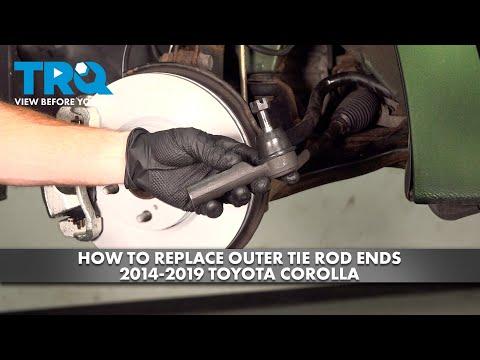







How to Replace the Outer Tie Rod End on a 2017 Toyota Corolla
Step-by-step DIY tie rod end replacement with tools, parts list, torque specs, safety tips, and cost savings
How to Replace the Outer Tie Rod End on a 2017 Toyota Corolla
Step-by-step DIY tie rod end replacement with tools, parts list, torque specs, safety tips, and cost savings


🔧 Corolla - Tie Rod End Replacement
We’ll go through how to replace a front tie rod end, which connects the steering rack to the wheel hub and keeps your steering aligned. A worn tie rod end can cause loose steering, clunks, and uneven tire wear.
Difficulty Level: Intermediate | Estimated Time: 1–2 hours per side
⚠️ Safety & Precautions
- 🛑 Always support the car with jack stands; never work under a car held up only by a jack.
- 🛑 Wear safety glasses; tie rod ends can release suddenly when separated.
- 🛑 Chock the rear wheels so the car cannot roll.
- 🛑 Do not put your hands between the tire and body while raising or lowering the car.
- 🛑 After this job you must get a professional wheel alignment to prevent tire wear.
- 🛑 This job does not require battery disconnection.
🔧 Required Tools
You'll need the following tools for this repair:
- 🧰 Floor jack (rated 2-ton or higher)
- 🧰 Jack stands (rated 2-ton or higher, Qty: 2)
- 🧰 Wheel chocks
- 🧰 Lug wrench or 21mm socket
- 🧰 Ratchet handle (3/8" or 1/2")
- 🧰 17mm socket
- 🧰 19mm open-end wrench
- 🧰 Adjustable wrench (250mm)
- 🧰 Torque wrench (10–150 ft-lbs range)
- 🧰 Tie rod end puller (specialty)
- 🧰 Needle-nose pliers
- 🧰 Wire brush
- 🧰 Paint marker or white correction pen
- 🧰 Penetrating oil spray
- 🧰 Hammer (small, 16–24 oz)
- 🧰 Flathead screwdriver (medium)
- 🧰 Measuring tape (metric)
- 🧰 Gloves
- 🧰 Safety glasses
🔩 Required Parts
HowToo sells all the parts you need for this repair:
- 🔩 Front outer tie rod end (left or right, as needed) - Qty: 1 per side
- 🔩 New tie rod end nut - Qty: 1 per side
- 🔩 New castle nut and cotter pin set - Qty: 1 set per side
- 🔩 Anti-seize compound - Qty: small tube
- 🔩 Penetrating oil - Qty: 1 can
- 🔩 Rust penetrant / light grease spray - Qty: 1 can
📋 Before You Begin
- 🧱 Park the Corolla on level ground, set the parking brake, and place wheel chocks behind the rear wheels.
- 🧱 Loosen (do not remove) the front wheel lug nuts a half-turn with the lug wrench or 21mm socket while the car is still on the ground.
- 🧱 Decide which side you are replacing: driver, passenger, or both. It’s best to replace in pairs.
- 🧱 Spray penetrating oil on the tie rod end threads and jam nut where it meets the inner tie rod; let it soak 5–10 minutes.
🔨 Step-by-Step Instructions
Follow these steps in order:
Step 1: Raise and support the front of the car
- Use the floor jack under the front center jacking point (behind the front bumper, on the subframe) to lift the front of the car.
- Place jack stands under the left and right front pinch welds or frame points and slowly lower the car onto the stands using the floor jack.
- Remove the front wheel on the side you’re working on using the lug wrench or 21mm socket.
- Give the car a shake on stands to confirm stability.
Step 2: Identify the outer tie rod end
- Look behind the brake rotor: the outer tie rod end is the small arm that connects the steering arm on the wheel hub (knuckle) to the inner tie rod coming from the steering rack.
- It has a ball joint stud going through the steering knuckle, with a nut and usually a cotter pin.
Step 3: Mark the tie rod length to keep alignment close
- Use the wire brush to clean the exposed threads where the outer tie rod meets the inner tie rod.
- Use the paint marker to draw a line across the outer tie rod and inner tie rod at their meeting point. This helps you put the new one in about the same position.
- With the measuring tape, measure from a fixed point on the inner tie rod (for example, from the shoulder of the inner rod) to the center of the tie rod end ball joint, and note the distance.
- Marking and measuring help reduce misalignment.
Step 4: Loosen the jam nut
- The jam nut is the nut on the inner tie rod that locks the outer tie rod in place. It prevents it from turning by itself.
- Hold the flats on the inner tie rod with the adjustable wrench if needed to keep it from twisting.
- Use the 19mm open-end wrench to loosen the jam nut by turning it a quarter to half turn counterclockwise. Do not move it more than needed.
- If it is stuck, spray penetrating oil again and tap the wrench lightly with the hammer.
Step 5: Remove the cotter pin and castle nut
- Use the needle-nose pliers to straighten the ends of the cotter pin going through the tie rod end stud.
- Pull the cotter pin out completely with the pliers. If it is rusted and breaks, remove any remaining pieces.
- Use the 17mm socket and ratchet to remove the castle nut from the tie rod end stud.
- If the stud spins, press down on the tie rod end with one hand while loosening the nut, or use the jack to gently support the arm under the joint.
Step 6: Separate the tie rod end from the steering knuckle
- Position the tie rod end puller (specialty) over the joint: one side of the tool grabs the knuckle, the center screw presses on the stud.
- Tighten the puller screw with the ratchet until the tie rod end pops free from the knuckle.
- If you don’t have a puller, you can strike the side of the steering knuckle boss sharply with the hammer while pulling down on the tie rod end. Do not hit the stud itself.
- Pop can be loud; this is normal.
Step 7: Remove the outer tie rod end from the inner tie rod
- Hold the inner tie rod with the adjustable wrench to prevent twisting the steering rack.
- Unthread the outer tie rod end by turning it counterclockwise by hand. Count the exact number of turns it takes to come off (for example, 14 full turns).
- Write down the number of turns for that side.
Step 8: Install the new outer tie rod end
- Compare the old and new tie rod ends side by side to confirm length and shape are the same.
- Apply a very light coating of anti-seize compound to the inner tie rod threads using your finger or a small brush (avoid excess).
- Thread the new outer tie rod end onto the inner tie rod by turning it clockwise the exact same number of turns you counted during removal.
- Align the new tie rod end so its stud is pointing up into the steering knuckle.
Step 9: Attach the tie rod end to the steering knuckle
- Insert the new tie rod end stud into the hole in the steering knuckle by hand.
- Install the new castle nut by hand, then tighten it with the 17mm socket and torque wrench.
- Tighten to 49 Nm (36 ft-lbs).
- Align a slot in the castle nut with the hole in the stud; if needed, tighten slightly more (do not loosen) until they line up.
- Insert a new cotter pin through the hole and bend the ends over with the needle-nose pliers.
Step 10: Tighten the jam nut
- Hold the tie rod end with your hand to keep it from turning.
- Use the 19mm open-end wrench to turn the jam nut against the tie rod end.
- Tighten the jam nut to 49 Nm (36 ft-lbs) using the torque wrench and 19mm wrench adapter if available.
- Check that your paint marks on the inner and outer tie rods are still close; a small difference is okay.
Step 11: Reinstall the wheel
- Put the wheel back on the hub and start all lug nuts by hand.
- Use the lug wrench or 21mm socket to snug the lug nuts in a star pattern while the car is on stands.
- Use the floor jack to lift the car slightly, remove the jack stands, then lower the car fully to the ground.
- Torque the lug nuts to 103 Nm (76 ft-lbs) with the torque wrench in a star pattern.
Step 12: Repeat on the other side (if doing both)
- Repeat all steps for the other front wheel if you are replacing both outer tie rod ends.
- Doing both sides is recommended for even steering feel.
✅ After Repair
- 🚗 Start the engine and gently turn the steering wheel from lock to lock while stationary to make sure it turns smoothly and without noise.
- 🚗 Take a short, slow test drive around your neighborhood. Pay attention to steering feel and any clunks.
- 🚗 Your steering wheel may not be perfectly straight; this is normal after tie rod work.
- 🚗 Schedule a professional wheel alignment as soon as possible. Tell the shop you replaced the outer tie rod end(s).
- 🚗 After the alignment, recheck lug nut torque to 103 Nm (76 ft-lbs).
💰 DIY vs Shop Cost
Shop Cost: $220–$380 per side (parts + labor)
DIY Cost: $40–$90 per side (parts only)
You Save: $180–$290 per side by doing it yourself!
Shop labor rates vary but typically run $100–$150/hour. This repair takes a shop approximately 1.0–1.5 hours per side.
🎯 Ready to get started?
HowToo makes it easy: same-day/2-day shipping on every part, plus all the tools and specialty tools you need! Check out the parts and tools sections above to add everything to your cart.