









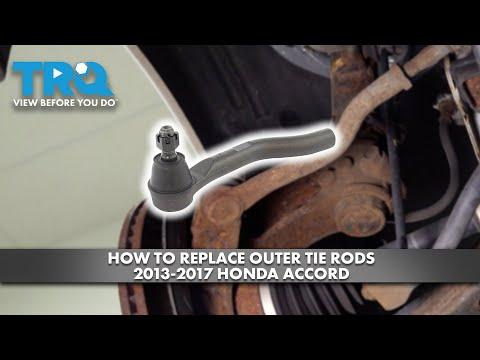







How to Replace the Outer Tie Rod End on a 2016 Acura ILX (DIY Guide)
Step-by-step instructions with required tools/parts, torque specs, safety tips, and alignment notes
How to Replace the Outer Tie Rod End on a 2016 Acura ILX (DIY Guide)
Step-by-step instructions with required tools/parts, torque specs, safety tips, and alignment notes


🔧 ILX - Outer Tie Rod End Replacement
The outer tie rod end connects your steering rack to the front knuckle and lets the wheel turn smoothly. If it’s loose, torn, or worn, you can get clunking, wandering steering, and uneven tire wear. This job is very doable at home, but you’ll still need a professional alignment afterward.
Difficulty Level: Intermediate | Estimated Time: 1.0-2.0 hours (both sides: 2.0-3.0 hours)
⚠️ Safety & Precautions
- ⚠️ Support the car with jack stands—never rely on a floor jack alone.
- ⚠️ Keep hands clear of pinch points when separating the tie rod from the knuckle.
- ⚠️ After replacement, get a front toe alignment ASAP to prevent rapid tire wear.
- ⚠️ If using a hammer near the knuckle, avoid striking the stud threads.
🔧 Required Tools
You'll need the following tools for this repair:
- Floor jack (rated 3-ton minimum)
- Jack stands (rated 3-ton minimum)
- Wheel chocks
- Safety glasses
- Nitrile gloves
- 17mm socket
- 1/2" drive breaker bar
- 1/2" drive torque wrench (20-150 ft-lbs range)
- Open-end wrench set (17mm, 19mm)
- Needle-nose pliers
- Ball joint separator (specialty)
- Hammer (16 oz)
- Wire brush
- Penetrating oil
- Paint marker
- Tape measure
🔩 Required Parts
HowToo sells all the parts you need for this repair:
- Outer tie rod end - Qty: 1
- Cotter pin - Qty: 1
- Jam nut - Qty: 1 (if not included)
- Anti-seize compound - Qty: 1
📋 Before You Begin
- Park on level ground, steering wheel straight, and set the parking brake.
- Place wheel chocks behind the rear wheels.
- Spray penetrating oil on the tie-rod jam nut and the tie-rod stud nut. Let it soak 5–10 minutes.
- Plan on an alignment after this repair. Counting turns helps you drive to the shop.
🔨 Step-by-Step Instructions
Follow these steps in order:
Step 1: Lift and secure the front corner
- Use a floor jack (rated 3-ton minimum) to lift the front corner you’re working on.
- Set the car down onto jack stands (rated 3-ton minimum) at the proper lift point.
- Remove the wheel using a 17mm socket and breaker bar.
Step 2: Mark and measure so you don’t lose toe
- Use a paint marker to mark the position of the jam nut on the inner tie rod threads.
- Use a tape measure to measure from a fixed point (example: the end of the inner tie rod) to the center of the outer tie rod stud. Write it down.
- Use a wire brush to clean exposed threads so the jam nut turns smoothly.
Step 3: Loosen the jam nut (do not remove it yet)
- Hold the inner tie rod with an open-end wrench (size varies by aftermarket part; typically 17mm or 19mm).
- Use a second open-end wrench set (17mm, 19mm) to turn the jam nut counter-clockwise and break it loose.
- Back the jam nut off a few turns, but leave it on the threads.
Step 4: Remove the cotter pin and tie rod stud nut
- Use needle-nose pliers to straighten and remove the cotter pin from the tie rod end stud.
- Remove the tie rod end nut with an open-end wrench set (17mm, 19mm) (nut size can vary by replacement part).
Step 5: Separate the tie rod end from the steering knuckle
- Install the ball joint separator (specialty) and tighten it until the stud “pops” free. (A ball joint separator is a tool that forces a tapered stud out of its seat without damaging parts.)
- If needed, use a hammer (16 oz) to strike the side of the knuckle boss (not the stud threads) to help release the taper.
Step 6: Remove the outer tie rod end while counting turns
- Spin the outer tie rod end off the inner tie rod by hand, counting the exact number of turns.
- Write the number down so the new part goes on the same amount.
Step 7: Install the new outer tie rod end
- Apply a light coat of anti-seize compound to the inner tie rod threads.
- Thread the new outer tie rod end on by hand the same number of turns you counted.
- Line the stud up with the knuckle and push it fully into the tapered hole.
Step 8: Tighten the stud nut and install a new cotter pin
- Tighten the tie rod end nut using an open-end wrench set (17mm, 19mm) and finish with a 1/2" drive torque wrench: Torque to 49 Nm (36 ft-lbs).
- If the cotter pin hole doesn’t line up, tighten the nut slightly more until it aligns (do not loosen to align).
- Install a new cotter pin using needle-nose pliers and bend the ends over securely.
Step 9: Set the jam nut and lock the adjustment
- Hold the outer tie rod end so it doesn’t rotate using an open-end wrench set (17mm, 19mm).
- Tighten the jam nut using an open-end wrench set (17mm, 19mm): Torque to 49 Nm (36 ft-lbs).
- Re-check your earlier measurement with a tape measure. Adjust if needed, then re-tighten the jam nut to spec.
Step 10: Reinstall the wheel
- Reinstall the wheel and hand-thread all lug nuts.
- Lower the car using the floor jack (rated 3-ton minimum).
- Tighten lug nuts in a star pattern with a 17mm socket and torque wrench: Torque to 108 Nm (80 ft-lbs).
✅ After Repair
- Start the car and turn the steering wheel lock-to-lock. Confirm nothing binds or rubs.
- Road test at low speed first. Listen for clunks and confirm the steering wheel returns to center.
- Get a professional alignment (front toe set). Driving unaligned can ruin tires quickly.
- Recheck the jam nut and lug nut torque after 50–100 miles using a torque wrench.
💰 DIY vs Shop Cost
Shop Cost: $180-$400 (parts + labor + basic alignment)
DIY Cost: $35-$120 (parts only)
You Save: $145-$280 by doing it yourself!
Shop labor rates vary but typically run $100-$150/hour. This repair takes a shop approximately 1.0-1.5 hours.
🎯 Ready to get started?
HowToo makes it easy: same-day/2-day shipping on every part, plus all the tools and specialty tools you need! Check out the parts and tools sections below to add everything to your cart.