









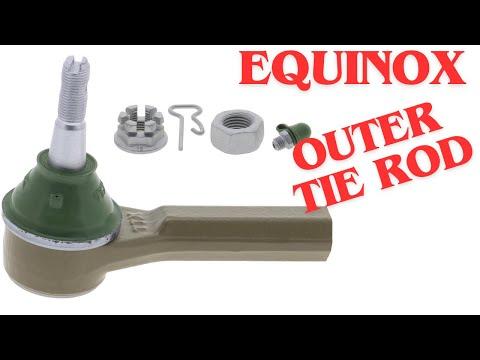







How to Replace the Outer Tie Rod End on a 2010-2021 Chevrolet Equinox
Step-by-step instructions with tools, torque specs, safety tips, and alignment guidance
How to Replace the Outer Tie Rod End on a 2010-2021 Chevrolet Equinox
Step-by-step instructions with tools, torque specs, safety tips, and alignment guidance for 2010, 2011, 2012, 2013, 2014, 2015, 2016, 2017, 2018, 2019, 2020, 2021


🔧 Tie Rod End - Replacement
The outer tie rod end connects the steering rack to the front wheel knuckle. Replacing a worn one can fix loose steering, clunks, and uneven tire wear, but the front alignment must be checked after the repair.
Difficulty Level: Intermediate | Estimated Time: 1.5-2.5 hours
⚠️ Safety & Precautions
- Work on a flat surface and chock the rear wheels.
- Support the vehicle with jack stands; never rely on a jack alone.
- Keep hands clear of the steering knuckle while separating the tie rod end.
- Do not drive long distances after this repair until a wheel alignment is performed.
- If the vehicle has steering angle or stability control warning lights after the repair, a scan check may be needed.
🔧 Required Tools
You'll need the following tools for this repair:
- Floor jack (rated 3-ton minimum)
- Jack stands
- Wheel chocks
- Safety glasses
- Mechanic gloves
- Breaker bar
- 17mm socket
- 18mm socket
- 21mm socket
- Torque wrench
- Pliers
- Punch or paint marker
- Hammer
- Tie rod end puller (specialty)
- Inner tie rod holding wrench (specialty)
🔩 Required Parts
HowToo sells all the parts you need for this repair:
- Outer tie rod end - Qty: 1
- Outer tie rod end jam nut - Qty: 1
- Cotter pin - Qty: 1
- Alignment mark paint or thread marking compound - Qty: 1
📋 Before You Begin
- Park on level ground and set the parking brake.
- Loosen the front wheel lug nuts slightly before lifting.
- Use a paint marker to mark the jam nut and tie rod end position first.
- If one side is being replaced, count the exposed threads and match the new part as close as possible to help preserve alignment.
🔨 Step-by-Step Instructions
Follow these steps in order:
Step 1: Lift and remove the wheel
- Use the floor jack to lift the front of the vehicle.
- Place jack stands under the proper support points and lower the vehicle onto them.
- Remove the wheel using a 21mm socket.
Step 2: Mark the current tie rod position
- Use a paint marker to mark the jam nut and tie rod end position.
- Count the exposed threads if visible.
- Keep the new part close to the old length.
Step 3: Loosen the jam nut
- Use an 18mm socket and breaker bar to loosen the jam nut on the inner tie rod.
- Do not remove it yet; just break it loose.
- Torque on reassembly: 55 Nm (41 ft-lbs)
Step 4: Remove the cotter pin and castle nut
- Use pliers to straighten and remove the cotter pin from the tie rod stud.
- Use a 17mm socket to remove the castle nut.
- Torque on reassembly: 60 Nm (44 ft-lbs)
Step 5: Separate the tie rod end from the knuckle
- Use a tie rod end puller (specialty) to separate the stud from the steering knuckle.
- If needed, use a light tap with a hammer on the knuckle area, not the stud.
- Do not strike the threaded stud directly.
Step 6: Remove the outer tie rod end
- Use your hand to spin the outer tie rod end off the inner tie rod.
- Count each turn as you remove it, or note the thread count.
- This helps get the new part close enough to drive to alignment safely.
Step 7: Install the new tie rod end
- Thread the new outer tie rod end onto the inner tie rod the same number of turns as the old one.
- Install the jam nut finger-tight for now.
- Make sure the boot is not twisted or pinched.
Step 8: Connect the stud to the knuckle
- Insert the tie rod stud into the steering knuckle.
- Use a 17mm socket to install the new castle nut.
- Torque to 60 Nm (44 ft-lbs).
- Continue tightening only enough to line up the cotter pin hole; never loosen to align.
- Install the new cotter pin with pliers.
Step 9: Tighten the jam nut
- Hold the outer tie rod end in position with your hand if needed.
- Use an 18mm socket to tighten the jam nut.
- Torque to 55 Nm (41 ft-lbs).
Step 10: Reinstall the wheel and lower the vehicle
- Reinstall the wheel and snug the lug nuts with a 21mm socket.
- Lower the vehicle to the ground.
- Torque the lug nuts in a star pattern to 140 Nm (103 ft-lbs).
✅ After Repair
- Start the vehicle and turn the steering wheel lock-to-lock while parked to check for abnormal noise.
- Check that the cotter pin is installed correctly and the jam nut is tight.
- Schedule a professional front-end alignment as soon as possible.
- Test-drive slowly at first and verify the steering wheel is centered.
💰 DIY vs Shop Cost
Shop Cost: $220-$420 (parts + labor)
DIY Cost: $35-$90 (parts only)
You Save: $185-$330 by doing it yourself!
Shop labor rates vary but typically run $100-$150/hour. This repair takes a shop approximately 1.0-1.5 hours.
🎯 Ready to get started?
HowToo makes it easy: same-day/2-day shipping on every part, plus all the tools and specialty tools you need! Check out the parts and tools sections below to add everything to your cart.
Guide for Steering Tie Rod End replace for these Chevrolet vehicles
| Year Make Model | Sub Model | Engine | Body Style |
|---|---|---|---|
| 2021 Chevrolet Equinox | - | - | - |
| 2020 Chevrolet Equinox | - | - | - |
| 2019 Chevrolet Equinox | - | - | - |
| 2018 Chevrolet Equinox | - | - | - |
| 2017 Chevrolet Equinox | - | - | - |
| 2016 Chevrolet Equinox | - | - | - |
| 2015 Chevrolet Equinox | - | - | - |
| 2014 Chevrolet Equinox | - | - | - |
| 2013 Chevrolet Equinox | - | - | - |
| 2012 Chevrolet Equinox | - | - | - |
| 2011 Chevrolet Equinox | - | - | - |
| 2010 Chevrolet Equinox | - | - | - |