









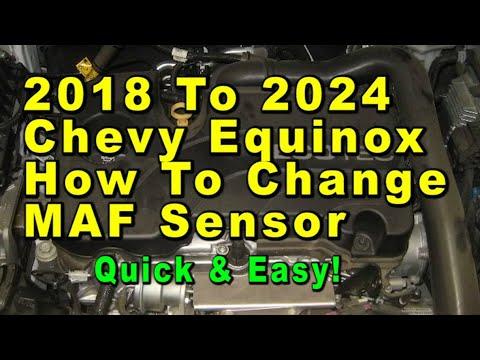



How to Replace the MAF Sensor on a 2019 Chevrolet Equinox
Step-by-step DIY guide with tools, parts list, safety tips, and install instructions to change the mass air flow sensor
How to Replace the MAF Sensor on a 2019 Chevrolet Equinox
Step-by-step DIY guide with tools, parts list, safety tips, and install instructions to change the mass air flow sensor


🔧 Equinox - Mass Air Flow (MAF) Sensor Replacement
This job is removing the old mass air flow (MAF) sensor from the intake tube, installing a new one, and making sure there are no air leaks. The MAF sensor measures how much air goes into the engine, so a bad one can cause poor power, smoke, or check-engine lights.
Difficulty Level: Beginner | Estimated Time: 0.5–1 hour
⚠️ Safety & Precautions
- ⚠️ Work with the engine off and completely cool so you don’t get burned.
- ⚠️ Do not touch the thin wire or element inside the MAF; it is very delicate.
- ⚠️ Keep dirt out of the intake tube and airbox; any debris can damage the turbo or engine.
- ⚠️ If you disconnect the battery, make sure you have radio/infotainment settings handy, as they may reset.
🔧 Required Tools
You'll need the following tools for this repair:
- 🛠️ Ratchet handle 1/4"
- 🛠️ 8mm socket
- 🛠️ 7mm socket
- 🛠️ T20 Torx screwdriver
- 🛠️ Small flathead screwdriver
- 🛠️ Needle-nose pliers
- 🛠️ OBD2 code reader (basic)
- 🛠️ Shop rags
- 🛠️ Nitrile gloves
- 🛠️ Safety glasses
🔩 Required Parts
HowToo sells all the parts you need for this repair:
- 🔩 Mass air flow (MAF) sensor - Qty: 1
- 🔩 MAF sensor sealing O-ring or gasket - Qty: 1
- 🔩 Intake hose clamp (airbox to intake tube, if damaged) - Qty: 1
- 🔩 Electronic contact cleaner (MAF-safe, non-residue spray) - Qty: 1
- 🔩 Dielectric grease (for electrical connectors) - Qty: 1
📋 Before You Begin
- Park the Equinox on level ground, shift to Park, and set the parking brake.
- Open the hood and secure it with the prop rod.
- You can leave the battery connected, but for extra safety you may disconnect the negative terminal using the 8mm socket.
- Locate the MAF sensor: on your Equinox it is mounted in the plastic intake duct just after the air filter box on the driver side of the engine bay.
🔨 Step-by-Step Instructions
Follow these steps in order:
Step 1: Identify the MAF sensor and clear the area
- Stand on the driver side and look at the black plastic airbox that holds the air filter; follow the large plastic tube that goes toward the engine.
- The MAF sensor is a small rectangular piece with a 4–5 wire connector, usually held in by two screws on top of that tube.
- Move any hoses or wiring gently out of the way using your hands or needle-nose pliers if they are clipped to the intake tube.
Step 2: Disconnect the MAF electrical connector
- Put on your safety glasses and nitrile gloves.
- Find the plastic locking tab on the MAF connector; it may have a small red or gray secondary lock.
- If there is a secondary lock, use the small flathead screwdriver to gently lift or slide it out to the “unlocked” position.
- Press down on the main release tab with your finger and pull the connector straight back. Do not pull on the wires.
- If it is stuck, gently wiggle the connector side to side while pulling, using your other hand to steady the sensor body.
Step 3: Remove the MAF sensor screws
- Use the T20 Torx screwdriver to remove the two screws holding the MAF to the intake tube.
- Keep a hand under the screws so they don’t fall into the engine bay; place them on a clean shop rag.
- Once the screws are out, gently pull the MAF sensor straight up and out of the intake tube.
- Do not twist hard; it should come out smoothly.
Step 4: Inspect the sensor seat and O-ring
- Look at the opening in the intake tube where the MAF was installed; make sure there is no dirt or debris sitting in the hole.
- Use a shop rag to gently wipe around the opening, but do not push dirt inside the tube.
- Check the old MAF sensor’s O-ring or gasket; note how it was seated so you can match it with the new one.
Step 5: Prepare the new MAF sensor
- Compare the old and new MAF sensors on a clean shop rag to confirm they are the same shape, connector type, and mounting hole positions.
- Install the new O-ring or gasket onto the new MAF sensor if it is not pre-installed.
- If desired, apply a tiny amount of dielectric grease to the rubber seal on the electrical connector, not on the pins.
Step 6: Install the new MAF sensor
- Align the new MAF sensor with the opening in the intake tube; make sure the screw holes line up exactly.
- Insert the sensor straight down into the opening so the O-ring seats evenly all the way around.
- Install the two mounting screws by hand to avoid cross-threading.
- Use the T20 Torx screwdriver to tighten the screws evenly, alternating between them so the sensor sits flat.
- The manufacturer does not publish a specific torque for these screws; tighten them just snug by hand. Stop as soon as they are snug.
Step 7: Reconnect the electrical connector
- Push the MAF connector straight onto the sensor until you hear or feel a click.
- If there is a secondary lock, use the small flathead screwdriver or your fingers to push it back into the “locked” position.
- Gently tug the connector to confirm it is fully seated and locked.
Step 8: Check nearby hose clamps and airbox
- Inspect the intake hose clamp near the MAF and at the airbox; loose clamps can cause air leaks and incorrect readings.
- Use the 7mm socket or 8mm socket with the ratchet handle 1/4" to gently snug any loose clamps.
- Again, no published torque here; just tighten until the hose is firmly clamped and does not move.
Step 9: Reconnect battery (if disconnected)
- If you disconnected the battery, reinstall the negative cable on the battery post.
- Use the 8mm socket and ratchet handle 1/4" to snug the clamp bolt. Do not overtighten; just firm enough that the clamp does not move.
Step 10: Clear codes and perform a short relearn drive
- Use the OBD2 code reader to read and clear any existing fault codes related to the MAF or intake air system, following the tool’s screen prompts.
- Start the engine and let it idle for a few minutes; the idle may change slightly as the computer relearns.
- Take a short test drive with gentle acceleration and steady speeds so the engine computer can adapt to the new sensor.
✅ After Repair
- Listen for any whistling or hissing noises around the intake tube; that could mean an air leak that needs a clamp tightened.
- Make sure the check engine light stays off after your test drive.
- Watch for smoother idle, better throttle response, and normal exhaust smoke.
- If any codes return, scan them again and note the exact code numbers before doing more work.
💰 DIY vs Shop Cost
Shop Cost: $220–$350 (parts + labor)
DIY Cost: $70–$160 (parts only)
You Save: $150–$190 by doing it yourself!
Shop labor rates are usually $100–$150/hour. This repair takes a shop about 0.5–0.8 hours.
🎯 Ready to get started?
HowToo makes it easy: same-day/2-day shipping on every part, plus all the tools and specialty tools you need! Check out the parts and tools sections above to add everything to your cart.