















How to Replace the Fuel Pump on a 2018 Ford Mustang (In-Tank or High-Pressure)
Step-by-step DIY instructions with safety tips, required tools/parts, priming steps, and leak-check guidance
How to Replace the Fuel Pump on a 2018 Ford Mustang (In-Tank or High-Pressure)
Step-by-step DIY instructions with safety tips, required tools/parts, priming steps, and leak-check guidance


🔧 Mustang - Fuel Pump Replacement
On your Mustang, “fuel pump” can mean either the in-tank low-pressure fuel pump module (inside the fuel tank) or the engine-mounted high-pressure fuel pump (for direct injection). The correct procedure depends on which one you’re replacing, because access and safety steps are very different.
Difficulty Level: Advanced | Estimated Time: 2-6 hours
Quick check (2 questions):
1) Are you replacing the in-tank pump (inside fuel tank) or the high-pressure pump on the engine?
2) Do you have an access cover under the rear seat (you can lift the rear seat bottom and look for a metal service plate), or is there no cover?
⚠️ Safety & Precautions
- 🧯 Work outside or in a very well-ventilated area; fuel vapors ignite easily.
- 🔥 No smoking, no heat guns, no shop lights with hot bulbs near open fuel lines.
- 🔋 Disconnect the negative (-) battery cable before opening the fuel system.
- ⛔ Relieve fuel pressure before disconnecting any fuel line to avoid spray.
- 🧤 Wear fuel-resistant gloves and safety glasses; keep rags ready.
- 🧼 Clean dirt around fittings first so debris doesn’t enter the system.
🔧 Required Tools
You'll need the following tools for this repair:
- Safety glasses
- Nitrile gloves
- Fire extinguisher Class B
- Floor jack (rated 3-ton minimum)
- Jack stands (rated 3-ton minimum)
- Wheel chocks
- 8mm socket
- 10mm socket
- 13mm socket
- Ratchet
- 6-inch extension
- Torque wrench (10–200 Nm range)
- Flat trim tool
- Pick tool
- Fuel line quick-disconnect tool set (specialty)
- Fuel pump lock ring tool (specialty)
- Siphon pump (hand pump)
- Drain pan (fuel-safe)
- Shop rags
- Marker pen
🔩 Required Parts
HowToo sells all the parts you need for this repair:
- In-tank fuel pump module assembly - Qty: 1
- Fuel pump module seal / tank gasket - Qty: 1
- High-pressure fuel pump - Qty: 1
- High-pressure fuel line (pump to fuel rail) - Qty: 1
- Fuel-safe shop towels - Qty: 1
📋 Before You Begin
- Park on level ground, set the parking brake, and use wheel chocks.
- Try to get the fuel level low (near 1/8 tank). A full tank is much heavier.
- Relieve fuel pressure: remove the fuel pump fuse/relay (from the under-hood fuse box), start the engine, and let it stall. Crank 3 more seconds, then turn key off.
- Disconnect battery: use a 10mm socket to remove the negative (-) cable and isolate it.
- “Quick-disconnect” fittings release with a special clip tool.
🔨 Step-by-Step Instructions
Follow these steps in order:
Step 1: Confirm which pump you’re replacing
- If the part is inside the fuel tank, follow Steps 2A–8A.
- If the part is bolted to the engine and has a metal high-pressure line, follow Steps 2B–7B.
Step 2A: In-tank pump access check (rear seat area)
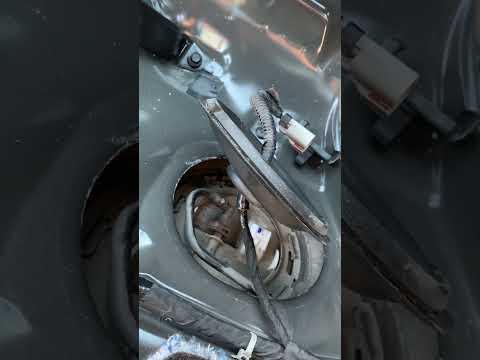
- Use a flat trim tool to lift the rear seat bottom and look for a service plate.
- If you find an access cover: you may be able to service the pump from inside the car—continue to Step 3A.
- If there is no cover: you’ll need to drop the fuel tank—skip to Step 4A.
Step 3A: Replace in-tank pump through access cover (if equipped)
- Use an 8mm socket or 10mm socket (varies by fasteners) to remove the service cover screws and lift the cover.
- Clean the top of the module: use shop rags so dirt can’t fall into the tank.
- Disconnect the electrical connector: release the lock with a pick tool.
- Disconnect fuel lines using the fuel line quick-disconnect tool set (specialty).
- Mark the module position with a marker pen for alignment.
- Remove the lock ring using the fuel pump lock ring tool (specialty).
- Lift out the module carefully; tip it into a drain pan (fuel-safe).
- Replace the seal with a new fuel pump module seal / tank gasket.
- Install the new module aligned to your marks; tighten the lock ring: Torque to factory specification.
Step 4A: Drop the fuel tank (if no access cover)
- Raise the rear of the car using a floor jack (rated 3-ton minimum) and support with jack stands (rated 3-ton minimum).
- Support the fuel tank with the floor jack (use a block of wood to spread the load).
- Use a 13mm socket to loosen and remove the fuel tank strap bolts.
- Lower the tank a few inches only (do not drop it) to access the lines and connectors on top.
Step 5A: Disconnect tank lines and wiring
- Disconnect the fuel pump electrical connector using a pick tool.
- Disconnect fuel/vapor lines using the fuel line quick-disconnect tool set (specialty).
- Keep a drain pan (fuel-safe) and shop rags under the connections.
Step 6A: Remove and replace the in-tank module
- Lower the tank fully with the floor jack and slide it out.
- Clean the module area with shop rags.
- Use the fuel pump lock ring tool (specialty) to remove the lock ring.
- Remove the module, replace the seal, and install the new module.
- Tighten lock ring: Torque to factory specification.
Step 7A: Reinstall the fuel tank
- Raise the tank with the floor jack and reconnect all lines and the electrical connector.
- Reinstall tank straps using a 13mm socket: Torque to factory specification.
- Lower the car from the jack stands.
Step 8A: Prime and leak-check (in-tank pump)
- Reconnect battery negative using a 10mm socket: Torque to factory specification.
- Cycle ignition ON for 5 seconds, OFF for 10 seconds, repeat 3–4 times to prime.
- Start engine and check for leaks at every fitting you touched.
Step 2B: High-pressure fuel pump (engine-mounted) removal
- Confirm fuel pressure was relieved in “Before You Begin.”
- Locate the high-pressure pump on the engine (it will have a rigid metal high-pressure line).
- Place shop rags under the line fitting.
- Disconnect the electrical connector using a pick tool.
Step 3B: Remove high-pressure line (replace it)
- Use the correct socket set to loosen the high-pressure line fittings.
- Remove the line and set it aside; install a new high-pressure fuel line during reassembly.
- High-pressure lines are typically one-time use.
Step 4B: Remove the high-pressure pump
- Use the appropriate socket to remove the pump mounting bolts.
- Pull the pump straight off to avoid binding the follower/contact area.
- Inspect the mounting area for debris; wipe with shop rags.
Step 5B: Install the new high-pressure pump
- Set the new pump in place and start bolts by hand.
- Tighten bolts evenly using a torque wrench: Torque to factory specification.
- Install the new high-pressure line and tighten with a torque wrench: Torque to factory specification.
- Reconnect the electrical connector.
Step 6B: Prime and leak-check (high-pressure pump)
- Reconnect battery negative using a 10mm socket: Torque to factory specification.
- Cycle ignition ON/OFF 3–4 times to build low-side pressure.
- Start the engine and check carefully for fuel leaks at the pump and line fittings.
Step 7B: Final verification
- Test drive briefly, then re-check for any fuel smell or seepage.
- If you have a scan tool, check for fuel pressure-related codes and clear if needed.
✅ After Repair
- Re-check for leaks after a 5–10 minute idle.
- Make sure there’s no fuel odor inside the cabin (especially important on a convertible).
- If the engine cranks longer than normal, cycle the key ON/OFF a few more times to prime.
💰 DIY vs Shop Cost
Shop Cost: $900-$2,200 (parts + labor)
DIY Cost: $250-$1,200 (parts only)
You Save: $650-$1,000 by doing it yourself!
Shop labor rates vary but typically run $100-$150/hour. This repair takes a shop approximately 2-6 hours.
🎯 Ready to get started?
HowToo makes it easy: same-day/2-day shipping on every part, plus all the tools and specialty tools you need! Check out the parts and tools sections below to add everything to your cart.
Guide for Direct Injection High Pressure Fuel Pump replace for these Ford vehicles
| Year Make Model | Sub Model | Engine | Body Style |
|---|