









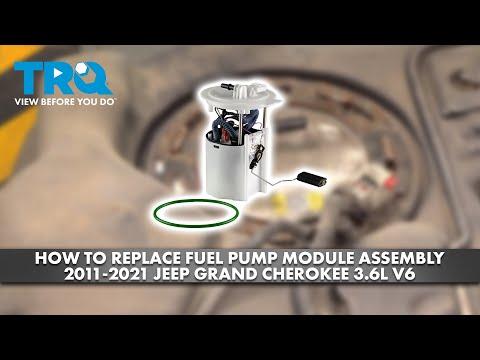





How to Replace the Fuel Pump on a 2011-2017 Jeep Grand Cherokee (Engine: V6 3.6L)
Step-by-step in-tank fuel pump module guide with tools, parts, torque specs, and safety tips
How to Replace the Fuel Pump on a 2011-2017 Jeep Grand Cherokee (Engine: V6 3.6L)
Step-by-step in-tank fuel pump module guide with tools, parts, torque specs, and safety tips for 2011, 2012, 2013, 2014, 2015, 2016, 2017


🔧 Grand Cherokee - Fuel Pump Module Replacement
Replacing the fuel pump on your Grand Cherokee means removing the fuel tank and replacing the in-tank fuel pump module. The pump module sends fuel from the tank to the engine, and a weak or failed pump can cause long cranking, stalling, no-start, or low fuel pressure.
Difficulty Level: Advanced | Estimated Time: 3-5 hours
⚠️ Safety & Precautions
- 🔥 Gasoline is extremely flammable. Work outside or in a very well-ventilated area away from sparks, cigarettes, heaters, and open flames.
- 👓 Wear safety glasses and fuel-resistant gloves. Fuel may spill when lines are disconnected.
- 🔋 Disconnect the negative battery cable before opening the fuel system.
- ⛽ Relieve fuel system pressure before disconnecting any fuel line.
- 🧯 Keep a Class B fire extinguisher nearby.
- 🚗 Support your Grand Cherokee securely with jack stands. Never rely on a jack alone.
- 📉 The fuel tank is heavy. Run the tank as low as possible before starting, ideally below 1/4 tank.
🔧 Required Tools
You'll need the following tools for this repair:
- 10mm socket
- 13mm socket
- 15mm socket
- Ratchet
- 6-inch extension
- Flathead screwdriver
- Fuel line disconnect tool set (specialty)
- Fuel pump lock ring tool (specialty)
- Torque wrench inch-pound
- Torque wrench foot-pound
- Floor jack rated 3-ton minimum
- Jack stands rated 3-ton minimum
- Transmission jack or wide wood board
- Wheel chocks
- Drain pan
- Shop towels
- Fuel-resistant gloves
- Safety glasses
- Class B fire extinguisher
🔩 Required Parts
HowToo sells all the parts you need for this repair:
- Fuel pump module assembly - Qty: 1
- Fuel pump module tank seal - Qty: 1
- Fuel pump lock ring - Qty: 1
- Fuel line retaining clips - Qty: As needed
- Evaporative emissions hose clips - Qty: As needed
📋 Before You Begin
- Park your Grand Cherokee on level ground and set the parking brake.
- Run the fuel level down as low as safely possible before starting.
- Place wheel chocks at the front wheels.
- Open the fuel filler cap to release tank vapor pressure.
- A fuel line disconnect tool releases the spring clip inside quick-connect fuel fittings without breaking them.
- A fuel pump lock ring tool turns the large metal retaining ring that holds the pump module to the fuel tank.
- Take photos of hose and connector locations before disconnecting them. This helps during reassembly.
🔨 Step-by-Step Instructions
Follow these steps in order:
Step 1: Relieve Fuel Pressure
- Use your hand to remove the fuel filler cap.
- Open the hood and locate the fuse/relay box.
- Use the fuse box cover diagram to identify the fuel pump fuse or relay.
- Use needle-style fingers or a fuse puller if equipped to remove the fuel pump fuse or relay.
- Start the engine and let it run until it stalls. This uses up pressure in the fuel line.
- Crank the engine for 3-5 seconds more.
- Turn the ignition off.
- Less pressure means less fuel spray.
Step 2: Disconnect the Battery
- Use a 10mm socket and ratchet to loosen the negative battery cable clamp.
- Remove the negative cable from the battery post and move it aside so it cannot spring back.
- Torque on reassembly: 5 Nm (44 in-lbs)
Step 3: Raise and Support the Vehicle
- Use a floor jack rated 3-ton minimum to lift the rear of your Grand Cherokee at the rear lift point.
- Place jack stands rated 3-ton minimum under the proper rear support points.
- Lower the vehicle gently onto the jack stands.
- Shake the vehicle lightly by hand to confirm it is stable.
- Never work under a jack-only vehicle.
Step 4: Remove Fuel Tank Shield or Skid Plate
- Use a 13mm socket, ratchet, and 6-inch extension to remove the fuel tank shield or skid plate fasteners if equipped.
- Support the shield by hand while removing the last fastener.
- Set the shield aside.
- Torque on reassembly: 28 Nm (21 ft-lbs)
Step 5: Support the Fuel Tank
- Position a transmission jack or floor jack with a wide wood board under the fuel tank.
- Raise the jack just enough to support the tank. Do not crush the tank.
- A transmission jack is a wide, stable lifting jack designed to hold large parts like tanks and transmissions.
Step 6: Disconnect Filler Neck and Vent Hoses
- Use a flathead screwdriver to loosen the filler neck hose clamp.
- Slide the filler hose off the tank neck by hand.
- Use a flathead screwdriver to release vent hose clips if fitted.
- Mark hose positions with tape if needed.
- Torque hose clamps on reassembly: 4 Nm (35 in-lbs)
Step 7: Disconnect Electrical Connectors and EVAP Lines
- Use your fingers to press the release tabs on the fuel pump electrical connector and fuel tank pressure sensor connector.
- Use a flathead screwdriver gently if a connector lock needs to be lifted.
- Use the fuel line disconnect tool set to release EVAP quick-connect lines.
- Do not pull on wires. Pull only on the connector body.
- EVAP means evaporative emissions. These hoses route fuel vapors to the emissions system.
Step 8: Disconnect the Fuel Supply Line
- Place a drain pan and shop towels under the fuel line connection.
- Use the correct-size fuel line disconnect tool from the fuel line disconnect tool set.
- Push the tool into the quick-connect fitting, then pull the line straight off.
- Cap or cover the open line with a clean shop towel.
- Expect a small fuel spill.
Step 9: Lower the Fuel Tank
- Use a 15mm socket, ratchet, and 6-inch extension to remove the fuel tank strap bolts.
- Keep one hand on the tank or have a helper steady it.
- Slowly lower the jack a few inches.
- Check for any still-connected hoses or wiring before lowering fully.
- Lower the tank enough to access the top of the fuel pump module.
- Torque on reassembly: 47 Nm (35 ft-lbs)
Step 10: Clean Around the Fuel Pump Module
- Use shop towels to clean dirt from the top of the fuel tank around the pump module.
- Do not let dirt fall into the tank.
- Cleanliness protects the new pump.
Step 11: Remove the Fuel Pump Lock Ring
- Use the fuel pump lock ring tool and ratchet to turn the lock ring counterclockwise.
- Remove the lock ring from the tank.
- Lift the fuel pump module straight up slowly.
- Tilt the module carefully to drain fuel from the reservoir into the tank.
- Remove and discard the old tank seal.
Step 12: Install the New Fuel Pump Module
- Install the new fuel pump module tank seal into the tank opening by hand.
- Lower the new fuel pump module into the tank carefully.
- Align the pump module marks with the tank marks.
- Install the new lock ring by hand first.
- Use the fuel pump lock ring tool and torque wrench foot-pound to tighten the lock ring.
- Torque to 75 Nm (55 ft-lbs)
Step 13: Raise and Secure the Fuel Tank
- Use the transmission jack or floor jack with wide wood board to lift the fuel tank into position.
- Make sure no hoses or wires are trapped above the tank.
- Use a 15mm socket and ratchet to install the fuel tank strap bolts.
- Use a torque wrench foot-pound with 15mm socket to tighten the strap bolts.
- Torque to 47 Nm (35 ft-lbs)
Step 14: Reconnect Fuel Lines, EVAP Lines, and Connectors
- Push the fuel supply line onto the pump fitting by hand until it clicks.
- Pull back lightly by hand to confirm it is locked.
- Reconnect EVAP lines by hand until each fitting clicks.
- Reconnect electrical connectors by hand until the locks click.
- Use a flathead screwdriver only if a connector safety lock must be slid closed.
Step 15: Reconnect Filler Neck and Vent Hoses
- Slide the filler hose fully onto the tank neck by hand.
- Use a flathead screwdriver to tighten the hose clamp.
- Reconnect vent hoses by hand and make sure clips are fully seated.
- Use a torque wrench inch-pound if the clamp uses a screw clamp.
- Torque to 4 Nm (35 in-lbs)
Step 16: Reinstall Fuel Tank Shield or Skid Plate
- Lift the shield into place by hand.
- Use a 13mm socket, ratchet, and 6-inch extension to install the fasteners.
- Use a torque wrench foot-pound with 13mm socket to tighten the fasteners.
- Torque to 28 Nm (21 ft-lbs)
Step 17: Lower the Vehicle
- Use the floor jack rated 3-ton minimum to lift the rear slightly off the jack stands.
- Remove the jack stands.
- Lower your Grand Cherokee slowly to the ground.
Step 18: Reconnect Battery and Prime the Fuel System
- Use a 10mm socket and ratchet to reconnect the negative battery cable.
- Use a torque wrench inch-pound with 10mm socket to tighten the battery terminal.
- Torque to 5 Nm (44 in-lbs)
- Reinstall the fuel pump fuse or relay by hand.
- Turn the ignition to ON for 5 seconds without starting.
- Turn the ignition OFF for 10 seconds.
- Repeat this ON/OFF cycle 3 times to prime the fuel system.
✅ After Repair
- Start the engine and let it idle.
- Check under your Grand Cherokee for fuel leaks near the tank, fuel line connection, and filler hose.
- If the engine cranks longer than normal, turn the key off and repeat the prime cycle.
- Confirm the fuel gauge reads normally.
- Road test for 10-15 minutes, then recheck for leaks.
- If the check engine light is on, scan for codes and clear them after confirming the repair is leak-free.
💰 DIY vs Shop Cost
Shop Cost: $650-$1,050 USD equivalent (parts + labor)
DIY Cost: $180-$450 USD equivalent (parts only)
You Save: $470-$600 USD equivalent by doing it yourself!
Shop labor rates vary but typically run $100-$150/hour. This repair takes a shop approximately 2.5-4.0 hours.
🎯 Ready to get started?
HowToo makes it easy: same-day/2-day shipping on every part, plus all the tools and specialty tools you need! Check out the parts and tools sections below to add everything to your cart.
Guide for Fuel Pump Module Assembly replace for these Jeep vehicles
| Year Make Model | Sub Model | Engine | Body Style |
|---|---|---|---|
| 2017 Jeep Grand Cherokee | - | V8 5.7L | - |
| 2017 Jeep Grand Cherokee | - | V8 6.4L | - |
| 2016 Jeep Grand Cherokee | - | V8 5.7L | - |
| 2016 Jeep Grand Cherokee | - | V8 6.4L | - |
| 2015 Jeep Grand Cherokee | - | V8 5.7L | - |
| 2015 Jeep Grand Cherokee | - | V8 6.4L | - |
| 2014 Jeep Grand Cherokee | - | V8 5.7L | - |
| 2014 Jeep Grand Cherokee | - | V8 6.4L | - |
| 2013 Jeep Grand Cherokee | - | V8 5.7L | - |
| 2013 Jeep Grand Cherokee | - | V8 6.4L | - |
| 2012 Jeep Grand Cherokee | - | V8 5.7L | - |
| 2012 Jeep Grand Cherokee | - | V8 6.4L | - |
| 2011 Jeep Grand Cherokee | - | V8 5.7L | - |