









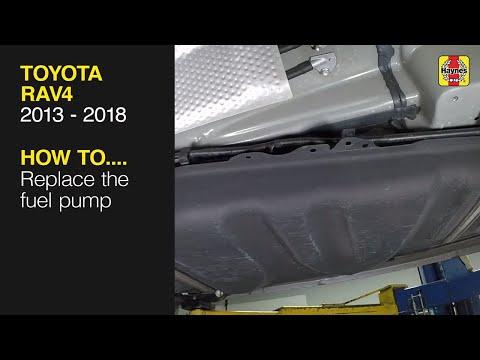




How to Replace the Fuel Pump on a 2009-2018 Toyota RAV4 (In-Tank Module) (Trim: LE | Engine: Inline 4 2.5L)
Step-by-step DIY fuel pump module replacement with tools, parts list, torque specs, safety tips, and cost savings for your 2017 RAV4
How to Replace the Fuel Pump on a 2009-2018 Toyota RAV4 (In-Tank Module) (Trim: LE | Engine: Inline 4 2.5L)
Step-by-step DIY fuel pump module replacement with tools, parts list, torque specs, safety tips, and cost savings for your 2017 RAV4 for 2009, 2010, 2011, 2012


🔧 RAV4 - Fuel Pump Module Replacement
You’ll be replacing the in-tank electric fuel pump module under the rear seat of your RAV4. This restores proper fuel pressure if you have issues like hard starting, stalling, or low power.
Difficulty Level: Intermediate | Estimated Time: 2-3 hours
⚠️ Safety & Precautions
- ⚠️ Work in a VERY well-ventilated area; fuel vapors can ignite easily.
- ⚠️ Keep all sparks, cigarettes, and open flames far away from the work area.
- ⚠️ Disconnect the negative battery cable before opening the fuel system.
- ⚠️ Do not use power tools that can spark near open fuel (no grinders, etc.).
- ⚠️ Wear safety glasses and fuel-resistant gloves; petrol is harmful to skin and eyes.
- ⚠️ Keep a class B or ABC fire extinguisher nearby.
- ⚠️ Clean dirt around the pump cover before opening to avoid getting debris into the tank.
- ⚠️ Avoid bending or damaging the fuel level float arm on the pump unit.
🔧 Required Tools
You'll need the following tools for this repair:
- 🧰 10mm socket
- 🧰 12mm socket
- 🧰 1/4" drive ratchet
- 🧰 3/8" drive ratchet
- 🧰 3/8" drive torque wrench (5–80 ft-lbs range)
- 🧰 Short extension (3")
- 🧰 Flathead screwdriver (small)
- 🧰 Trim removal tool (plastic)
- 🧰 Needle-nose pliers
- 🧰 Fuel line disconnect tool set (quick-connect type) (specialty)
- 🧰 Fuel pump lock ring tool (Toyota-style ring spanner) (specialty)
- 🧰 Rubber mallet
- 🧰 Shop rags
- 🧰 Small parts tray
- 🧰 Safety glasses
- 🧰 Nitrile or fuel-rated gloves
- 🧰 Flashlight or work light (non-sparking)
🔩 Required Parts
HowToo sells all the parts you need for this repair:
- 🔩 Fuel pump module assembly (in-tank, with fuel level sender) - Qty: 1
- 🔩 Fuel pump module gasket / O-ring - Qty: 1
- 🔩 Fuel pump lock ring (retainer) - Qty: 1 (recommended if old is corroded)
- 🔩 Fuel line quick-connect clips - Qty: 1 set
- 🔩 Electrical contact cleaner (aerosol, plastic-safe) - Qty: 1
- 🔩 Shop towels or absorbent pads - Qty: 1 pack
- 🔩 Disposable container for any spilled fuel - Qty: 1
📋 Before You Begin
- 📝 Park your RAV4 on level ground, shift to Park, and set the parking brake.
- 📝 Ideally, work with the fuel tank under half full to reduce spillage.
- 📝 Turn ignition OFF and remove the key from the vehicle.
- 📝 Open all doors or windows for ventilation.
- 📝 Disconnect the negative battery terminal using a 10mm socket and move the cable aside so it cannot spring back.
- 📝 Relieve fuel pressure by leaving the vehicle sitting for at least 10–15 minutes after shutting off, before opening any fuel lines.
🔨 Step-by-Step Instructions
Follow these steps in order:
Step 1: Access the fuel pump under the rear seat
- Slide the front seats forward to make rear space.
- Fold the rear seat backs forward.
- Lift the rear seat bottom cushion: pull up on the front edge near each outer corner; use a trim removal tool (plastic) if the clips are tight.
- Remove the seat cushion from the vehicle and set it aside somewhere clean.
- Locate the round metal access cover on the floor on the right side; this is above the fuel pump.
Step 2: Remove the fuel pump access cover
- Use a trim removal tool or flathead screwdriver to gently pry up the access cover; it is usually held by adhesive or small tabs.
- Peel the cover back carefully so you don’t tear it; you can re-use it.
- Wipe any loose dirt or dust around the pump area using shop rags. Keep tank area very clean
Step 3: Disconnect electrical connector and clean area
- Use a flashlight to clearly see the top of the pump module.
- Locate the electrical connector going into the pump top. Press the lock tab and pull it off by hand; if tight, gently help it with a flathead screwdriver.
- Spray a small amount of electrical contact cleaner on the connector if dirty, then set the harness safely aside.
- Carefully clean all around the pump lock ring and gasket area with shop rags. No dirt should fall into tank
Step 4: Disconnect the fuel lines
- Place shop rags under the fuel line connections to catch any drips.
- Identify the quick-connect fuel lines on top of the pump.
- Use your fuel line disconnect tool set (specialty) per its instructions: usually you slide the tool into the connector to spread the internal clips, then pull the line straight off.
- Gently twist and pull the line; do not force. Avoid bending the plastic lines.
- Cap or plug the open ends (if you have caps) and keep them clean.
Step 5: Remove the fuel pump lock ring
- The large plastic or metal ring around the pump is the lock ring that holds the pump in the tank.
- Install the fuel pump lock ring tool (specialty) onto the ring according to its design.
- Use a 3/8" drive ratchet with the lock ring tool to loosen the ring counterclockwise.
- If you don’t have the exact tool, carefully tap the ring tabs counterclockwise using a flathead screwdriver and rubber mallet, but be very gentle to avoid sparks or damage.
- Remove the lock ring and set it aside; if it is damaged or corroded, plan to replace it.
Step 6: Lift out the fuel pump module
- Note the orientation of the pump (mark the tank and pump with a marker if needed). Helps align new pump
- Carefully lift the pump module straight up by hand.
- Tilt slightly as needed to clear the float arm; do not bend the thin float arm.
- Allow excess fuel to drain from the module into the tank before fully lifting out.
- Place the old pump module into a drain-safe container to avoid fuel spills.
Step 7: Remove the old gasket and inspect tank opening
- Lift off the old rubber/foam gasket or O-ring from the tank opening by hand or with needle-nose pliers.
- Wipe the tank sealing surface using shop rags. Make sure it is smooth, clean, and free of debris.
- Do not push dirt into the tank—clean outward away from the opening.
Step 8: Prepare the new fuel pump module
- Compare the new module to the old one on a bench. Check that connectors, fuel line ports, and float arm look the same.
- Install any supplied new filter sock or strainer onto the new pump if it is not pre-installed, using your hands or needle-nose pliers carefully.
- Install the new gasket / O-ring onto the tank opening or onto the pump base as per the design (most RAV4 units have the gasket on the tank side).
Step 9: Install the new fuel pump module into the tank
- Carefully lower the new pump module into the tank, guiding the float arm in first.
- Align the pump with the marks you made or match the original orientation tabs in the tank.
- Make sure the gasket stays in place and is not twisted or pinched.
Step 10: Reinstall and torque the lock ring
- Place the lock ring over the pump and start it by hand, making sure it engages the threads or locking grooves evenly.
- Use the fuel pump lock ring tool (specialty) and a 3/8" drive ratchet to tighten the ring clockwise.
- Using a 3/8" drive torque wrench, tighten the lock ring to 68 Nm (50 ft-lbs) if your tool allows it and the ring design supports torqueing.
- If you cannot torque exactly, ensure the ring is fully seated and the pump is firmly clamped without over-tightening or skipping teeth.
Step 11: Reconnect fuel lines and electrical connector
- Reconnect the quick-connect fuel lines by pushing them straight onto the pump ports until you hear or feel a click.
- Gently tug each line by hand to confirm it is locked.
- Reconnect the electrical connector by hand until it clicks.
- If needed, use a small amount of electrical contact cleaner before reconnecting to ensure good contact.
Step 12: Reinstall access cover and rear seat
- Position the metal/foil access cover back over the opening and press it down firmly so the adhesive reseals; use a trim removal tool handle to press it evenly.
- Place the rear seat cushion back in the vehicle.
- Align the rear hooks first, then push down firmly at the front corners to re-engage the seat clips until they snap into place.
Step 13: Reconnect the battery and prime the fuel system
- Reconnect the negative battery terminal using a 10mm socket and tighten snugly. Torque to 5–7 Nm (4–5 ft-lbs) if you have a small torque wrench.
- Turn the ignition key to ON (not start) for about 5 seconds, then OFF. Repeat 2–3 times. This primes the fuel line and builds pressure.
- While priming, listen near the rear seat for the pump humming briefly; that’s normal.
Step 14: Start the engine and check for leaks
- Start the engine and let it idle.
- Carefully look around the access area for any signs of fuel seepage (use a flashlight), especially at the fuel line connections and around the lock ring.
- If you see or smell fuel, shut off the engine immediately and re-check line connections and lock ring seating.
✅ After Repair
- ✅ Take a short test drive, paying attention to smooth acceleration and normal power.
- ✅ Verify there is no strong fuel smell in or around the vehicle after parking.
- ✅ If the check engine light comes on, have codes scanned; sometimes stored fuel pressure codes need to be cleared.
- ✅ Recheck the rear seat area after your first drive to ensure there are still no leaks or fuel smells.
💰 DIY vs Shop Cost
Shop Cost: $700–$1,000 (parts + labor)
DIY Cost: $250–$450 (parts only)
You Save: $250–$550 by doing it yourself!
Shop labor rates typically run $100–$150/hour. This repair takes a shop approximately 2–3 hours.
🎯 Ready to get started?
HowToo makes it easy: same-day/2-day shipping on every part, plus all the tools and specialty tools you need! Check out the parts and tools sections above to add everything to your cart.
Guide for Fuel Pump Module Assembly replace for these Toyota vehicles
| Year Make Model | Sub Model | Engine | Body Style |
|---|---|---|---|
| 2018 Toyota RAV4 | Limited | Inline 4 2.5L | - |
| 2018 Toyota RAV4 | LE | Inline 4 2.5L | - |
| 2018 Toyota RAV4 | XLE | Inline 4 2.5L | - |
| 2018 Toyota RAV4 | SE | Inline 4 2.5L | - |
| 2018 Toyota RAV4 | Platinum | Inline 4 2.5L | - |
| 2018 Toyota RAV4 | Adventure | Inline 4 2.5L | - |
| 2017 Toyota RAV4 | Limited | Inline 4 2.5L | - |
| 2017 Toyota RAV4 | LE | Inline 4 2.5L | - |
| 2017 Toyota RAV4 | XLE | Inline 4 2.5L | - |
| 2017 Toyota RAV4 | SE | Inline 4 2.5L | - |
| 2017 Toyota RAV4 | Platinum | Inline 4 2.5L | - |
| 2016 Toyota RAV4 | Limited | Inline 4 2.5L | - |
| 2016 Toyota RAV4 | LE | Inline 4 2.5L | - |
| 2016 Toyota RAV4 | XLE | Inline 4 2.5L | - |
| 2016 Toyota RAV4 | SE | Inline 4 2.5L | - |
| 2015 Toyota RAV4 | Limited | Inline 4 2.5L | - |
| 2015 Toyota RAV4 | LE | Inline 4 2.5L | - |
| 2015 Toyota RAV4 | XLE | Inline 4 2.5L | - |
| 2014 Toyota RAV4 | Limited | Inline 4 2.5L | - |
| 2014 Toyota RAV4 | LE | Inline 4 2.5L | - |
| 2014 Toyota RAV4 | XLE | Inline 4 2.5L | - |
| 2013 Toyota RAV4 | Limited | Inline 4 2.5L | - |
| 2013 Toyota RAV4 | LE | Inline 4 2.5L | - |
| 2013 Toyota RAV4 | XLE | Inline 4 2.5L | - |
| 2012 Toyota RAV4 | Base | Inline 4 2.5L | - |
| 2012 Toyota RAV4 | Base | V6 3.5L | - |
| 2012 Toyota RAV4 | Limited | Inline 4 2.5L | - |
| 2012 Toyota RAV4 | Limited | V6 3.5L | - |
| 2012 Toyota RAV4 | Sport | Inline 4 2.5L | - |
| 2012 Toyota RAV4 | Sport | V6 3.5L | - |
| 2011 Toyota RAV4 | Base | Inline 4 2.5L | - |
| 2011 Toyota RAV4 | Base | V6 3.5L | - |
| 2011 Toyota RAV4 | Limited | Inline 4 2.5L | - |
| 2011 Toyota RAV4 | Limited | V6 3.5L | - |
| 2011 Toyota RAV4 | Sport | Inline 4 2.5L | - |
| 2011 Toyota RAV4 | Sport | V6 3.5L | - |
| 2010 Toyota RAV4 | Base | Inline 4 2.5L | - |
| 2010 Toyota RAV4 | Base | V6 3.5L | - |
| 2010 Toyota RAV4 | Limited | Inline 4 2.5L | - |
| 2010 Toyota RAV4 | Limited | V6 3.5L | - |
| 2010 Toyota RAV4 | Sport | Inline 4 2.5L | - |
| 2010 Toyota RAV4 | Sport | V6 3.5L | - |
| 2009 Toyota RAV4 | Base | Inline 4 2.5L | - |
| 2009 Toyota RAV4 | Base | V6 3.5L | - |
| 2009 Toyota RAV4 | Limited | Inline 4 2.5L | - |
| 2009 Toyota RAV4 | Limited | V6 3.5L | - |
| 2009 Toyota RAV4 | Sport | Inline 4 2.5L | - |
| 2009 Toyota RAV4 | Sport | V6 3.5L | - |