









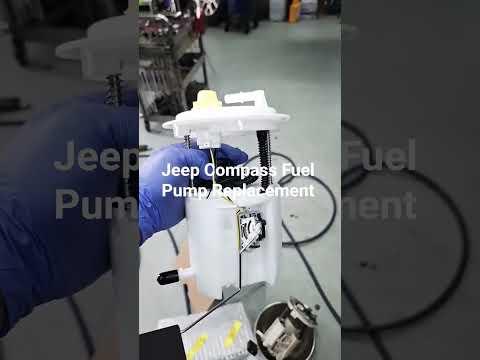







How to Replace the Fuel Pump on a 2007-2018 Jeep Compass (In-Tank Module Guide) (Engine: Inline 4 2.4L)
Step-by-step instructions with tools, parts, safety tips, and key torque specs for access panel or tank-drop methods
How to Replace the Fuel Pump on a 2007-2018 Jeep Compass (In-Tank Module Guide) (Engine: Inline 4 2.4L)
Step-by-step instructions with tools, parts, safety tips, and key torque specs for access panel or tank-drop methods for 2007, 2008, 2009, 2010, 2011, 2012, 2013, 2014, 2015, 2016, 2017, 2018


🔧 Compass - Fuel Pump Replacement
The fuel pump on your Compass is an in-tank module (pump + level sender) that supplies pressurized fuel to the engine. Replacement is usually done through an access panel under the rear seat; if your Compass doesn’t have that access panel, the fuel tank must be lowered to reach the pump.
Difficulty Level: Intermediate | Estimated Time: 2-4 hours
⚠️ Safety & Precautions
- 🧯 Work outside or in a very well-ventilated area; fuel vapors ignite easily.
- 🔥 No smoking, no open flames, no hot work lights near the vehicle.
- 🧤 Wear safety glasses and fuel-resistant gloves; fuel can splash when lines are opened.
- 🔋 Disconnect the negative battery cable before unplugging the pump wiring.
- ⛽ Relieve fuel pressure before disconnecting any fuel line.
- 🛑 If lowering the tank: support it with a jack and use jack stands on the body pinch welds/subframe points.
🔧 Required Tools
You'll need the following tools for this repair:
- Safety glasses
- Nitrile gloves
- Fire extinguisher Class B
- Floor jack (rated 3-ton minimum)
- Jack stands (rated 3-ton minimum)
- Wheel chocks
- Trim removal tool
- Flat-blade screwdriver
- Ratchet
- 8mm socket
- 10mm socket
- 13mm socket
- 6-inch extension
- Torque wrench (5–80 ft-lbs range)
- Fuel line disconnect pick set
- Brass drift/punch
- Dead-blow hammer
- Drain pan
- Shop towels
- Work light (LED)
🔩 Required Parts
HowToo sells all the parts you need for this repair:
- Fuel pump module assembly - Qty: 1
- Fuel pump module tank seal/O-ring - Qty: 1
- Fuel line retaining clips - Qty: 1 set
📋 Before You Begin
- Park on level ground, set the parking brake, and chock the rear wheels.
- Drive until the fuel level is low (under 1/4 tank makes this much easier).
- Relieve fuel pressure before opening fuel lines (steps below).
- Quick-connect fuel fittings use plastic locks; don’t pry hard.
🔨 Step-by-Step Instructions
Follow these steps in order:
Step 1: Relieve fuel pressure
- Open the hood.
- Use a 10mm socket to loosen the negative battery terminal and remove the cable. Torque to 6 Nm (53 in-lbs) during reassembly.
- Locate the under-hood fuse/relay box and remove the fuel pump relay (label may read “FUEL PUMP”). Use a trim removal tool or your fingers.
- Reconnect the negative battery cable temporarily (use the 10mm socket), start the engine, and let it stall. Crank for 3 seconds one more time to bleed off remaining pressure.
- Disconnect the negative battery cable again with the 10mm socket.
Step 2: Access the fuel pump (Access Panel path)
- Fold up the rear seat bottom cushion (or remove it if needed) using a trim removal tool to pop any clips carefully.
- Look for a round/oval metal access cover on the floor above the tank.
- If you see the cover: remove the cover fasteners using an 8mm socket or 10mm socket (varies by cover style). Torque to 3 Nm (27 in-lbs) on reinstall.
- If you do NOT see an access cover, skip to Step 6 (Fuel tank lowering path).
Step 3: Disconnect the pump wiring and fuel lines
- Clean the area around the pump top with shop towels so dirt doesn’t fall in.
- Unplug the electrical connector by releasing the lock tab with a flat-blade screwdriver (gentle pressure).
- Place a drain pan and shop towels under the lines.
- Disconnect the fuel line(s) using a fuel line disconnect pick set to lift the retaining lock, then pull the line straight off.
- Twist slightly, then pull straight.
Step 4: Remove the lock ring and pump module
- Mark the pump module’s orientation to the tank with a work light (LED) and a visual reference mark.
- Use a brass drift/punch and dead-blow hammer to tap the lock ring counterclockwise until it releases.
- Lift the pump module straight up carefully. Angle it slightly as needed to clear the float arm (fuel level sender).
- Remove the old tank seal/O-ring from the opening using a trim removal tool.
Step 5: Install the new pump module and reassemble (Access Panel path)
- Install the new seal/O-ring into the tank opening (clean and fully seated).
- Lower the new pump module into the tank in the same orientation as removed.
- Install the lock ring and tap it clockwise using the brass drift/punch and dead-blow hammer until it aligns with the seated/locked marks. Torque to 60 Nm (44 ft-lbs) equivalent lock-ring seating force (fully locked to stops).
- Reconnect the fuel line(s) until you hear/feel a click. Install any new retaining clips from the parts set.
- Reconnect the electrical connector.
- Reinstall the access cover using an 8mm socket or 10mm socket. Torque to 3 Nm (27 in-lbs)
- Reinstall the rear seat cushion (press clips in firmly by hand).
Step 6: Fuel tank lowering path (only if no access panel)
- Raise the vehicle and support it securely with a floor jack (rated 3-ton minimum) and jack stands (rated 3-ton minimum).
- Support the fuel tank with the floor jack (use a wide pad or wood block so you don’t dent the tank).
- Disconnect the EVAP/vapor and fuel lines at the tank area using a fuel line disconnect pick set and flat-blade screwdriver for lock tabs (as equipped).
- Disconnect the tank electrical connector.
- Remove the tank strap bolts using a 13mm socket and ratchet. Torque to 55 Nm (41 ft-lbs) on reinstall.
- Lower the tank slowly with the floor jack and watch for any hoses still attached.
- With the tank lowered enough, perform Steps 4–5 to replace the module and seal.
- Reinstall the tank in reverse order and reconnect all lines until fully clicked/locked.
✅ After Repair
- Reinstall the fuel pump relay in the fuse/relay box.
- Reconnect the negative battery cable using a 10mm socket. Torque to 6 Nm (53 in-lbs)
- Prime the system: key ON for 3 seconds, key OFF for 5 seconds; repeat 3 times (do not crank).
- Start the engine and check carefully for leaks at the pump top and fuel line connections.
- Test drive for 10 minutes, then re-check for fuel smell or dampness.
💰 DIY vs Shop Cost
Shop Cost: ₹18,000-₹45,000 (parts + labor)
DIY Cost: ₹10,000-₹30,000 (parts only)
You Save: ₹8,000-₹15,000 by doing it yourself!
Shop labor rates vary but typically run ₹1,500-₹3,000/hour. This repair takes a shop approximately 2-4 hours.
🎯 Ready to get started?
HowToo makes it easy: same-day/2-day shipping on every part, plus all the tools and specialty tools you need! Check out the parts and tools sections below to add everything to your cart.
Guide for Fuel Pump Module Assembly replace for these Jeep vehicles
| Year Make Model | Sub Model | Engine | Body Style |
|---|---|---|---|
| 2018 Jeep Compass | - | Inline 4 2.4L | - |
| 2017 Jeep Compass | - | Inline 4 2.4L | - |
| 2017 Jeep Compass | - | Inline 4 2.0L | - |
| 2016 Jeep Compass | - | Inline 4 2.4L | - |
| 2016 Jeep Compass | - | Inline 4 2.0L | - |
| 2015 Jeep Compass | - | Inline 4 2.4L | - |
| 2015 Jeep Compass | - | Inline 4 2.0L | - |
| 2014 Jeep Compass | - | Inline 4 2.4L | - |
| 2014 Jeep Compass | - | Inline 4 2.0L | - |
| 2013 Jeep Compass | - | Inline 4 2.4L | - |
| 2013 Jeep Compass | - | Inline 4 2.0L | - |
| 2012 Jeep Compass | - | Inline 4 2.4L | - |
| 2012 Jeep Compass | - | Inline 4 2.0L | - |
| 2011 Jeep Compass | - | Inline 4 2.4L | - |
| 2011 Jeep Compass | - | Inline 4 2.0L | - |
| 2010 Jeep Compass | - | Inline 4 2.4L | - |
| 2010 Jeep Compass | - | Inline 4 2.0L | - |
| 2009 Jeep Compass | - | Inline 4 2.4L | - |
| 2009 Jeep Compass | - | Inline 4 2.0L | - |
| 2008 Jeep Compass | - | Inline 4 2.4L | - |
| 2008 Jeep Compass | - | Inline 4 2.0L | - |
| 2007 Jeep Compass | - | Inline 4 2.4L | - |
| 2007 Jeep Compass | - | Inline 4 2.0L | - |