









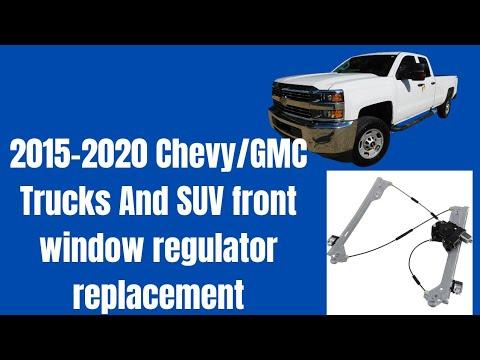







How to Replace the Front Window Regulator on a 2016 Chevrolet Suburban (Driver or Passenger)
Step-by-step front door panel removal, glass support, motor transfer, and torque specs for a smooth window repair
How to Replace the Front Window Regulator on a 2016 Chevrolet Suburban (Driver or Passenger)
Step-by-step front door panel removal, glass support, motor transfer, and torque specs for a smooth window repair


🔧 Suburban - Front Window Regulator Replacement
The front window regulator is the mechanism that lifts and lowers your window glass. When it fails, the window may move crooked, drop into the door, or stop moving (often with grinding/clicking noises).
Difficulty Level: Intermediate | Estimated Time: 2-4 hours (per front door)
Assumption: Your Suburban uses a cable-style regulator; fastener types may vary.
⚠️ Safety & Precautions
- ⚠️ Support the glass before unbolting it; it can drop suddenly and shatter.
- ⚠️ Keep fingers clear of the regulator scissors/cables while testing.
- ⚠️ Disconnect the battery negative cable if you’ll unplug airbag-related connectors in the door (some trims have side-impact sensors in the door).
- ⚠️ Wear gloves—inner door metal edges are sharp.
🔧 Required Tools
You'll need the following tools for this repair:
- Safety glasses
- Mechanic gloves
- Floor jack (rated 3-ton minimum)
- Jack stands (rated 3-ton minimum)
- 10mm socket
- 13mm socket
- 1/4" drive ratchet
- 3/8" drive ratchet
- 3" extension
- 6" extension
- Torque wrench (10–60 Nm range)
- Torx T20 screwdriver
- Torx T30 screwdriver
- Trim removal tool set
- Small flat-blade screwdriver
- Needle-nose pliers
- Painter’s tape (1.5" wide)
- Rivet gun (specialty)
- Drill
- Drill bit set (1/8" and 1/4")
- Magnetic pickup tool
- Work light
🔩 Required Parts
HowToo sells all the parts you need for this repair:
- Front window regulator - Qty: 1
- Front window motor - Qty: 1 (only if not included / if your motor is bad)
- Door trim panel retainers (clips) - Qty: 6-12 (as needed)
- Water shield butyl tape - Qty: 1 (as needed)
- Aluminum rivets (1/4") - Qty: 6-10 (only if your regulator is riveted in)
📋 Before You Begin
- Park on level ground, shift to Park, and set the parking brake.
- Lower the window to about halfway if it still moves (this usually lines up the glass-to-regulator fasteners).
- If you plan to disconnect electrical connectors inside the door: use a 10mm socket to disconnect the battery negative cable.
- Have painter’s tape ready to hold the glass up to the door frame.
🔨 Step-by-Step Instructions
Follow these steps in order:
Step 1: Remove the front door trim panel
- Use a trim removal tool set to pop off the small trim covers near the door handle and armrest fasteners.
- Remove screws using a Torx T20 screwdriver and/or Torx T30 screwdriver (locations commonly include the pull handle and behind small caps).
- Use the trim removal tool set to release the door panel clips around the edges.
- Lift the panel straight upward to unhook it from the window ledge.
- Unplug electrical connectors using a small flat-blade screwdriver to release locks if needed (a connector lock is a small tab that prevents unplugging).
Step 2: Remove the water shield (vapor barrier)
- Carefully peel the plastic water shield back using a trim removal tool set.
- If the sticky butyl tears or won’t reseal, plan to replace it with water shield butyl tape.
- Tip: Don’t throw it away—reuse is common.
Step 3: Support the window glass
- If the glass is still attached and movable, plug the window switch back in temporarily and use it to position the glass so the clamp/bolt access holes line up in the door.
- Once positioned, turn the key off and unplug the switch again.
- Use painter’s tape (1.5" wide) to tape the glass to the door frame (run multiple strips from outside glass over the top of the door frame to inside).
- If the glass already dropped, lift it by hand and tape it up securely.
Step 4: Detach the glass from the regulator
- Through the door access openings, remove the glass-to-regulator fasteners using a 10mm socket (some versions use different fasteners, but 10mm is common).
- Carefully push the regulator carrier away from the glass and make sure the glass stays taped up.
- Torque to 10 Nm (89 in-lbs) when reinstalling glass clamp bolts.
Step 5: Unplug the window motor and free the harness
- Unplug the window motor connector (press the tab; use needle-nose pliers only if needed—don’t crush it).
- Release any harness clips using a trim removal tool set so the wiring isn’t stretched during removal.
Step 6: Remove the regulator/motor assembly
- If your regulator is bolted: remove fasteners using a 10mm socket and/or 13mm socket.
- If your regulator is riveted: use a drill with a 1/4" drill bit to drill the rivet heads off, then push rivet bodies through the door with a small flat-blade screwdriver.
- Support the regulator as the last fastener comes out, then maneuver it out through the largest door opening.
- Tip: Go slow—cable ends can snag.
Step 7: Transfer the motor (only if your new regulator doesn’t include it)
- Remove the motor screws using a 10mm socket or Torx T30 screwdriver (varies by replacement design).
- Install the motor onto the new regulator and tighten evenly.
- Torque to 9 Nm (80 in-lbs) for motor-to-regulator fasteners (typical GM spec range for small fasteners).
Step 8: Install the new regulator
- Place the new regulator into the door and align mounting holes.
- If bolted: install bolts finger-tight first using a 10mm socket/13mm socket, then tighten.
- Torque to 10 Nm (89 in-lbs) for regulator mounting bolts (typical for 6mm fasteners).
- If riveted: install new rivets using a rivet gun (specialty) and aluminum rivets (1/4").
- Reconnect the motor connector until it clicks.
Step 9: Reattach the glass to the regulator
- Remove some painter’s tape so the glass can lower slightly, but keep at least 1-2 strips holding it.
- Lower the glass carefully into the regulator carrier and start the bolts by hand.
- Tighten using a 10mm socket.
- Torque to 10 Nm (89 in-lbs).
Step 10: Function test before reassembly
- Plug in the window switch and cycle the window up/down using the vehicle power.
- Watch the glass edge in the run channel (the vertical felt/rubber guide) to ensure it moves straight and doesn’t twist.
- If it binds, stop immediately and re-check glass seating and fastener alignment.
Step 11: Reinstall the water shield and door panel
- Press the water shield back into the butyl. If needed, apply water shield butyl tape around the perimeter.
- Reconnect all door electrical connectors.
- Hang the door panel on the top ledge and press clips in around the edges.
- Reinstall screws using a Torx T20 screwdriver / Torx T30 screwdriver.
- Reinstall trim covers by pressing them in by hand.
Step 12: Reconnect battery (if disconnected)
- Reconnect the negative cable using a 10mm socket.
✅ After Repair
- Cycle the window fully down and fully up 5–10 times to make sure it learns smooth travel.
- Confirm door locks, mirror controls, and speaker work (easy to miss a connector).
- Listen for clicking/grinding; that usually means misalignment or a loose fastener.
- If you removed the battery cable, reset the clock/radio presets as needed.
💰 DIY vs Shop Cost
Shop Cost: $450-$900 (parts + labor, per front door)
DIY Cost: $90-$250 (parts only, per front door)
You Save: $300-$650 by doing it yourself!
Shop labor rates vary but typically run $100-$150/hour. This repair takes a shop approximately 2-3 hours per door.
🎯 Ready to get started?
HowToo makes it easy: same-day/2-day shipping on every part, plus all the tools and specialty tools you need! Check out the parts and tools sections below to add everything to your cart.