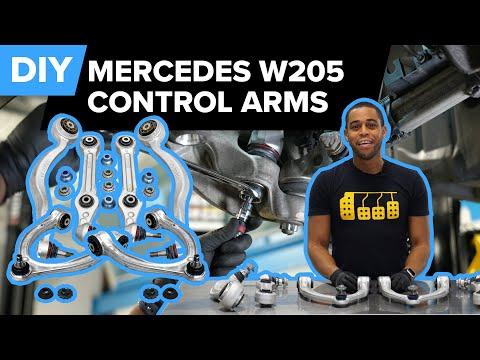
🔧 GLC300 - Front Upper Ball Joint Replacement
On your GLC300, the front upper ball joint is part of the upper control arm (also called the upper wishbone). On this suspension design, the ball joint is not a separate service part from the factory, so the correct repair is replacing the complete front upper control arm assembly on the affected side.
Difficulty Level: Advanced | Estimated Time: 2-4 hours (one side)
⚠️ Safety & Precautions
- ⚠️ Support the SUV with jack stands on the proper lift points; never rely on a floor jack alone.
- ⚠️ Keep hands clear when separating the ball joint; the knuckle can drop or shift suddenly.
- ⚠️ Do not heat the knuckle/control arm; heat can damage the aluminum knuckle and nearby components.
- ⚠️ Tighten suspension bolts at normal ride height; tightening while hanging can ruin the bushing quickly.
- ⚠️ If you remove a wheel speed sensor wire bracket, route it exactly as original to avoid ABS faults.
🔧 Required Tools
You'll need the following tools for this repair:
- Floor jack (rated 3-ton minimum)
- Jack stands (rated 3-ton minimum)
- Wheel chocks
- Safety glasses
- Mechanic gloves
- Breaker bar (1/2" drive)
- Torque wrench (20–200 Nm range)
- 17mm socket
- E-Torx socket set (E10–E18)
- Socket set (10mm–21mm)
- Wrench set (10mm–21mm)
- Ball joint separator (specialty)
- Pry bar (18")
- Dead blow hammer (2 lb)
- Paint marker
- Penetrating oil
🔩 Required Parts
HowToo sells all the parts you need for this repair:
- Front upper control arm assembly (with ball joint) - Qty: 1
- Upper control arm-to-knuckle pinch bolt/nut kit - Qty: 1
- Upper control arm inner mounting bolt(s)/nut(s) kit - Qty: 1
📋 Before You Begin
- Park on level ground, set the parking brake, and chock the rear wheels.
- Crack the front wheel lug bolts loose slightly using a 17mm socket before lifting.
- Plan to do a wheel alignment after this job; replacing the upper arm can change camber/caster.
- Spray fasteners with penetrating oil early.
🔨 Step-by-Step Instructions
Follow these steps in order:
Step 1: Lift and remove the wheel
- Use a floor jack (rated 3-ton minimum) to lift the front corner.
- Place jack stands (rated 3-ton minimum) under the proper lift point and lower the SUV onto the stands.
- Remove the wheel lug bolts using a 17mm socket and set the wheel aside.
Step 2: Locate the front upper control arm and clear access
- The upper control arm sits above the steering knuckle and connects to the body/subframe at the inner side.
- If any brake hose/ABS wire brackets block access, remove the small fasteners using the correct 10mm socket or E-Torx socket as equipped, then move the bracket gently aside.
- Do not pull on the ABS wire.
Step 3: Separate the upper ball joint from the steering knuckle
- Mark the current position of any eccentric/alignment marks (if present) using a paint marker.
- Remove the ball joint pinch bolt/nut at the knuckle using the correct E-Torx socket and matching wrench.
- Install a ball joint separator (specialty) (this tool pushes the joint out without smashing parts). Tighten it until the ball joint stud pops free from the knuckle.
- If needed, use a dead blow hammer (2 lb) to tap the knuckle boss lightly while tension is on the separator.
Step 4: Remove the upper control arm inner mounting bolts
- Support the steering knuckle so it doesn’t strain the CV axle using a floor jack (rated 3-ton minimum) under the lower arm/knuckle area.
- Remove the inner mounting bolt(s) for the upper arm using the correct socket set (10mm–21mm) or E-Torx socket set (E10–E18) depending on fastener type.
- Remove the upper control arm from the vehicle.
Step 5: Install the new upper control arm (leave inner bolts snug, not final tight)
- Position the new upper control arm and start the inner bolt(s) by hand using the correct socket set (10mm–21mm) to avoid cross-threading.
- Snug the inner bolt(s) with a ratchet, but do not fully torque yet.
Step 6: Seat the new ball joint into the knuckle and install new pinch hardware
- Guide the ball joint stud into the knuckle.
- If the knuckle needs to move slightly, use a pry bar (18") carefully to align it.
- Install the new pinch bolt/nut using the correct E-Torx socket and wrench.
- Torque to manufacturer spec (varies by fastener version). If you don’t have the exact spec for your hardware, do not guess—use a spec-matched source for your exact fastener set.
Step 7: Torque the inner bushing bolts at normal ride height
- Reinstall the wheel using a 17mm socket and snug the lug bolts.
- Use the floor jack (rated 3-ton minimum) to raise the suspension until it sits at normal ride height (control arms roughly level), while still safely supported.
- Torque the upper control arm inner mounting bolt(s) using a torque wrench (20–200 Nm range).
- Torque to manufacturer spec (varies by bolt type/side). The ride-height tightening is the key point here.
Step 8: Final reassembly
- Reattach any brackets you moved using the correct 10mm socket or E-Torx socket.
- Lower the SUV fully and torque the wheel lug bolts using a torque wrench (20–200 Nm range).
- Torque to 150 Nm (111 ft-lbs) for the wheel lug bolts.
✅ After Repair
- Road test at low speed first. Listen for clunks over bumps and verify steering feels normal.
- Get a 4-wheel alignment as soon as possible to prevent tire wear.
- Recheck lug bolt torque after 25–50 miles using a torque wrench (20–200 Nm range).
💰 DIY vs Shop Cost
Shop Cost: $600-$1,200 (parts + labor)
DIY Cost: $180-$450 (parts only)
You Save: $420-$750 by doing it yourself!
Shop labor rates vary but typically run $100-$150/hour. This repair takes a shop approximately 2-4 hours.
🎯 Ready to get started?
HowToo makes it easy: same-day/2-day shipping on every part, plus all the tools and specialty tools you need! Check out the parts and tools sections below to add everything to your cart.